energy healing

Navdurga and Seven Chakras – Spiritual Energy and Inner Balance
Spiritual sadhana, Uncategorized

Navdurga and Chakras

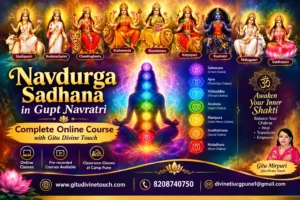
In Hinduism, the seven primary chakras are energy centers in the human body, each associated with specific qualities, elements, colors, and, in some traditions, Hindu deities or goddesses. These goddesses symbolize the divine feminine energy (Shakti) that activates and sustains each chakra. Below is an elaboration on how these chakras are linked to particular Hindu goddesses: 1. **Muladhara Chakra (Root Chakra)** – **Location**: Base of the spine – **Color**: Red – **Element**: Earth – **Goddess**: **Goddess Shailaputri** – **Details**: Shailaputri, a form of Goddess Parvati, is associated with the Muladhara Chakra. She represents stability, grounding, and the foundational energy of life. Just as the root chakra forms the foundation for the energy body, Shailaputri is considered the root form of Shakti, signifying the awakening of consciousness. 2. **Swadhisthana Chakra (Sacral Chakra)** – **Location**: Lower abdomen, about two inches below the navel – **Color**: Orange – **Element**: Water – **Goddess**: **Goddess Brahmacharini** – **Details**: Brahmacharini, another form of Goddess Parvati, is linked with the Swadhisthana Chakra. She embodies purity, devotion, and the power of transformation. This chakra governs emotions, creativity, and sexuality, and Brahmacharini’s energy helps to purify and channel these forces constructively. 3. **Manipura Chakra (Solar Plexus Chakra)** – **Location**: Above the navel, in the stomach area – **Color**: Yellow – **Element**: Fire – **Goddess**: **Goddess Chandraghanta** – **Details**: Chandraghanta is associated with the Manipura Chakra, symbolizing courage, power, and the ability to overcome fear. The solar plexus chakra is the center of personal power, self-esteem, and determination, and Chandraghanta’s energy activates these qualities, leading to greater self-confidence and the ability to manifest one’s desires. 4. **Anahata Chakra (Heart Chakra)** – **Location**: Center of the chest, near the heart – **Color**: Green – **Element**: Air – **Goddess**: **Goddess Kushmanda** – **Details**: Kushmanda, revered as the creator of the universe, is linked to the Anahata Chakra. This chakra is the center of love, compassion, and balance. Kushmanda’s energy fosters unconditional love, harmony, and a sense of interconnectedness with all beings, promoting emotional healing and spiritual growth. 5. **Vishuddha Chakra (Throat Chakra)** – **Location**: Throat region – **Color**: Blue – **Element**: Ether (Space) – **Goddess**: **Goddess Skandamata** – **Details**: Skandamata, the mother of Lord Skanda (Kartikeya), is associated with the Vishuddha Chakra. This chakra governs communication, expression, and truth. Skandamata’s energy enhances one’s ability to speak and live truthfully, promoting clarity in thought and speech, and encouraging the expression of higher wisdom. 6. **Ajna Chakra (Third Eye Chakra)** – **Location**: Forehead, between the eyebrows – **Color**: Indigo – **Element**: Light – **Goddess**: **Goddess Katyayani** – **Details**: Katyayani, a fierce form of Goddess Durga, is connected with the Ajna Chakra. This chakra is the center of intuition, insight, and spiritual vision. Katyayani’s energy aids in the awakening of inner wisdom, enhancing psychic abilities, and leading to a deeper understanding of the self and the universe. ### 7. **Sahasrara Chakra (Crown Chakra)** – **Location**: Top of the head – **Color**: Violet or White – **Element**: Cosmic Energy – **Goddess**: **Goddess kalratri** – **Details**: She is known for her fierce, destructive form, which represents the powerful force that removes darkness and negativity. Kaalratri’s fierce form is symbolic of the destruction of ignorance and the ego, paving the way for the ultimate realization of truth and unity with the cosmos. Her energy is believed to dissolve the barriers that separate the individual soul from the divine, leading to a state of pure consciousness ###8. – **Sahasrara Chakra**: Located at the top of the head, the Sahasrara Chakra is associated with the highest state of consciousness, spiritual enlightenment, and the connection to the divine. – **Devi Mahagauri**: She symbolizes purity, serenity, and the energy that leads to spiritual liberation. Mahagauri is often depicted in white, representing the purity of consciousness. Her association with the Sahasrara Chakra indicates her role in guiding the soul towards enlightenment and union with the divine. When the Sahasrara Chakra is activated and balanced, it brings about a sense of oneness with the universe and deep spiritual bliss, qualities embodied by Mahagauri. **Devi Mahagauri** is predominantly associated with the **Sahasrara Chakra (Crown Chakra)**, symbolizing the purity and spiritual enlightenment that comes with the awakening of this chakra. ###9. **Ajna Chakra (Third Eye Chakra)** or **Sahasrara Chakra (Crown Chakra)** – **Details**: – **Ajna Chakra**: Located between the eyebrows, the Ajna Chakra is the center of intuition, insight, and inner wisdom. It is often called the “Third Eye” and is associated with psychic abilities and spiritual vision. – **Devi Siddhidhatri**: Siddhidhatri is known as the giver of supernatural powers (siddhis) and is often depicted as sitting on a lotus, symbolizing spiritual perfection. Her connection to the Ajna Chakra signifies her ability to bestow wisdom and clarity, helping one develop intuitive abilities and higher perception. – **Sahasrara Chakra**: In some traditions, Siddhidhatri is also associated with the Sahasrara Chakra, as she represents the culmination of spiritual practice and the attainment of divine powers and consciousness – **Devi Siddhidhatri** is associated with both the **Ajna Chakra (Third Eye Chakra)**, where she bestows wisdom and psychic abilities, and the **Sahasrara Chakra (Crown Chakra)**, where she represents the ultimate realization and attainment of siddhis or divine powers. These goddesses embody different aspects of spiritual energy and assist in the awakening, balancing, and mastering of the higher chakras, leading to spiritual growth and enlightenment. Each of these goddesses personifies the energies and qualities associated with their respective chakras. They represent the Shakti (divine feminine energy) that is essential for the activation and balance of these energy centers, guiding the practitioner on a journey of spiritual growth and self-realization. https://gitudivinetouch.com/navdurga-sadhana-in-gupt-navratri-complete-online-course/ To learn more about Navdurga spiritual course online and classroom:

Navdurga and Chakras Read Post »
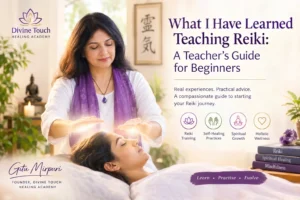
Learn Reiki: A Beginner’s Guide by Gitu Mirpuri book cover
Learn Reiki

Learn Reiki beginners guide

Online & in Pune: A Teacher’s Guide for Beginners | Gitu Mirpuri What I Have Learned Teaching Reiki: A Teacher’s Guide for Beginners By Gitu Mirpuri, Founder of Divine Touch Healing Academy Reiki is often the first energy-healing practice that introduces people to the world of spiritual healing. Over the years, I have had the opportunity to teach Reiki to students from different backgrounds, ages and levels of experience. One thing I have learned is that most beginners do not simply want to learn Reiki techniques. They want to understand what they are learning, how to practise it correctly and how they can develop confidence in their own spiritual journey. At Divine Touch Healing Academy, I teach Reiki through a structured approach that combines learning, practice, meditation, attunement and continued guidance. For someone considering a Reiki course for the first time, I believe it is important to understand what Reiki training actually involves, what a student should look for in a course and how to continue practising after the training is completed. What Is Reiki? Reiki is a Japanese spiritual and energy-healing practice that is traditionally associated with working with universal life-force energy. The word Reiki is commonly explained through two Japanese terms: “Rei,” referring to universal or spiritual, and “Ki,” referring to life-force energy. In Reiki practice, students learn techniques involving meditation, hand positions, energy awareness and other traditional practices. Different Reiki schools may follow different teaching methods, symbols and levels of training. At Divine Touch Healing Academy, Reiki is taught as a spiritual and complementary wellness practice. It is not presented as a replacement for medical diagnosis or treatment. For me, Reiki is not simply about learning a set of hand positions. It is also about developing awareness, discipline, compassion and a regular personal practice. Why Do People Choose to Learn Reiki? Students come to Reiki training for many different reasons. Some people are interested in meditation and spiritual development. Others want to learn self-healing practices or understand energy work. Some students eventually want to incorporate Reiki into their existing wellness or spiritual practice. Common reasons people explore Reiki include: There is no single reason that someone must have for learning Reiki. One of the things I tell beginners is that they should first understand why they want to learn. When the intention is clear, it becomes easier to remain committed to regular practice. What I Have Learned From Teaching Reiki Beginners Every student is different, but certain questions and challenges appear repeatedly. 1. Beginners often want immediate results Many students expect that after learning Reiki they will immediately feel a strong energy sensation or experience something extraordinary. Sometimes students do experience warmth, tingling, relaxation or other personal sensations. Sometimes they do not notice anything dramatic at all. Neither experience should automatically be considered a measure of success. Reiki practice is not a competition. I encourage students to focus on learning the method properly, developing regularity and becoming more aware of their own experience rather than constantly asking, “Am I feeling the energy correctly?” Consistency is more important than trying to force an experience. 2. Regular practice matters more than simply completing a course Completing a Reiki course is the beginning of practice, not necessarily the end of learning. A student may attend classes, receive instruction and complete an attunement, but personal development comes through continued practice. I encourage students to create a simple routine. For example: Morning:A few minutes of quiet breathing and intention setting. During the day:Awareness of thoughts, emotions and reactions. Evening:Self-Reiki, meditation or quiet reflection. The exact routine can vary according to the student’s circumstances. The important point is to develop consistency. 3. Students should understand the difference between learning and practising A Reiki course provides instruction. Practice develops familiarity. These are two different stages. During a course, a student may learn: But understanding these topics intellectually is different from incorporating them into everyday practice. This is why I encourage students to practise after every level rather than immediately rushing from one level to the next. 4. Reiki should not be treated as a substitute for medical care This is an important point for every student. Reiki belongs to the field of spiritual and complementary wellness practices. Students should not use Reiki as a replacement for qualified medical diagnosis or treatment. If someone has a medical condition, they should seek appropriate medical care from a qualified healthcare professional. Reiki practice can instead be approached as part of a person’s broader spiritual or wellness routine, depending on their individual beliefs and circumstances. A responsible teacher should communicate this clearly. What Should You Look for in a Reiki Course? There are now many Reiki courses available online and offline. Choosing between them can sometimes be confusing. Before joining a course, I recommend asking the following questions. Who is teaching the course? Learn about the teacher’s background, experience and training. A course website should clearly identify the person responsible for teaching rather than hiding the teacher behind a generic academy name. What exactly is included? Ask whether the course includes: How long is the training? Do not select a Reiki course based only on the number of hours. A short course is not automatically better or worse than a longer course. The important question is whether the curriculum provides enough explanation and practice for the level being taught. Is there a structured curriculum? A good course should tell you what you will actually learn. Students should not have to discover the curriculum only after paying for the course. Can I ask questions? This is especially important for online learning. A prerecorded video may provide information, but students often need guidance when they begin practising. At Divine Touch Healing Academy, I believe interaction and student questions are an important part of learning. Can Beginners Learn Reiki? Yes, Reiki training is commonly available to beginners, depending on the particular Reiki system and teacher. You do not necessarily need to have years of meditation experience before exploring Reiki. However,

Learn Reiki beginners guide Read Post »

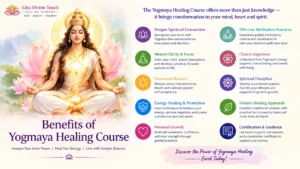
Benefits of Yogmaya Healing Course at Gitu Divine Touch Healing Academy, showing spiritual connection, mental clarity, emotional balance, energy healing, chakra alignment, spiritual discipline and personal guidance.
Yogmaya Healing

Yogmaya healing benefits

Yogmaya Healing Course: Benefits, Training & Guide Yogmaya healing course: Benefits, Spiritual Practice, Training and How to Choose the Right Course There are moments in life when you feel that you are doing everything you can, yet something still seems difficult to understand. You may feel emotionally stuck, repeatedly face the same patterns, struggle to move forward, or simply feel that you want a deeper connection with your spiritual practice. This is where many seekers begin exploring Devi traditions, meditation, energy work and different forms of spiritual healing. Yogmaya healing course training is becoming an area of interest for students who want to explore Yogmaya Devi through spiritual learning, meditation, mantra-oriented practices and energy work. Yogmaya has a significant place in Hindu traditions. In the Bhagavata tradition, Yogamaya is associated with the divine power of the Lord and with the story surrounding the birth of Krishna. Hindupedia, drawing on the Bhagavata Purana and Bhagavad Gita, describes Yogamaya as a divine power and an aspect of Durga. For a serious student, however, learning about Yogmaya should not mean simply memorising a story or repeating a mantra without understanding its context. A good course should give you a structured approach to spiritual practice while respecting the traditional background of the deity. That is what makes choosing the right Yogmaya healing course important. What Is Yogmaya? Before enrolling in any Yogmaya training, it is worth understanding who Yogmaya is and why she is spiritually significant. The name Yogamaya is associated with the Sanskrit concept of divine or spiritual power. Different Hindu traditions interpret the term and the goddess in somewhat different ways. In Vaishnava traditions, Yogamaya is connected with the divine power of Vishnu and the earthly pastimes of Krishna. In Shakta traditions, Yogamaya can be understood in relation to the Divine Mother and forms of Shakti. One of the best-known stories appears around the birth of Krishna. According to the Bhagavata tradition, Yogamaya was born to Yashoda on the same night Krishna was born to Devaki. Vasudeva carried Krishna to Gokul and brought Yashoda’s daughter back to Mathura. When Kamsa attempted to kill the infant, she escaped his grasp and revealed her divine nature. This story gives Yogmaya an important symbolic dimension. She is associated with divine power, protection, transformation and the mystery of maya. For a spiritual student, the story is not simply mythology to be memorised. It can become a starting point for reflection on attachment, perception, divine will, fear, protection and the difference between what appears to be reality and what lies beyond ordinary perception. What Makes a Yogmaya Healing Course Special? A Yogmaya healing course is different from a general meditation course because its spiritual focus is connected with the Yogmaya tradition. The exact teaching method varies from one teacher to another, so students should always check the syllabus before enrolling. A well-structured course may introduce students to areas such as: The important word here is structured. Anyone can find a mantra online. Anyone can watch a five-minute meditation video. But learning a spiritual practice properly requires context. You need to know what you are doing, why you are doing it and how to practise consistently. Learning with intention Imagine a student who has recently started exploring Devi practices. She may have watched several videos about Yogmaya, saved a few mantras and read different interpretations online. She has plenty of information, but no clear routine. A structured course changes that. Instead of jumping from one practice to another, she can study the tradition, learn the meditation method, practise regularly and gradually develop confidence. That is the real value of training. Yogmaya Healing Benefits: What Do Practitioners Traditionally Seek? People searching for Yogmaya healing benefits are often looking for personal transformation rather than a simple list of spiritual claims. It is important to approach these benefits responsibly. Yogmaya practices belong to a spiritual and religious context. They should not be presented as medically proven treatments for physical or mental illness. Instead, practitioners may experience the practice as a form of meditation, prayer, spiritual reflection and personal discipline. 1. A deeper spiritual connection For devotees and spiritual seekers, Yogmaya practice can create a regular relationship with the Divine Mother. Prayer and meditation can become a dedicated time to step away from everyday distractions. 2. Greater self-awareness Spiritual practice encourages you to observe your thoughts and reactions. Instead of immediately reacting to every emotion, you learn to notice what is happening within you. That awareness can become valuable in everyday life. 3. A sense of inner grounding Regular meditation and prayer can provide a quiet period during a busy day. Some practitioners use spiritual practices specifically to create a feeling of steadiness and inner focus. 4. Devotional discipline A spiritual course can help students develop consistency. Rather than practising only when they are emotionally overwhelmed, they learn to create a regular routine. 5. Reflection on maya and perception The concept of maya is particularly relevant to Yogmaya discussions. It encourages students to reflect on how perception, attachment and assumptions influence their experience of life. 6. Personal spiritual growth Many students are not looking for a “quick fix.” They want to understand themselves better. They want to meditate more regularly. They want to deepen their connection with Devi. They want a spiritual practice they can continue after completing the course. These are meaningful reasons to study Yogmaya. Why Many People Prefer to Buy a Yogmaya Healing Course Online Online spiritual education has made specialised subjects accessible to students who may not have a teacher or academy nearby. A student in Pune, Delhi, Mumbai or Bengaluru can potentially learn from an experienced teacher without travelling every day. The advantages include several practical factors. Learn from home You can create a dedicated learning space at home. For spiritual practices, this can actually be beneficial because you can practise in the same environment where you intend to continue your routine. Flexible learning If the course includes recorded material, you can revisit lessons. A mantra,

Yogmaya healing benefits Read Post »

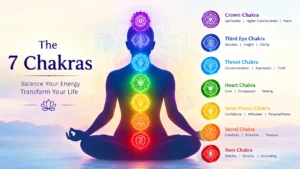
7 Chakra Healing Course at Gitu Divine Touch Healing Academy, Pune, featuring Root, Sacral, Solar Plexus, Heart, Throat, Third Eye and Crown Chakras.
Chakra Healing, Energy Healing

Chakras: Seven Chakras, Healing, Balancing and How to Choose the Right Chakra Healing Course

Chakras: Seven Chakras, Healing, Balancing and How to Choose the Right Chakra Healing Course Have you ever felt that something is “off” even when everything seems fine on the outside? Perhaps you feel tired without understanding why, struggle to express your feelings, lack confidence, find it difficult to stay focused, or simply feel disconnected from yourself. Many people who begin exploring meditation, Reiki, yoga and energy healing eventually come across the concept of chakras. The chakra system gives spiritual practitioners a way to understand the relationship between different areas of the body, emotions, thoughts and spiritual awareness. The commonly taught system describes seven chakras, beginning at the base of the spine and moving upward toward the crown of the head. For many people, learning about chakras is not simply about memorising seven names and seven colours. It becomes a personal journey of awareness. A structured chakra healing course can help you understand the traditional chakra system, meditation, visualisation, affirmations, breathing techniques, energy awareness and practical methods for working with each chakra. If you have been searching for chakra healing courses online, chakra balancing techniques or a practical way to understand the seven chakras, choosing the right training can make your learning much more meaningful. What Makes Chakras Special? The word chakra comes from Sanskrit and is commonly translated as “wheel” or “circle.” Chakra concepts have roots in South Asian spiritual traditions, including Hindu and Buddhist traditions. The modern wellness world often discusses the seven chakras as energy centres associated with different areas of the body, emotional themes, colours and elements. Cleveland Clinic notes that chakras are part of traditional South Asian systems and that Western science does not recognise them as physical structures. At the same time, practices associated with chakra work, such as meditation, breathwork and yoga, can be used as wellness practices. (Cleveland Clinic) This distinction is important. A responsible chakra practitioner does not need to claim that a chakra is a physical organ or promise that chakra balancing can cure a disease. Instead, chakra work can be approached as a traditional spiritual and self-awareness practice. Why are people attracted to chakra healing? One reason is that the chakra system gives people a simple framework for self-reflection. For example: These associations can provide useful themes for meditation and personal reflection. Imagine someone who constantly says, “I don’t feel confident enough to speak.” Instead of simply telling that person to “be confident,” a chakra practitioner might use the Solar Plexus and Throat Chakra themes as starting points for meditation, breathing, affirmations and self-observation. That gives the person a structured practice. Understanding the Seven Chakras If you are considering purchasing a chakra healing course, one of the first things you should check is whether the course teaches the chakra system in a structured way. A good course should not simply give you a list of chakra names. It should help you understand how to work with each one. 1. Root Chakra – Muladhara The Root Chakra is traditionally associated with the base of the spine. Its themes include: When working with the Root Chakra, practitioners often use grounding exercises, breathwork, visualisation and meditation. The colour traditionally associated with it is red, and Earth is commonly identified as its element. A Root Chakra meditation may focus on feeling physically grounded and secure. 2. Sacral Chakra – Svadhisthana The Sacral Chakra is associated with the lower abdomen. Its traditional themes include: People who have difficulty expressing emotions may find Sacral Chakra meditation an interesting self-reflection practice. Water is traditionally associated with this chakra, making flowing imagery particularly useful during meditation. 3. Solar Plexus Chakra – Manipura The Solar Plexus Chakra is associated with the upper abdomen. It is traditionally connected with: This is often one of the most popular chakras for people interested in personal growth. Someone who constantly doubts their decisions may choose Solar Plexus-focused meditation and affirmations as part of their personal development routine. 4. Heart Chakra – Anahata The Heart Chakra is traditionally located around the centre of the chest. Its themes include: Heart Chakra meditation can be particularly meaningful for people who are working through emotional experiences or trying to develop greater compassion toward themselves and others. 5. Throat Chakra – Vishuddha The Throat Chakra is associated with communication and expression. Its themes include: A person may be highly intelligent but still struggle to communicate what they actually feel. Throat Chakra practices can provide a symbolic framework for exploring that issue. 6. Third Eye Chakra – Ajna The Third Eye Chakra is traditionally associated with the area between the eyebrows. It is linked with: Third Eye meditation often involves visualisation and concentration. It is important, however, not to confuse the traditional Third Eye concept with a literal physical organ or claim that activating it provides guaranteed supernatural abilities. 7. Crown Chakra – Sahasrara The Crown Chakra is traditionally associated with the top of the head. It is connected with themes such as: For many practitioners, Crown Chakra work is less about physical sensation and more about contemplative and spiritual practice. Together, these seven centres form the commonly taught chakra framework. Why People Choose to Buy a Chakra Healing Course Online Searching for information about chakras is easy. Actually learning how to work with them is different. This is why many students eventually move from watching random videos to purchasing a structured chakra healing course. 1. A structured learning path Online information is scattered. One video may discuss the Root Chakra. Another may teach a completely different meditation. A third may use different terminology. A structured course brings the information together. You know: 2. Learn from home An online course is especially convenient for students who cannot attend a physical academy every day. You can learn from: 3. Repeat the lessons This is a major advantage of recorded learning. If a meditation technique takes time to understand, you can revisit it. You don’t have to remember everything after hearing it once. 4. Combine online learning with live guidance

Chakras: Seven Chakras, Healing, Balancing and How to Choose the Right Chakra Healing Course Read Post »

Ut elit tellus, luctus nec ullamcorper mattis, pulvinar dapibus leo.

Work Hours

Oh to talking improve produce in limited offices fifteen an. Wicket branch to answer do we.

© 2026 All right reserved – Gitu Divine Touch Healing Academy | Designed by PREPelite.IN