
Online & in Pune: A Teacher’s Guide for Beginners | Gitu Mirpuri
What I Have Learned Teaching Reiki: A Teacher’s Guide for Beginners
By Gitu Mirpuri, Founder of Divine Touch Healing Academy
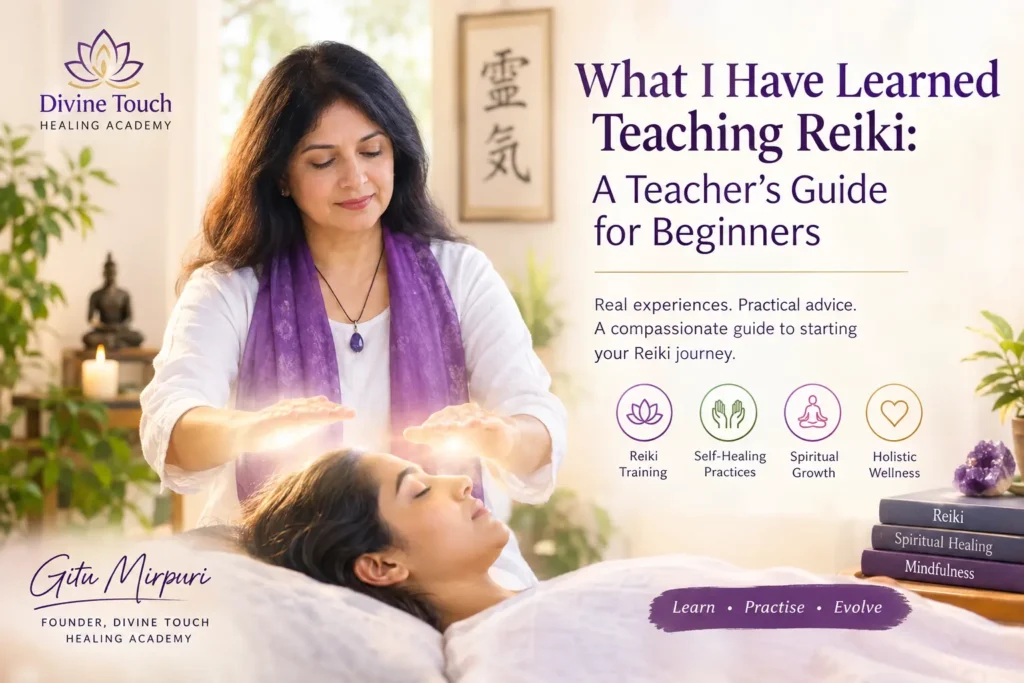
Reiki is often the first energy-healing practice that introduces people to the world of spiritual healing. Over the years, I have had the opportunity to teach Reiki to students from different backgrounds, ages and levels of experience. One thing I have learned is that most beginners do not simply want to learn Reiki techniques. They want to understand what they are learning, how to practise it correctly and how they can develop confidence in their own spiritual journey.
At Divine Touch Healing Academy, I teach Reiki through a structured approach that combines learning, practice, meditation, attunement and continued guidance.
For someone considering a Reiki course for the first time, I believe it is important to understand what Reiki training actually involves, what a student should look for in a course and how to continue practising after the training is completed.
What Is Reiki?
Reiki is a Japanese spiritual and energy-healing practice that is traditionally associated with working with universal life-force energy.
The word Reiki is commonly explained through two Japanese terms: “Rei,” referring to universal or spiritual, and “Ki,” referring to life-force energy.
In Reiki practice, students learn techniques involving meditation, hand positions, energy awareness and other traditional practices. Different Reiki schools may follow different teaching methods, symbols and levels of training.
At Divine Touch Healing Academy, Reiki is taught as a spiritual and complementary wellness practice. It is not presented as a replacement for medical diagnosis or treatment.
For me, Reiki is not simply about learning a set of hand positions. It is also about developing awareness, discipline, compassion and a regular personal practice.
Why Do People Choose to Learn Reiki?
Students come to Reiki training for many different reasons.
Some people are interested in meditation and spiritual development. Others want to learn self-healing practices or understand energy work. Some students eventually want to incorporate Reiki into their existing wellness or spiritual practice.
Common reasons people explore Reiki include:
- Personal spiritual growth
- Meditation and mindfulness
- Developing greater awareness of energy
- Learning a structured self-practice
- Exploring complementary wellness practices
- Supporting a personal spiritual routine
- Learning techniques that can be practised with others
- Developing skills for a Reiki-based professional practice
There is no single reason that someone must have for learning Reiki.
One of the things I tell beginners is that they should first understand why they want to learn. When the intention is clear, it becomes easier to remain committed to regular practice.
What I Have Learned From Teaching Reiki Beginners
Every student is different, but certain questions and challenges appear repeatedly.
1. Beginners often want immediate results
Many students expect that after learning Reiki they will immediately feel a strong energy sensation or experience something extraordinary.
Sometimes students do experience warmth, tingling, relaxation or other personal sensations. Sometimes they do not notice anything dramatic at all.
Neither experience should automatically be considered a measure of success.
Reiki practice is not a competition.
I encourage students to focus on learning the method properly, developing regularity and becoming more aware of their own experience rather than constantly asking, “Am I feeling the energy correctly?”
Consistency is more important than trying to force an experience.
2. Regular practice matters more than simply completing a course
Completing a Reiki course is the beginning of practice, not necessarily the end of learning.
A student may attend classes, receive instruction and complete an attunement, but personal development comes through continued practice.
I encourage students to create a simple routine.
For example:
Morning:
A few minutes of quiet breathing and intention setting.
During the day:
Awareness of thoughts, emotions and reactions.
Evening:
Self-Reiki, meditation or quiet reflection.
The exact routine can vary according to the student’s circumstances.
The important point is to develop consistency.
3. Students should understand the difference between learning and practising
A Reiki course provides instruction.
Practice develops familiarity.
These are two different stages.
During a course, a student may learn:
- Reiki principles
- Hand positions
- Meditation
- Energy awareness
- Self-Reiki
- Reiki symbols at the appropriate level
- Attunement-related practices
- Methods for working with others
- Practical considerations
- Spiritual development practices
But understanding these topics intellectually is different from incorporating them into everyday practice.
This is why I encourage students to practise after every level rather than immediately rushing from one level to the next.
4. Reiki should not be treated as a substitute for medical care
This is an important point for every student.
Reiki belongs to the field of spiritual and complementary wellness practices. Students should not use Reiki as a replacement for qualified medical diagnosis or treatment.
If someone has a medical condition, they should seek appropriate medical care from a qualified healthcare professional.
Reiki practice can instead be approached as part of a person’s broader spiritual or wellness routine, depending on their individual beliefs and circumstances.
A responsible teacher should communicate this clearly.
What Should You Look for in a Reiki Course?
There are now many Reiki courses available online and offline.
Choosing between them can sometimes be confusing.
Before joining a course, I recommend asking the following questions.
Who is teaching the course?
Learn about the teacher’s background, experience and training.
A course website should clearly identify the person responsible for teaching rather than hiding the teacher behind a generic academy name.
What exactly is included?
Ask whether the course includes:
- Live teaching
- Practical training
- Meditation
- Attunement, where applicable
- Course notes
- Recordings
- Question-and-answer support
- Certificate
- Post-course guidance
How long is the training?
Do not select a Reiki course based only on the number of hours.
A short course is not automatically better or worse than a longer course.
The important question is whether the curriculum provides enough explanation and practice for the level being taught.
Is there a structured curriculum?
A good course should tell you what you will actually learn.
Students should not have to discover the curriculum only after paying for the course.
Can I ask questions?
This is especially important for online learning.
A prerecorded video may provide information, but students often need guidance when they begin practising.
At Divine Touch Healing Academy, I believe interaction and student questions are an important part of learning.
Can Beginners Learn Reiki?
Yes, Reiki training is commonly available to beginners, depending on the particular Reiki system and teacher.
You do not necessarily need to have years of meditation experience before exploring Reiki.
However, beginners should approach the practice with an open mind and realistic expectations.
You do not need to force yourself to experience something unusual.
Start with the basics.
Learn the method.
Practise regularly.
Observe your experience.
Ask questions.
Then gradually develop your practice.
What Is Reiki Attunement?
Attunement is an important part of many Reiki teaching systems.
The exact process and terminology can vary between Reiki traditions and teachers.
In systems that use attunement, it is traditionally taught as part of the process through which a Reiki teacher introduces the student to the practice at a particular level.
Students should ask their teacher what attunement involves and how it fits into the course they are joining.
I believe that students should understand the purpose and structure of their training rather than treating attunement as something mysterious that automatically guarantees spiritual development.
Learning and personal practice remain important.
Reiki Levels: Why Progressive Learning Can Help
Reiki is commonly taught progressively.
The exact level structure differs among Reiki schools, but a structured progression may allow students to develop their practice gradually.
At the beginner level, students generally start with the foundations of Reiki and self-practice.
More advanced levels may introduce additional techniques, symbols or approaches depending on the particular Reiki system.
At Divine Touch Healing Academy, Reiki training is designed as a progression rather than treating the entire subject as something that can be understood in a single session.
Students can therefore build their knowledge step by step.
Reiki Self-Practice Is an Important Part of Learning
One of the most valuable things a Reiki student can develop is a personal practice.
When students learn only for the purpose of working with other people, they may miss an important part of the learning process.
Self-practice gives students an opportunity to become familiar with:
- Their own routine
- Their attention
- Their breathing
- Their reactions
- Their ability to remain present
- Their experience of meditation
- Their consistency
I encourage students to approach self-practice without constantly judging whether they are doing it “perfectly.”
A spiritual practice develops with patience.
What Happens After a Reiki Course?
This is a question I am asked frequently.
After completing a course, students may choose different paths.
Some continue Reiki primarily as a personal spiritual practice.
Some combine it with meditation or other complementary practices.
Others continue into advanced Reiki training.
Some students eventually explore additional modalities such as chakra healing, crystal healing, Lama Fera or other spiritual practices.
There is no requirement that every student follow the same path.
Your learning should develop according to your interests, experience and goals.
Reiki and Other Energy-Healing Practices
Students often ask me how Reiki differs from other practices.
Reiki, chakra healing, crystal healing, Lama Fera and other systems have their own histories, terminology, methods and teaching traditions.
For example, chakra healing commonly works with a traditional framework of seven major chakras, while Reiki training follows its own system of principles and techniques.
Crystal healing incorporates crystals as part of a spiritual or energetic practice.
Lama Fera is another distinct healing system with its own symbols and methods.
These practices should not simply be treated as interchangeable.
If you are interested in several modalities, I recommend learning one system properly before adding too many different techniques at once.
This allows you to understand the practice rather than collecting techniques without developing depth.
My Advice to Someone Choosing Their First Reiki Course
If you are thinking about learning Reiki for the first time, I would suggest keeping your decision simple.
Ask yourself:
Why do I want to learn Reiki?
Is it for personal development, meditation, spiritual exploration, complementary wellness practice or professional training?
Who will teach me?
Read about the teacher.
What exactly will I learn?
Look for a clear curriculum.
Is the course interactive?
Find out whether you can ask questions.
What happens after the course?
Check whether there is continued guidance or an opportunity for further learning.
Is the information transparent?
The course duration, format, language, prerequisites and certification should be clearly explained.
And most importantly, choose a course because its teaching approach is appropriate for your learning goals, rather than simply because it has the largest number of claims or the lowest price.
Why I Continue Teaching Reiki
For me, teaching Reiki is not simply about completing a syllabus.
Every student arrives with a different story.
Some people come because they want to understand themselves better. Some are looking for a spiritual practice. Some have already explored meditation, yoga, crystals or other modalities. Others are completely new to energy healing.
What I enjoy most is seeing students gradually become more confident in their own practice.
A student who initially asks, “How do I know whether I am doing this correctly?” may eventually develop a regular meditation and Reiki routine and begin understanding their own experiences with greater clarity.
That process of learning, practising and becoming more aware is what makes teaching meaningful to me.
Learn Reiki Online or in Pune With Divine Touch Healing Academy
At Divine Touch Healing Academy, Reiki is taught through structured training designed for students who want to explore Reiki as a spiritual and complementary wellness practice.
Training may be available through online and offline formats, depending on the current batch.
Students can learn through a combination of instruction, meditation, practical exercises, guidance and the relevant attunement process for their level.
The academy also offers training in other areas of spiritual and complementary practices, including chakra healing, Akashic Records, crystal healing, Lama Fera, tarot, astrology and other specialised courses.
If Reiki is your first step into spiritual learning, you do not need to learn everything at once.
Start with one system.
Learn its foundations.
Practise consistently.
Ask questions.
And allow your understanding to develop with experience.
Frequently Asked Questions
Can a complete beginner learn Reiki?
Yes. Reiki courses are commonly structured to introduce beginners to the foundations of the practice. Specific prerequisites depend on the teacher and Reiki system.
How long does it take to learn Reiki?
The duration depends on the level and teaching format. Different Reiki schools structure their courses differently, so always check the current curriculum and schedule before enrolling.
Is Reiki available online?
Yes, many Reiki teachers offer online training. The exact format, practical components and attunement process depend on the course and teacher.
Do I need meditation experience before learning Reiki?
Not necessarily. Beginners can learn the foundational practices and gradually develop their meditation and self-practice.
Can Reiki replace medical treatment?
No. Reiki should not be considered a substitute for medical diagnosis or treatment. People with medical concerns should consult an appropriately qualified healthcare professional.
Can Reiki be learned for personal practice?
Yes. Many students explore Reiki primarily as a personal spiritual or complementary wellness practice.
Can I learn other healing modalities after Reiki?
Yes. Students may choose to explore other spiritual and complementary practices after developing their Reiki foundation.
How do I choose the right Reiki course?
Look at the teacher’s experience, curriculum, course duration, learning format, practical training, student support, certification and what happens after the course.
Final Thoughts
Learning Reiki is not about collecting another certificate or trying to experience something extraordinary immediately.
It is about learning a system, developing awareness and giving yourself enough time to practise.
If you are considering Reiki for the first time, take the time to understand the teacher, the curriculum and the learning process before you enrol.
A good spiritual education should leave you with more understanding, more awareness and greater confidence in your own practice.
— Gitu Mirpuri
Founder, Divine Touch Healing Academy
Pune | Online Training
Author:
Gitu Mirpuri