Reiki Healing Course: Learn Reiki Healing Online and in Pune
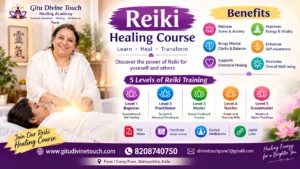
Reiki Healing Course: A Complete Guide to Reiki Training from Beginner to Grandmaster Are you looking for a Reiki healing course to learn energy healing, develop a regular self-healing practice, and understand how to offer Reiki sessions responsibly? Reiki is a Japanese-origin complementary practice in which practitioners use gentle hand placements or hold their hands near the body with the intention of supporting relaxation and well-being. A structured Reiki healing course introduces students to Reiki principles, hand positions, self-treatment, practical exercises, and the responsibilities involved in working with others. Depending on the course and lineage, training may also include symbols, attunements or initiations, distant Reiki techniques, guided meditations, and practitioner development. At Gitu Divine Touch Healing Academy in Pune, students can explore Reiki training through online learning and guided practice. The academy offers a structured learning approach intended to help students progress from foundational knowledge to more advanced Reiki study. Whether you are a beginner, a meditation enthusiast, a wellness practitioner, or someone interested in learning a new complementary practice, this guide explains Reiki, the levels of training, the course syllabus, the learning process, and how to choose a suitable Reiki healing course. Join Gitu Divine Touch to enquire about Reiki training, upcoming batches, course materials, and online learning options. What Is Reiki Healing? Reiki is a complementary practice that originated in Japan in the early twentieth century and is associated with Mikao Usui. The word is commonly explained through the Japanese terms rei and ki, although translations and interpretations vary. In Reiki traditions, practitioners understand Reiki as a form of universal life energy. They use gentle hand placements or hands held near the body as part of a session. A typical Reiki session takes place in a calm environment. The recipient usually remains fully clothed, seated or lying comfortably, while the practitioner follows an agreed sequence of hand positions. Some people find Reiki sessions relaxing or use them as part of a broader personal wellness routine. However, scientific evidence does not establish the existence of the proposed energy mechanism, and Reiki has not been shown to cure diseases. It should not replace medical diagnosis, prescribed treatment, or professional mental health care. What Is a Reiki Healing Course? A Reiki healing course is a structured training program that introduces students to the principles and practices of Reiki. Students learn how to prepare for a session, practise self-Reiki, understand hand positions, maintain appropriate boundaries, and approach Reiki with care and respect. Depending on the teaching lineage and level, a course may cover: A good course should clearly explain its learning objectives, the experience required for each level, the type of instructor support available, and what a completion certificate represents. Benefits of Learning Reiki People choose a Reiki healing course for different reasons. Some want to establish a personal relaxation routine, while others wish to learn a complementary wellness practice. 1. Develop a self-care routine Reiki training introduces a structured practice that students may incorporate into quiet time, meditation, or personal reflection. 2. Practise relaxation and mindfulness A Reiki session often involves a peaceful setting, focused attention, and time away from everyday distractions. These features may help some participants feel relaxed. 3. Learn a structured complementary practice A course provides a framework for learning hand positions, session preparation, practical techniques, and appropriate communication with recipients. 4. Build confidence through practice Guided exercises, feedback, and regular practice can help students become more familiar with the session process. 5. Develop listening and interpersonal skills Responsible Reiki practice includes listening to the recipient, explaining what will happen, respecting preferences, and obtaining consent before any touch. 6. Explore personal spiritual development Some Reiki students understand the practice through a spiritual framework. Others approach it as a relaxation or mindfulness activity. Students can learn about the tradition while respecting different personal beliefs. 7. Continue learning at different levels Depending on the lineage, students may progress from foundational Reiki training to more advanced study. Each stage should have clearly defined learning outcomes and prerequisites. These are potential learning and personal-wellness benefits, not guarantees of medical improvement or supernatural outcomes. Reiki Healing Course Syllabus A comprehensive Reiki healing course can be organised into modules that support gradual learning. Module 1: Introduction to Reiki Module 2: Preparing for Reiki Practice Module 3: Reiki Hand Positions Module 4: Self-Reiki and Daily Practice Module 5: Reiki Principles and Ethics Module 6: Attunements or Initiations Some Reiki lineages include an attunement or initiation process taught by an instructor. Students should ask what the process involves, how it is conducted, and whether it is included in the course. Different Reiki traditions may use different procedures. Module 7: Symbols and Advanced Techniques At levels where these are included, students may learn the traditional Reiki symbols and how they are used within their lineage. Some courses introduce emotional or mental Reiki practices, distant Reiki, and additional meditation techniques. These should be taught in the appropriate level and context. Module 8: Practical Training and Revision The precise syllabus varies by lineage and level. Students should obtain the instructor’s current curriculum before enrolling. Understanding the Different Levels of Reiki Reiki training is often divided into levels, although names, teaching methods, and the number of stages vary across traditions. Reiki Level 1: Foundational Training Reiki Level 1 generally introduces students to the history and principles of Reiki, self-treatment, basic hand positions, and introductory practice with others. Depending on the lineage, the instructor may conduct an attunement or initiation. This level is suitable for people who want to understand Reiki fundamentals and establish a personal practice. Reiki Level 2: Symbols and Further Practice Reiki Level 2 commonly introduces symbols and techniques that build on foundational training. In some lineages, distant Reiki is also taught at this stage. Students should learn the traditional context and appropriate use of each technique from their instructor. Reiki Level 3: Advanced or Master-Level Study The meaning of Level 3 differs across Reiki traditions. Some lineages distinguish an advanced practitioner level from a master level,
Reiki Healing Course: Learn Reiki Healing Online and in Pune Read Post »