
Reiki Healing Course: A Complete Guide to Reiki Training from Beginner to Grandmaster
Are you looking for a Reiki healing course to learn energy healing, develop a regular self-healing practice, and understand how to offer Reiki sessions responsibly? Reiki is a Japanese-origin complementary practice in which practitioners use gentle hand placements or hold their hands near the body with the intention of supporting relaxation and well-being.
A structured Reiki healing course introduces students to Reiki principles, hand positions, self-treatment, practical exercises, and the responsibilities involved in working with others. Depending on the course and lineage, training may also include symbols, attunements or initiations, distant Reiki techniques, guided meditations, and practitioner development.
At Gitu Divine Touch Healing Academy in Pune, students can explore Reiki training through online learning and guided practice. The academy offers a structured learning approach intended to help students progress from foundational knowledge to more advanced Reiki study.
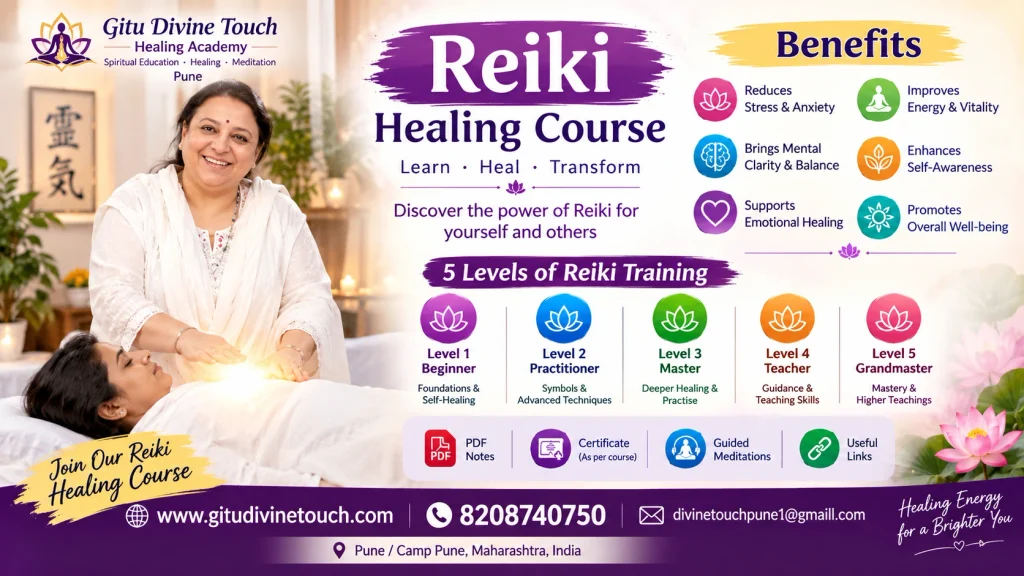
Whether you are a beginner, a meditation enthusiast, a wellness practitioner, or someone interested in learning a new complementary practice, this guide explains Reiki, the levels of training, the course syllabus, the learning process, and how to choose a suitable Reiki healing course.
Join Gitu Divine Touch to enquire about Reiki training, upcoming batches, course materials, and online learning options.
What Is Reiki Healing?
Reiki is a complementary practice that originated in Japan in the early twentieth century and is associated with Mikao Usui. The word is commonly explained through the Japanese terms rei and ki, although translations and interpretations vary.
In Reiki traditions, practitioners understand Reiki as a form of universal life energy. They use gentle hand placements or hands held near the body as part of a session.
A typical Reiki session takes place in a calm environment. The recipient usually remains fully clothed, seated or lying comfortably, while the practitioner follows an agreed sequence of hand positions.
Some people find Reiki sessions relaxing or use them as part of a broader personal wellness routine. However, scientific evidence does not establish the existence of the proposed energy mechanism, and Reiki has not been shown to cure diseases. It should not replace medical diagnosis, prescribed treatment, or professional mental health care.
What Is a Reiki Healing Course?
A Reiki healing course is a structured training program that introduces students to the principles and practices of Reiki.
Students learn how to prepare for a session, practise self-Reiki, understand hand positions, maintain appropriate boundaries, and approach Reiki with care and respect.
Depending on the teaching lineage and level, a course may cover:
- The history and principles of Reiki.
- The relationship between meditation, relaxation, and Reiki practice.
- Reiki hand positions for self-treatment.
- Hand positions used during sessions with consenting recipients.
- The role of attunements or initiations in the relevant lineage.
- Traditional Reiki symbols and their uses, where appropriate to the level.
- Distant Reiki techniques, where included in the curriculum.
- Practical exercises and guided meditations.
- Practitioner ethics, consent, hygiene, and professional boundaries.
- Maintaining a personal Reiki practice.
A good course should clearly explain its learning objectives, the experience required for each level, the type of instructor support available, and what a completion certificate represents.
Benefits of Learning Reiki
People choose a Reiki healing course for different reasons. Some want to establish a personal relaxation routine, while others wish to learn a complementary wellness practice.
1. Develop a self-care routine
Reiki training introduces a structured practice that students may incorporate into quiet time, meditation, or personal reflection.
2. Practise relaxation and mindfulness
A Reiki session often involves a peaceful setting, focused attention, and time away from everyday distractions. These features may help some participants feel relaxed.
3. Learn a structured complementary practice
A course provides a framework for learning hand positions, session preparation, practical techniques, and appropriate communication with recipients.
4. Build confidence through practice
Guided exercises, feedback, and regular practice can help students become more familiar with the session process.
5. Develop listening and interpersonal skills
Responsible Reiki practice includes listening to the recipient, explaining what will happen, respecting preferences, and obtaining consent before any touch.
6. Explore personal spiritual development
Some Reiki students understand the practice through a spiritual framework. Others approach it as a relaxation or mindfulness activity. Students can learn about the tradition while respecting different personal beliefs.
7. Continue learning at different levels
Depending on the lineage, students may progress from foundational Reiki training to more advanced study. Each stage should have clearly defined learning outcomes and prerequisites.
These are potential learning and personal-wellness benefits, not guarantees of medical improvement or supernatural outcomes.
Reiki Healing Course Syllabus
A comprehensive Reiki healing course can be organised into modules that support gradual learning.
Module 1: Introduction to Reiki
- History and origins of Reiki.
- Mikao Usui and the development of Reiki traditions.
- Understanding Reiki terminology.
- The Reiki precepts and their role in practice.
- Expectations and responsibilities of a Reiki student.
Module 2: Preparing for Reiki Practice
- Creating a calm and comfortable practice environment.
- Personal preparation and focused attention.
- Explaining the session to a recipient.
- Consent and preferences concerning touch.
- Respecting privacy and personal boundaries.
Module 3: Reiki Hand Positions
- Basic self-treatment positions.
- General hand-position sequences used in the taught lineage.
- Adapting positioning for comfort and accessibility.
- Practising with a consenting partner.
- Closing a session and checking in with the recipient.
Module 4: Self-Reiki and Daily Practice
- Establishing a regular practice routine.
- Using guided meditation alongside Reiki.
- Keeping a practice journal.
- Reflecting on personal experiences without making assumptions about their cause.
- Maintaining realistic expectations.
Module 5: Reiki Principles and Ethics
- Understanding the traditional Reiki precepts.
- Respectful communication.
- Consent and confidentiality.
- Recognising the limits of Reiki practice.
- Referring health concerns to appropriate qualified professionals.
Module 6: Attunements or Initiations
Some Reiki lineages include an attunement or initiation process taught by an instructor.
Students should ask what the process involves, how it is conducted, and whether it is included in the course. Different Reiki traditions may use different procedures.
Module 7: Symbols and Advanced Techniques
At levels where these are included, students may learn the traditional Reiki symbols and how they are used within their lineage.
Some courses introduce emotional or mental Reiki practices, distant Reiki, and additional meditation techniques. These should be taught in the appropriate level and context.
Module 8: Practical Training and Revision
- Reviewing hand positions and session structure.
- Practising with feedback.
- Discussing common questions.
- Understanding appropriate record-keeping.
- Planning continued practice and study.
The precise syllabus varies by lineage and level. Students should obtain the instructor’s current curriculum before enrolling.
Understanding the Different Levels of Reiki
Reiki training is often divided into levels, although names, teaching methods, and the number of stages vary across traditions.
Reiki Level 1: Foundational Training
Reiki Level 1 generally introduces students to the history and principles of Reiki, self-treatment, basic hand positions, and introductory practice with others.
Depending on the lineage, the instructor may conduct an attunement or initiation.
This level is suitable for people who want to understand Reiki fundamentals and establish a personal practice.
Reiki Level 2: Symbols and Further Practice
Reiki Level 2 commonly introduces symbols and techniques that build on foundational training. In some lineages, distant Reiki is also taught at this stage.
Students should learn the traditional context and appropriate use of each technique from their instructor.
Reiki Level 3: Advanced or Master-Level Study
The meaning of Level 3 differs across Reiki traditions. Some lineages distinguish an advanced practitioner level from a master level, while others use different structures.
Training may include additional symbols, advanced practice, or preparation for further teaching.
Reiki Grandmaster or Teacher Training
Some schools offer a separate master-teacher or Grandmaster pathway. The curriculum, eligibility, and teaching authority depend on the lineage and the school.
Before enrolling, ask whether the course prepares students to practise Reiki, teach Reiki, conduct attunements, or all of these. A certificate alone does not establish universal recognition across different Reiki organisations.
Online Reiki Healing Course vs Classroom Training
Online and classroom training can both be useful when the learning format matches the student’s needs.
Online Reiki course
- Learn from home.
- Review prerecorded lessons where provided.
- Attend live sessions or instructor-led practice if included.
- Access digital notes and meditation resources where offered.
- Study without needing to travel to Pune.
Classroom Reiki course
- Interact directly with the instructor.
- Participate in in-person demonstrations.
- Practise hand positions under direct supervision.
- Ask questions during practical exercises.
- Experience the learning environment with other students.
When choosing a Reiki healing course, ask how practical skills are taught, whether feedback is available, and how any required attunements are conducted.
How to Choose the Right Reiki Healing Course
Before registering, consider the following points.
- Review the instructor’s background. Ask about training, lineage, practical experience, and teaching approach.
- Request the complete syllabus. Check which levels, symbols, techniques, and practice sessions are included.
- Understand the attunement process. Confirm whether it is included and how it will be conducted.
- Check the teaching format. Find out whether classes are live, prerecorded, classroom-based, or a combination.
- Ask about student support. Clarify whether questions, practice feedback, and revision sessions are available.
- Confirm course materials. Ask about PDFs, meditation recordings, class recordings, and certificates.
- Understand the certificate. Check what it represents and whether any external recognition is claimed.
- Look for ethical teaching. A responsible instructor should not promise cures, guaranteed results, or replacement of medical treatment.
A clear syllabus and realistic expectations are important parts of a good learning experience.
Who Can Join a Reiki Healing Course?
Reiki training may appeal to:
- Beginners interested in Reiki.
- People who want to learn self-Reiki.
- Meditation and mindfulness enthusiasts.
- Complementary wellness practitioners.
- People interested in spiritual learning.
- Existing Reiki students considering further training.
No particular spiritual belief should be assumed to be universal among students. Ask the instructor about any prerequisites, particularly for advanced levels or teacher training.
Frequently Asked Questions About Reiki Healing Courses
1. What is taught in a Reiki healing course?
A Reiki course may include Reiki history and principles, self-treatment, hand positions, session preparation, ethics, practical exercises, and level-specific techniques. The syllabus depends on the lineage and level.
2. Can beginners learn Reiki?
Yes. Many Reiki Level 1 courses are designed for beginners. Check the prerequisites and course format before enrolling.
3. Can I learn Reiki online?
Yes, many instructors offer online Reiki education. Ask how practical training, student feedback, and any required attunements are handled.
4. How many levels are there in Reiki?
Many systems use three principal levels, while others divide advanced and teacher training into additional stages. The structure depends on the tradition.
5. What is a Reiki attunement?
In traditions that use attunements, the instructor conducts a process understood within that lineage as supporting the student’s connection to Reiki practice. Procedures and explanations differ between schools.
6. Can Reiki cure diseases?
Reiki should not be presented as a proven cure for disease. It may be used by some people as a complementary relaxation practice, but it must not replace appropriate medical care.
7. Can I practise Reiki on another person after training?
That depends on the level completed and the training received. Practice should involve informed consent, appropriate boundaries, and respect for the recipient’s preferences.
8. Will I receive a certificate?
Certificate arrangements vary by course. Ask the academy whether a certificate is included, what requirements apply, and what the certificate represents.
9. What is the difference between Reiki Level 1 and Level 2?
Level 1 commonly focuses on foundations, self-treatment, and basic hand positions. Level 2 often introduces symbols and further techniques, depending on the lineage.
10. Where can I learn Reiki in Pune?
You can enquire with Gitu Divine Touch Healing Academy in Pune about the available Reiki levels, upcoming batches, online training, fees, and study materials.
Reiki Healing Course at Gitu Divine Touch Healing Academy
Gitu Divine Touch Healing Academy, founded by Gitu Mirpuri, offers spiritual education and healing-related courses in Pune and through online learning.
The academy’s Reiki learning pathway has included multiple levels, prerecorded lessons, live attunements, guided meditations, study PDFs, and live problem-solving sessions. Confirm the current availability and inclusions of your preferred level before registration.
Why enquire with Gitu Divine Touch?
- Structured learning across Reiki levels.
- Opportunities to enquire about online and in-person training.
- Course materials and meditation resources where included.
- Guidance on the learning pathway and prerequisites.
- Information about further study and teacher-level training.
Start Your Reiki Learning Journey
Learning Reiki is an opportunity to explore a traditional complementary practice, develop a structured self-care routine, and understand the responsibilities of working with others.
Choose a course that provides clear instruction, practical guidance, ethical boundaries, and realistic expectations.
Enquire about the Reiki Healing Course with Gitu Divine Touch Healing Academy, Pune.
Website: www.gitudivinetouch.com
Phone: 8208740750
Email: divinetouchpune1@gmail.com
Gitu Divine Touch Healing Academy
Pune / Camp Pune, Maharashtra, India
Reiki is a complementary practice and should not replace professional medical assessment or treatment.