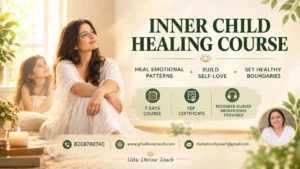
Inner Child Healing Course
Inner Child Healing is a gentle self-reflection practice that helps people understand childhood experiences, emotional patterns, unmet needs, and beliefs that may continue to influence their adult lives. At Gitu Divine Touch, Pune, this topic can be explored through guided reflection, meditation, affirmations, and practical self-awareness exercises. This guide explains the meaning of Inner Child Healing, its potential benefits, beginner-friendly techniques, daily practices, and how to learn through a structured course. Explore Inner Child Healing, its benefits, simple techniques and meditation practices. Discover inner child healing training at Gitu Divine Touch, Pune. Inner Child Healing – Complete Guide for Beginners Introduction: What is Inner Child Healing? Have you ever felt unusually hurt when someone criticised you? Do you sometimes fear rejection, struggle to say no, feel that you are not good enough, or worry excessively about disappointing others? Sometimes, our reactions in adult life are influenced by earlier experiences. These may include feeling unheard, being compared with siblings, experiencing harsh criticism, facing family conflict, or not receiving the reassurance we needed as children. Inner Child Healing is a self-reflection approach that helps us recognise and respond compassionately to these emotional patterns. The term inner child is a metaphor for the childhood experiences, feelings, needs, memories and beliefs that may remain meaningful to us as adults. The purpose is not to blame parents or relive every painful memory. It is to understand ourselves better, develop healthier responses, and learn to offer ourselves the care, safety and encouragement we may need today. Inner Child Healing can be explored through journaling, visualisation, mindfulness, affirmations and, when appropriate, professional therapeutic support. In this article, you will learn: 1. What is Inner Child Healing? Inner Child Healing is a process of understanding the younger parts of ourselves and responding to their emotional needs with greater compassion. In everyday language, imagine that the younger version of you still carries memories of times when you felt frightened, lonely, ignored, misunderstood or not accepted. As an adult, you may notice similar feelings when situations remind you of those experiences. Inner Child Healing invites you to pause and ask: These questions can help you move from automatic reactions towards greater self-awareness. A simple example Imagine that a manager says, “Please improve this report.” One employee considers the feedback and makes the changes. Another feels deeply ashamed and thinks, “I am useless. Everyone will reject me.” The second person may have learned earlier in life to associate mistakes with criticism, punishment or loss of approval. This is only one possible explanation; the reaction could have other causes too. Inner Child Healing encourages the person to separate the present situation from old beliefs. A more balanced response might be: “I have received feedback about one piece of work. This does not define my worth. I can learn and improve.” The goal is not to eliminate every uncomfortable emotion. It is to respond with greater understanding and flexibility. 2. Inner Child Healing meaning: Understanding the inner child The inner child is not a separate person living inside your body. It is a psychological and reflective metaphor used in some therapeutic and personal development approaches. It can represent: Your inner child is not necessarily associated only with painful experiences. It may also represent the joyful, imaginative and playful parts of your personality. The different experiences we may carry The unheard child A person who often felt that their opinions did not matter may find it difficult to express needs or speak up in adult relationships. The perfectionist child Someone who received approval mainly for achievements may become afraid of making mistakes or disappointing others. The playful child This represents curiosity, imagination, humour and the ability to enjoy simple activities without constantly judging oneself. These are illustrative patterns, not diagnoses. Different people have different histories, and the same childhood experience can affect people in different ways. 3. Why do childhood experiences matter in adult life? Childhood is an important period for learning about relationships, emotions, boundaries and self-worth. Experiences with caregivers, teachers, family members and peers can influence how a person understands themselves and others. However, childhood does not determine your entire future. People continue to learn, develop supportive relationships and change their responses throughout life. Some patterns worth exploring include: Fear of rejection: You may feel anxious when someone takes longer than usual to reply to a message. People-pleasing: You may agree to requests even when you are exhausted because saying no feels uncomfortable. Harsh self-criticism: You may speak to yourself more cruelly than you would ever speak to a friend. Difficulty trusting others: You may expect people to disappoint you, even when there is little evidence that they will. Difficulty accepting appreciation: Compliments may make you uncomfortable because you have trouble believing positive things about yourself. Fear of mistakes: A small error may feel like proof that you are not capable. These patterns can have many causes. Inner Child Healing offers one way to explore them without assuming that every difficulty originates in childhood. Example: The fear of saying no Suppose a woman grew up believing that a good daughter should never disagree with family members. As an adult, she may accept every family request, even when it interferes with her own needs. She may then feel frustrated or resentful. An inner child reflection could help her recognise the belief: “If I disagree, people will stop loving me.” She can begin replacing it with a more balanced understanding: “I can care about my family and still have reasonable boundaries. Disagreement does not automatically mean rejection.” She can practise saying no respectfully, starting with small, manageable situations. This is a practical example of self-awareness and behaviour change, not a promise that one exercise will resolve a long-standing pattern. 4. What are the main principles of Inner Child Healing? Inner Child Healing can be approached through several practical principles. 4.1 Awareness before change You cannot change a pattern easily if you do not recognise it. Start by noticing your feelings, thoughts and reactions
Inner Child Healing Course Read Post »