spiritual wellness

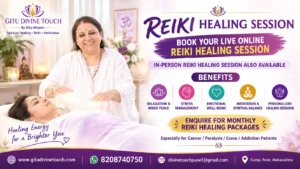
Online Reiki session and guided relaxation from home with Gitu Divine Touch.
Healing sessions, reiki session

Online reiki sessions: Benefit Process and Guide

Online Reiki Session – A Complete Guide to Reiki Healing from Home Introduction: Discover the Experience of an Online Reiki Session Have you ever wished to experience Reiki healing from the comfort of your home? An online Reiki session allows you to connect with a Reiki practitioner remotely, without travelling to a healing centre. You can sit or lie down in a peaceful space, relax your body, focus on your breathing and receive a guided complementary spiritual wellness experience. An online Reiki session is an option for people who are curious about Reiki, want to include relaxation in their routine, or wish to explore energy healing from a distance. It can be particularly convenient for people with busy schedules, those living in another city, and individuals who prefer receiving a session in a familiar environment. At Gitu Divine Touch in Pune, Reiki is part of a broader approach to spiritual education, meditation and healing practices. Reiki is also taught through structured learning programmes for people interested in understanding its principles and developing their own practice. In this guide, you will learn what an online Reiki session means, how distance Reiki is traditionally practised, what happens during a session, its potential benefits, how to prepare, and how to explore Reiki sessions or training with Gitu Divine Touch. What Is an Online Reiki Session? An online Reiki session is a remote Reiki practice in which a practitioner and recipient are in different physical locations. Depending on the practitioner’s approach, the session may include a video or telephone conversation, relaxation guidance, meditation, and a distance Reiki practice. Reiki is a Japanese-origin complementary practice associated with the concept of working with universal life energy. In traditional Reiki understanding, practitioners use specific hand positions during in-person sessions and may use distance-healing methods in systems that teach them. In an online session, physical contact is not required. Some practitioners work at an agreed time while the recipient rests quietly at home. Others combine the practice with a live video call. Simple definition: An online Reiki session is a remotely conducted Reiki wellness practice intended to support relaxation, calmness and personal reflection. It is not a substitute for medical diagnosis, prescribed treatment or professional mental health care. What Does Distance Reiki Mean? Distance Reiki refers to a method of Reiki practice in which the practitioner and recipient are not physically together. Some Reiki traditions teach that focused intention, prayer, symbols and meditation can be used to direct Reiki across distance. These are traditional spiritual explanations rather than scientifically established mechanisms of energy transmission. A person may choose to experience distance Reiki because they are unable to visit a practitioner in person or simply prefer a quiet session at home. For example, someone living in Pune may arrange a remote session with a practitioner while travelling or staying with family in another city. The recipient can follow the agreed instructions and relax in a comfortable environment. The experience varies from person to person. Some people report feeling peaceful or sleepy, while others notice no unusual sensation. Neither a particular sensation nor its absence proves that healing has occurred. How Does an Online Reiki Session Work? The precise process depends on the practitioner, Reiki tradition and session format. A typical session may include the following steps. 1. Discuss your intention Before the session, the practitioner may ask what you hope to gain from the experience. Your intention might be to: You do not need to disclose private information that you are uncomfortable sharing. 2. Choose a quiet place Find a comfortable room where you can sit or lie down without interruption. Keep your phone on silent unless it is being used for the session. You may keep a cushion, blanket or glass of water nearby. 3. Begin with relaxation The session may start with slow breathing, a short meditation or a moment of silence. Allow yourself to settle without expecting a special sensation. You can keep your eyes open or closed, whichever feels comfortable. 4. Participate in the Reiki practice The practitioner conducts the agreed Reiki practice remotely, according to their training and tradition. You may be asked to rest quietly, follow guided relaxation or maintain a simple intention. If the session is conducted through a video call, you can communicate with the practitioner when needed. If it is conducted without a continuous call, the practitioner should explain the timing and process beforehand. 5. Return gently to your routine At the end, take a few moments to notice how you feel. Stretch gently, drink water if you wish, and resume your activities at a comfortable pace. The practitioner may invite you to share your experience or suggest a simple relaxation practice for later. What Are the Benefits of an Online Reiki Session? People explore Reiki for different personal and spiritual reasons. Some value the quiet time, some appreciate the ritual, and others are interested in Reiki as part of their spiritual journey. The following are possible subjective benefits, not guaranteed outcomes. 1. Relaxation and quiet time Setting aside time for a session can offer a break from work, household responsibilities and digital distractions. The quiet environment and relaxation practices may help some people feel calmer. 2. Support for a meditation routine An online session can encourage you to create a regular period of stillness. If you find it difficult to meditate alone, having an agreed session time may provide structure. 3. Convenience from home One of the most practical advantages is that there is no need to travel to a centre. You can participate from your home, subject to the session arrangements. 4. Personal reflection Quiet time can give you an opportunity to reflect on your feelings, daily habits and personal intentions. Journalling after a session may help you notice patterns in your experience. 5. Spiritual exploration People who are interested in Reiki philosophy may appreciate exploring its traditional concepts, meditation methods and approach to mindful living. 6. Access across locations Remote sessions can make it easier to

Online reiki sessions: Benefit Process and Guide Read Post »
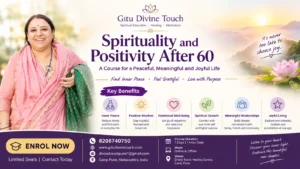
Spirituality and positivity after 60 through meditation, gratitude and peaceful reflection.
Personal Development & Communication

Spiritualit and postivity after 60 course

Spirituality and Positivity After 60 – A Complete Guide to Finding Peace, Purpose and Happiness Introduction: A Beautiful New Chapter of Life Life after 60 can be a meaningful opportunity to rediscover yourself. By this stage, many people have experienced the joys and challenges of family life, work, relationships, responsibilities and personal change. Children may have grown up, careers may be winding down, and daily routines may be different from what they once were. These changes can sometimes bring loneliness, uncertainty or a feeling that life has become less exciting. But they can also create space for something beautiful: self-reflection, spiritual growth, gratitude and a deeper appreciation of life. Spirituality and positivity after 60 are not about pretending that everything is perfect. They are about learning to accept life’s changes, appreciate what remains, discover new meaning and nurture a peaceful relationship with yourself and the world around you. Spirituality does not have to mean following a particular religion. It can mean prayer, meditation, connecting with nature, helping others, reading inspiring teachings, practising gratitude or simply spending a few quiet moments with yourself. At Gitu Divine Touch, a spiritual education, healing and meditation academy in Pune, we encourage people to explore spiritual practices in ways that feel comfortable and meaningful to them. In this guide, you will discover how to develop a positive outlook after 60, begin a simple spiritual routine, manage everyday worries, reconnect with your purpose and make each day more meaningful. 1. What Is Spirituality and Positivity After 60? Spirituality and positivity after 60 means approaching later life with greater awareness, acceptance, gratitude and a willingness to continue growing. Spirituality helps you explore questions such as: Positivity means looking for possibilities without denying difficulties. A positive person can feel sad, worried or disappointed. The difference is that they try not to let difficult emotions define their entire life. For example, someone who has retired may initially feel that they are no longer useful. With time, they might discover a new purpose by mentoring younger people, learning meditation, volunteering, pursuing a hobby or spending meaningful time with family and friends. Spirituality and positivity work together when inner reflection helps you understand your experiences and a positive outlook encourages you to move forward. A simple definition Spirituality and positivity after 60 is the practice of finding peace, purpose, gratitude and hope during later life through meaningful daily activities, personal reflection, relationships and spiritual practices. 2. Why Spirituality Can Become Important After 60 Every stage of life brings different questions. In younger years, much of our attention may be on education, earning money, raising children and building a career. Later in life, we may have more time to reflect on our experiences and values. Some people naturally become more interested in spirituality as they grow older. Others discover new interests, while some have followed a spiritual path throughout their lives. Common reasons for exploring spirituality after 60 include: Retirement and changes in routine: When work no longer provides a daily structure, spiritual practice can offer a peaceful routine and a new focus. Family changes: Children may move away, relationships may change, and people may need to discover new ways of feeling connected. A desire for meaning: Life may feel more fulfilling when daily activities reflect personal values rather than obligations alone. Reflection on past experiences: Some people wish to understand old disappointments, practise forgiveness or make peace with decisions they cannot change. A desire to give back: Helping others, sharing life lessons and participating in community activities can create a sense of purpose. There is no single correct age or reason to begin. You can explore spirituality at any time. 3. The Meaning of Positivity in Later Life Being positive after 60 does not mean smiling all day or refusing to talk about problems. Genuine positivity is realistic, gentle and flexible. It involves recognising difficulties while also noticing what is still possible. Consider these examples: Negative thought A more balanced thought “My useful years are over.” “I can still learn, contribute and enjoy new experiences.” “My children are busy, so I am alone.” “I miss spending time with them, and I can also build friendships and interests of my own.” “I am too old to learn meditation.” “I can begin with two quiet minutes and progress at my own pace.” “I cannot change my past.” “I can learn from my past and choose how I live today.” “Every day is the same.” “I can introduce one small, meaningful activity into my day.” Positive thinking is not a promise that life will always be easy. It is a way of responding to life with greater awareness and self-kindness. 4. The Spiritual Principles That Support a Positive Life After 60 You do not need to master complicated spiritual teachings. A few simple principles can guide everyday life. Gratitude Gratitude means noticing and appreciating what is valuable in your life. It might be a supportive friend, a comfortable home, a pleasant conversation, a favourite song or a peaceful morning. Try writing down three things you appreciate each evening. They do not need to be extraordinary. Acceptance Acceptance means acknowledging reality without spending all your energy fighting what cannot be changed. It does not mean tolerating mistreatment or giving up on improvement. It means understanding what is within your control and deciding where your energy is best used. Forgiveness Forgiveness may help some people release the burden of carrying old resentment. It is a personal process, not an obligation. It does not require you to excuse harmful behaviour, forget what happened or resume an unsafe relationship. You can begin by acknowledging your feelings and considering what would help you move forward. Compassion Compassion means treating yourself and others with understanding. You may have regrets about the past, but constant self-criticism rarely helps you live better today. Ask yourself, “If a close friend were experiencing this, what kind words would I offer them?” Then try offering some of those words to yourself. Living in the

Spiritualit and postivity after 60 course Read Post »

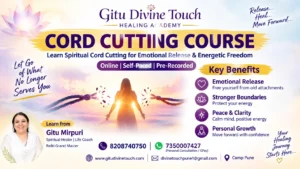
Cord Cutting Course online by Gitu Divine Touch Healing Academy with Gitu Mirpuri
CORD CUTTING COURSE, Energy Healing

Cord Cutting Course Online | Learn Energy Cord Cutting

Cord Cutting Course: Learn Spiritual Cord Cutting Online for Emotional Release Have you ever felt emotionally connected to a person, relationship, memory, or situation long after you wanted to move forward? Sometimes a relationship ends, but the emotional attachment seems to remain. You may keep thinking about someone, replaying old conversations, feeling drained after certain interactions, or finding it difficult to create a sense of inner distance. This is one reason many people become interested in a cord cutting course. Cord cutting is a spiritual and energy-healing practice traditionally used by practitioners as a symbolic way of releasing unwanted energetic or emotional attachments. It is not about harming another person, erasing memories, or forcing somebody to leave your life. Instead, the practice focuses on your own sense of boundaries, emotional release, awareness, and moving forward. A properly structured course can help students understand the concept of energetic cords, learn preparation and grounding practices, and develop a consistent personal spiritual routine. For someone looking for flexibility, a cord cutting course online can be particularly convenient. You can learn from home, revisit lessons, practise privately, and progress according to your own schedule. If you have been searching for a practical spiritual course that focuses on letting go and creating healthier energetic boundaries, learning cord cutting may be worth exploring. What Makes a Cord Cutting Course Special? The appeal of cord cutting is often very personal. Imagine someone who has spent months trying to move beyond a difficult relationship. Logically, they know the relationship has ended. Yet certain memories continue returning. A particular place, photograph, conversation, or even a person’s name can trigger a strong emotional reaction. Spiritual practices can provide a structured ritual for acknowledging those feelings and consciously choosing to release attachment. A good cord cutting course should not simply teach a ritual and send students away. It should explain the ideas behind the practice and help students understand when and how to use it responsibly. What you may learn in a structured course Depending on the school’s methodology, training may cover: The exact techniques differ between spiritual traditions and teachers. Therefore, prospective students should always ask what the course actually teaches rather than choosing a course solely because the words “cord cutting” appear in its title. Is cord cutting about another person? This is an important question. A responsible spiritual approach focuses primarily on your own energy, emotions, attachments and boundaries. It should not be presented as a technique for controlling another person’s thoughts, decisions, behaviour, relationships or free will. For example, if you have experienced a difficult breakup, the intention may be: “I choose to release unhealthy attachment and reclaim my emotional space.” That is very different from an intention such as trying to force another person to return, disappear, suffer, or behave in a particular way. This distinction matters when selecting a course. Why Many People Prefer to Buy a Cord Cutting Course Online One of the biggest advantages of online spiritual education is flexibility. A classroom course requires you to be available at a particular place and time. An online programme can give you the opportunity to study from your home. A cord cutting course online may be especially useful for students who live outside Pune or who cannot regularly attend an in-person class. Learn at your own pace Pre-recorded lessons can be paused, replayed and reviewed. This is valuable when learning meditation, visualisation or energy-healing techniques because students may want to repeat a particular section several times before practising independently. Study from home You don’t necessarily need to travel to a healing centre for every lesson. You can create a quiet corner at home and develop your own practice routine. More flexibility for working students People with jobs, family responsibilities or irregular schedules can often fit online learning around their existing commitments. Easy access to course materials Depending on the programme, students may receive: Always check exactly what is included before purchasing. You can revisit the training This is one of the strongest reasons to consider a pre-recorded course. Instead of relying on memory after a single workshop, students can return to the lessons whenever they need a refresher. Where to Buy the Best Cord Cutting Course Online When searching for a cord cutting course online, don’t choose solely because a course appears first in a search result. Look at the teacher, syllabus, teaching format, student support and course accessibility. For a spiritual training programme, the credibility and teaching approach of the practitioner are particularly important. Look for an established teacher or academy Check: Consider the official course platform If a teacher provides the course through an established learning platform such as Graphy, students may have a more organised learning experience than receiving random videos through messaging applications. For a pre-recorded course, check whether you receive a personal login, how long you have access to the course, and whether you can watch lessons on mobile and desktop devices. Ask questions before purchasing A trustworthy course provider should be comfortable answering questions such as: These questions can prevent disappointment after purchase. How to Choose the Right Cord Cutting Course Not every course will suit every student. Someone who has never studied energy healing may need more foundational guidance than an experienced Reiki or spiritual practitioner. Before buying, look beyond attractive promotional claims. 1. Check the syllabus A detailed syllabus is a positive sign because you know what you are purchasing. Look for clear modules rather than vague promises. A useful course may cover: 2. Check whether beginners are welcome If you are completely new to energy healing, choose a programme that explains terminology rather than assuming you already understand chakras, aura, energy fields or meditation. 3. Consider the teacher’s experience Experience does not automatically guarantee that a particular teaching style will suit you, but it is useful information when making your decision. Read the teacher’s biography and look for details about their training and teaching background. 4. Understand what “certification” means Some spiritual courses provide certificates

Cord Cutting Course Online | Learn Energy Cord Cutting Read Post »

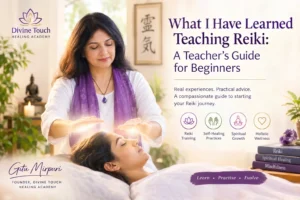
Learn Reiki: A Beginner’s Guide by Gitu Mirpuri book cover
Learn Reiki

Learn Reiki beginners guide

Online & in Pune: A Teacher’s Guide for Beginners | Gitu Mirpuri What I Have Learned Teaching Reiki: A Teacher’s Guide for Beginners By Gitu Mirpuri, Founder of Divine Touch Healing Academy Reiki is often the first energy-healing practice that introduces people to the world of spiritual healing. Over the years, I have had the opportunity to teach Reiki to students from different backgrounds, ages and levels of experience. One thing I have learned is that most beginners do not simply want to learn Reiki techniques. They want to understand what they are learning, how to practise it correctly and how they can develop confidence in their own spiritual journey. At Divine Touch Healing Academy, I teach Reiki through a structured approach that combines learning, practice, meditation, attunement and continued guidance. For someone considering a Reiki course for the first time, I believe it is important to understand what Reiki training actually involves, what a student should look for in a course and how to continue practising after the training is completed. What Is Reiki? Reiki is a Japanese spiritual and energy-healing practice that is traditionally associated with working with universal life-force energy. The word Reiki is commonly explained through two Japanese terms: “Rei,” referring to universal or spiritual, and “Ki,” referring to life-force energy. In Reiki practice, students learn techniques involving meditation, hand positions, energy awareness and other traditional practices. Different Reiki schools may follow different teaching methods, symbols and levels of training. At Divine Touch Healing Academy, Reiki is taught as a spiritual and complementary wellness practice. It is not presented as a replacement for medical diagnosis or treatment. For me, Reiki is not simply about learning a set of hand positions. It is also about developing awareness, discipline, compassion and a regular personal practice. Why Do People Choose to Learn Reiki? Students come to Reiki training for many different reasons. Some people are interested in meditation and spiritual development. Others want to learn self-healing practices or understand energy work. Some students eventually want to incorporate Reiki into their existing wellness or spiritual practice. Common reasons people explore Reiki include: There is no single reason that someone must have for learning Reiki. One of the things I tell beginners is that they should first understand why they want to learn. When the intention is clear, it becomes easier to remain committed to regular practice. What I Have Learned From Teaching Reiki Beginners Every student is different, but certain questions and challenges appear repeatedly. 1. Beginners often want immediate results Many students expect that after learning Reiki they will immediately feel a strong energy sensation or experience something extraordinary. Sometimes students do experience warmth, tingling, relaxation or other personal sensations. Sometimes they do not notice anything dramatic at all. Neither experience should automatically be considered a measure of success. Reiki practice is not a competition. I encourage students to focus on learning the method properly, developing regularity and becoming more aware of their own experience rather than constantly asking, “Am I feeling the energy correctly?” Consistency is more important than trying to force an experience. 2. Regular practice matters more than simply completing a course Completing a Reiki course is the beginning of practice, not necessarily the end of learning. A student may attend classes, receive instruction and complete an attunement, but personal development comes through continued practice. I encourage students to create a simple routine. For example: Morning:A few minutes of quiet breathing and intention setting. During the day:Awareness of thoughts, emotions and reactions. Evening:Self-Reiki, meditation or quiet reflection. The exact routine can vary according to the student’s circumstances. The important point is to develop consistency. 3. Students should understand the difference between learning and practising A Reiki course provides instruction. Practice develops familiarity. These are two different stages. During a course, a student may learn: But understanding these topics intellectually is different from incorporating them into everyday practice. This is why I encourage students to practise after every level rather than immediately rushing from one level to the next. 4. Reiki should not be treated as a substitute for medical care This is an important point for every student. Reiki belongs to the field of spiritual and complementary wellness practices. Students should not use Reiki as a replacement for qualified medical diagnosis or treatment. If someone has a medical condition, they should seek appropriate medical care from a qualified healthcare professional. Reiki practice can instead be approached as part of a person’s broader spiritual or wellness routine, depending on their individual beliefs and circumstances. A responsible teacher should communicate this clearly. What Should You Look for in a Reiki Course? There are now many Reiki courses available online and offline. Choosing between them can sometimes be confusing. Before joining a course, I recommend asking the following questions. Who is teaching the course? Learn about the teacher’s background, experience and training. A course website should clearly identify the person responsible for teaching rather than hiding the teacher behind a generic academy name. What exactly is included? Ask whether the course includes: How long is the training? Do not select a Reiki course based only on the number of hours. A short course is not automatically better or worse than a longer course. The important question is whether the curriculum provides enough explanation and practice for the level being taught. Is there a structured curriculum? A good course should tell you what you will actually learn. Students should not have to discover the curriculum only after paying for the course. Can I ask questions? This is especially important for online learning. A prerecorded video may provide information, but students often need guidance when they begin practising. At Divine Touch Healing Academy, I believe interaction and student questions are an important part of learning. Can Beginners Learn Reiki? Yes, Reiki training is commonly available to beginners, depending on the particular Reiki system and teacher. You do not necessarily need to have years of meditation experience before exploring Reiki. However,

Learn Reiki beginners guide Read Post »

Ut elit tellus, luctus nec ullamcorper mattis, pulvinar dapibus leo.

Work Hours

Oh to talking improve produce in limited offices fifteen an. Wicket branch to answer do we.

© 2026 All right reserved – Gitu Divine Touch Healing Academy | Designed by PREPelite.IN