
Astrology

Discover astrology courses and spiritual learning resources at Gitu Divine Touch. Learn the fundamentals of Vedic astrology, planets, zodiac signs, houses, nakshatras, planetary influences, and chart interpretation. Build your understanding of astrology through structured courses designed for beginners and advanced learners.

Learn Horary Astrology and Vedic Prashna Kundali with Gitu Divine Touch. Explore question-based astrology, the twelve houses, planetary lords and traditional Prashna chart interpretation. Contact us to enquire about course details.
Astrology

Horary Astrology course

1. What is Horary Astrology? Horary Astrology is a branch of astrology that interprets a chart created for the time a particular question is asked or accepted for analysis, according to the astrologer’s chosen tradition. In Vedic astrology, this method is commonly called Prashna Kundali or Prashna Jyotish. The word Prashna means “question” in Sanskrit. Kundali refers to a horoscope or astrological chart. Together, Prashna Kundali means a horoscope used for analysing a question. A birth chart represents the planetary positions at a person’s birth. A Prashna chart, by contrast, represents planetary positions at a relevant question time. A simple example Suppose a person asks: “I have attended a job interview. Will I receive an offer?” A Prashna astrologer may cast a chart for the relevant question time and examine traditional indicators associated with: The astrologer then interprets these factors within the chosen school of astrology. This process is different from simply giving a yes-or-no answer based on one planet. A careful traditional analysis considers the whole question chart, its context and the limitations of the method. Important: Astrology is a traditional belief system, and its predictive accuracy has not been established as a reliable scientific method. Major decisions about employment, health, finances or relationships should also be based on practical evidence and appropriate professional advice. 2. Prashna Kundali meaning in Vedic astrology Prashna Kundali is a traditional branch of Jyotish that uses a question chart to interpret a specific matter. It is often used by practitioners for questions about: Different lineages use different rules and interpretive methods. Some rely primarily on the twelve houses, planetary lords and aspects. Others incorporate specialised Prashna techniques, additional charts or traditional omens. The purpose of learning Prashna Jyotish is to understand the logic of the chosen tradition, rather than memorising isolated planetary combinations without considering the question. 3. History and background of Prashna Jyotish Prashna Jyotish belongs to the wider tradition of Indian astrology, or Jyotisha. Question-based astrology also has a long history in other astrological traditions, where it is commonly called horary astrology. Within Indian astrology, Prashna methods have been transmitted through classical texts, commentaries, regional practices and teacher-student traditions. One important traditional source is Prashna Marga, a Sanskrit work associated with Kerala’s astrological tradition. Other classical Jyotisha works provide principles relevant to planetary interpretation, houses and astrological judgement. When studying historical sources, it is important to distinguish a text’s traditional claims from modern scientific evidence. Historical influence and cultural importance do not, by themselves, establish the accuracy of predictions. Prashna Jyotish versus Western Horary Astrology Both traditions use a chart associated with a question, but their methods are not identical. Feature Vedic Prashna Jyotish Western Horary Astrology Tradition Indian Jyotisha Western astrological tradition Zodiac Commonly sidereal Commonly tropical Planetary interpretation Often uses Vedic house lords, planetary dignity, aspects and yogas Often emphasises significators, receptions, aspects and traditional horary rules Timing Depends on the particular school and method Depends on the particular school and method Special techniques May include specialised Prashna rules and traditional omens May include horary-specific rules and considerations Relationship to natal astrology Can be used alongside birth chart analysis Can be used alongside natal astrology These are general distinctions. Individual practitioners may use different combinations of techniques. 4. Difference between Prashna Kundali and birth chart astrology One of the most important concepts for beginners is the difference between a natal horoscope and a question horoscope. Janma Kundali — Birth chart Prepared using the person’s birth date, birth time and birthplace. Traditionally interpreted for broad life themes, personality, relationships, education, career and planetary periods. Prashna Kundali — Question chart Prepared for a relevant question time and location according to the practitioner’s method. Traditionally used to examine one specific concern or situation. Does Prashna Kundali require birth details? In many Prashna methods, the person’s birth time and birthplace are not required because the analysis uses the question chart rather than the natal chart. However, the astrologer must establish the relevant question time and location and use a consistent chart calculation method. Some practitioners may also request birth details for additional context or comparison. Prashna astrology should not be confused with a method that needs no time or location information at all. 5. Basic principles of Vedic Horary Astrology A traditional Prashna analysis generally begins with five questions: 5.1 The ascendant or Lagna The ascendant is the zodiac sign rising on the eastern horizon at the chart time and location. In many Prashna methods, the Lagna and its lord represent the person asking the question. The condition of the ascendant lord is therefore an important part of the traditional interpretation. For example, a strong ascendant lord may traditionally be read as indicating greater agency or capacity to deal with a situation. The exact judgement depends on the entire chart and the specific question. 5.2 The twelve houses The twelve houses represent different areas of life in Vedic astrology. The correct house selection depends on what the person is asking. The twelve houses in Prashna analysis House Traditional significations 1st Questioner, self, condition of the querent 2nd Money, possessions, speech, family resources 3rd Communication, effort, siblings, short journeys 4th Home, property, mother, emotional foundations 5th Children, learning, creativity, intelligence 6th Work-related difficulties, disputes, debts, illness 7th Partner, spouse, other party, agreements 8th Hidden matters, obstacles, sudden changes 9th Higher learning, teachers, fortune, long journeys 10th Career, profession, status, actions 11th Gains, fulfilment of aims, networks 12th Expenses, losses, isolation, foreign residence These are broad traditional significations. The same house can have different applications depending on the question and the interpretive school. 5.3 House lords Each zodiac sign is ruled by a planet in the standard Vedic planetary rulership scheme. The planet ruling the sign on a house cusp is called that house’s lord. For example, if Aries is the ascendant, Mars is the ascendant lord. If Libra occupies the seventh house in that chart, Venus is the seventh-house lord. The astrologer examines the relevant house lord’s placement, dignity, associations, aspects and relationship

Horary Astrology course Read Post »

Positive qualities of Manglik people showing Mangal Dosha, Mars energy, courage, confidence, leadership and determination in Vedic astrology.
Astrology

Positve qualities of manglik people

Understanding Mangal Dosha and Kuja Dosha Positive qualities of Manglik people are often overlooked when discussing Mangal Dosha or Kuja Dosha in a birth chart. In traditional Vedic astrology, Manglik people are frequently described mainly in terms of marital challenges, anger, aggression or conflict. However, Mars is also a planet of energy, courage, confidence, determination, initiative, leadership and action. Therefore, understanding the positive qualities of Manglik people is just as important as understanding the challenges traditionally associated with Mangal Dosha. According to traditional Vedic astrology, Mangal Dosha, also known as Kuja Dosha or Bhauma Dosha, is considered when Mars is placed in particular houses of the horoscope, commonly the 1st, 2nd, 4th, 7th, 8th or 12th house depending on the astrological tradition and reference chart being used. Some astrologers specifically assess Mangal Dosha from the Ascendant/Lagna and Moon chart, along with other factors. A person whose horoscope is considered to have Mangal Dosha is commonly called Manglik. However, having Mangal Dosha does not mean that a person is necessarily destined for an unhappy marriage. A complete horoscope analysis considers the 7th house, 7th lord, Venus, Jupiter, Navamsa chart, planetary aspects, conjunctions, strength of Mars, cancellation or balancing factors and the relevant planetary periods. This is where the positive qualities of Manglik people become important. As a senior astrologer, Gitu Mirpuri, founder of Gitu Divine Touch, approaches Mangal Dosha by looking at the complete birth chart rather than judging a person from Mars placement alone. What Is Mangal Dosha or Kuja Dosha? Mangal Dosha is one of the commonly discussed concepts in Vedic astrology. Mars, known as Mangal or Kuja, represents qualities such as: When Mars occupies certain houses, traditional astrology may classify the horoscope as having Mangal Dosha. The interpretation, however, depends on the complete horoscope. This is extremely important because Mangal Dosha should not be interpreted in isolation. A strong Mars can give tremendous drive and determination. The same Mars, if poorly placed or afflicted and not balanced by other factors, may traditionally be associated with impatience, arguments, impulsiveness or relationship tension. Therefore, when discussing the positive qualities of Manglik people, we should understand that the same Martian energy can manifest constructively or destructively depending on how it is expressed. Positive Qualities of Manglik People The positive qualities of Manglik people are closely connected with the characteristics traditionally attributed to Mars. Manglik people are often described as energetic, action-oriented and determined. They may not be comfortable sitting idle for long periods. They usually want to do something, achieve something and move forward. Let us understand the major positive qualities of Manglik people. 1. Strong Willpower One of the important positive qualities of Manglik people is strong willpower. Mars represents determination and the ability to take action. A person with strong Martian energy may continue working toward a goal even when there are obstacles. This quality can be valuable in: The ability to keep moving forward can become one of the greatest positive qualities of Manglik people. 2. Courage and Confidence Another important characteristic among the positive qualities of Manglik people is courage. Manglik individuals are traditionally associated with a willingness to face challenges rather than constantly avoiding difficult situations. They may be prepared to take responsibility and make decisions when others hesitate. This Martian confidence can be particularly useful when a person needs to: Therefore, confidence is one of the important positive qualities of Manglik people that should not be ignored when analysing Mangal Dosha. 3. High Energy Levels Mars is traditionally considered a planet of energy and action. Many astrologers therefore associate Manglik people with a strong internal drive. This energy can be channelled into: This is why one of the major positive qualities of Manglik people can be their ability to remain active and productive. However, excessive energy without proper direction may sometimes manifest as impatience or irritation. The objective is therefore not to suppress Martian energy but to channel it constructively. 4. Fighting Spirit A strong fighting spirit is another important entry in the list of positive qualities of Manglik people. Here, “fighting spirit” does not necessarily mean fighting with other people. It can mean the determination to fight against: A Manglik person may be able to recover from setbacks because of a strong desire to try again. This quality can become extremely useful throughout life. 5. Positive Competitive Spirit Competition is another Mars-related quality. One of the positive qualities of Manglik people can be their desire to improve themselves and achieve higher standards. Healthy competition can encourage a person to: The important distinction is between healthy competition and destructive conflict. When Mars is channelled positively, competitive energy can become a powerful source of achievement. 6. Leadership Ability Leadership is another potential strength associated with strong Mars. Manglik people may naturally prefer taking initiative rather than waiting for someone else to make every decision. This can help in: Leadership is therefore another significant example of the positive qualities of Manglik people. 7. Good Driving and Mechanical Skills Traditional astrology associates Mars with machines, tools, physical activity and technical energy. For this reason, some astrologers associate strong Martian influence with an interest or ability in: These are among the practical positive qualities of Manglik people that may become visible in everyday life. 8. Interest in Sports and Outdoor Activities Mars has a strong association with physical activity. Another important group of positive qualities of Manglik people can therefore be seen in sports and outdoor activities. Manglik individuals may enjoy: A healthy physical routine can be particularly useful for people who experience strong Martian energy. Regular exercise may provide a constructive outlet for excess restlessness and help develop discipline. 9. Martial Arts and Physical Discipline Mars is traditionally connected with warriors, courage and physical strength. This makes martial arts another area frequently associated with the positive qualities of Manglik people. Activities such as martial arts can teach: This demonstrates an important principle in astrology: Strong energy needs direction. When Martian energy is disciplined, it can become a

Positve qualities of manglik people Read Post »

Dhan Yog in Kundali showing planetary combinations, wealth houses and financial prosperity in Vedic astrology.
Astrology, Yogas in astrology

Dhan yog in Kundli

Dhan Yog (Wealth Yoga) in Vedic astrology refers to specific planetary combinations that are believed to bring wealth, prosperity, and financial success to an individual. The presence of Dhan Yog in a horoscope indicates the potential for significant material gains. Here are some key Dhan Yogas and their effects: 1. **Combination of Wealth-Related Houses**: – 2nd House: Represents accumulated wealth, family, and speech. 11th House: Denotes gains, profits, and fulfillment of desires. 5th House: Indicates intelligence, speculative gains, and past life merits. 9th House: Represents luck, fortune, and long-distance travel. 1st House (Ascendant): Represents the self and overall life path. Beneficial combinations and connections between these houses and their lords can create powerful Dhan Yogas. 2. **Specific Dhan Yogas**: -Dhan Yoga: Formed when the lords of the 2nd and 11th houses are in conjunction, mutual aspect, or exchange houses. -Lakshmi Yoga: Occurs when the lord of the 9th house is in its own or exaltation sign and is placed in a Kendra (1st, 4th, 7th, 10th) or Trikona (1st, 5th, 9th) house, and the ascendant lord is strong. – **Chandra-Mangal Yoga**: Created when the Moon and Mars are in conjunction or mutual aspect, indicating potential for wealth through property, real estate, or business ventures. – **Gaja Kesari Yoga**: Formed when Jupiter is in a Kendra from the Moon, signifying wealth, intelligence, and good fortune. – **Parivartan Yoga**: Occurs when two planets exchange signs, such as the lords of the 2nd and 11th houses, enhancing the wealth potential. 3. **Impact of Benefic Planets**: – The presence of benefic planets (Jupiter, Venus, Mercury) in the 2nd and 11th houses, or their aspect on these houses, strengthens the Dhan Yogas. – The influence of the 5th and 9th house lords on the 2nd and 11th houses or their lords also boosts financial prospects. 4. **Raj Yogas**: – Certain Raj Yogas, which confer power and status, also contribute to wealth. These include combinations involving the lords of the Kendra and Trikona houses. 5. **Navamsa Chart Consideration**: – Analyzing the Navamsa (D9) chart for supportive combinations can confirm and enhance the predictions of Dhan Yogas in the main birth chart. ### Example of Dhan Yoga: Suppose an individual’s horoscope shows the following: – The lord of the 2nd house (wealth) is Venus, and it is placed in the 11th house (gains). – The lord of the 11th house is Mercury, and it is placed in the 2nd house. – This mutual exchange (Parivartan Yoga) between the 2nd and 11th houses indicates a strong Dhan Yoga, suggesting significant financial gains and wealth accumulation. ### Important Considerations: – The strength and placement of the involved planets should be analyzed for precise predictions. – The presence of malefic influences (such as Saturn, Mars, Rahu, Ketu) can impact the results of Dhan Yogas. – The overall Dasha (planetary periods) and transits should be favorable to experience the full benefits of Dhan Yogas. Consulting with an experienced astrologer Gitu Mirpuri can provide a detailed analysis of Dhan Yogas in your horoscope and offer personalized insights into your financial potential.

Dhan yog in Kundli Read Post »

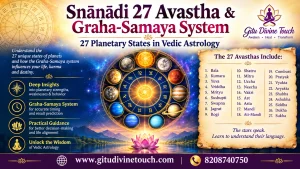
Snānādi 27 Avastha and Graha-Samaya system chart showing 27 planetary states, calculation method, Vimshottari Dasha years, interpretation and remedies by Gitu Divine Touch.
Astrology

27 Avasthas of a Planet

Snānādi 27 Avastha & Graha-Samaya System – 27 Planetary States in Vedic Astrology | Gitu Divine Touch 27 Snānādi Avasthās The sequence given in the traditional source is: No. Sanskrit name Meaning Traditional Dasha indication 1 स्नान (Snāna) Bathing Success in undertakings, servants/support, children, wealth and honour 2 वस्त्रधारण (Vastradhāraṇa) Wearing clothes Clothes, gems, influence, position and wealth 3 आमोद (Āmoda) Pleasure/fragrance Gain through foreign/ distant places, fame and honour 4 पूजारम्भ (Pūjārambha) Beginning worship Land, honour and vehicles 5 प्रार्थना (Prārthanā) Prayer Government-related difficulties, blame/loss; inclination toward agriculture 6 पूजन (Pūjana) Worship Honour, wealth; association with harsh/difficult people 7 यज्ञारम्भ (Yajñārambha) Beginning a yajña Paternal/“pitta” ailments, difficulties, but educational gain 8 प्रभुध्यान (Prabhudhyāna) Meditation on the Lord Wealth, destruction of enemies, gain through land 9 उपवेश (Upaveśa) Sitting Vehicle, cleverness/deception and pleasant speech 10 प्रदक्षिणा (Pradakṣiṇā) Circumambulation Blame, cardiac/chest problems and digestive illness 11 भावना (Bhāvanā) Contemplation Success, family happiness and good conduct 12 अतिथिसत्कार (Atithisatkara) Honouring guests Pride, occult/abhichāra-related matters and hidden wealth 13 भोजन (Bhojana) Eating Family/social difficulties, deceit, illness and adharmic tendencies 14 जलसेवन (Jalasevana) Drinking water Improper conduct and unsuitable food 15 क्रोध (Krodha) Anger Public criticism and self-pride 16 ताम्बूलचर्वण (Tāmbūla-carvaṇa) Chewing tāmbūla Deep learning, prosperity, fame and good position 17 सभावसति (Sabhāvasati) Staying in an assembly Completion of work, inclination toward dharma, honour and reputation for integrity 18 मुकुटधारण (Mukuṭadhāraṇa) Wearing a crown Learning, courage in conflict, victory and wealth 19 मन्त्र (Mantra) Mantra Laziness and carelessness 20 [Textual variation] — The particular source consulted omits the name of No. 20 21 शयन (Śayana) Lying down Harshness in the home, weakness/inactivity and disease 22 मद्यपान (Madyapāna) Drinking alcohol Carelessness, destructive tendencies, betrayal by friends and humiliation 23 मिष्टपान (Miṣṭapāna) Sweet drink/consumption Good children, attractive/loving spouse, good health, good food and respect from friends 24 धनागमन (Dhanāgama) Arrival of wealth Humility and profit through trade 25 मुकुटत्याग (Mukuṭatyāga) Removal of crown Disrespect from one’s own people, sorrow and financial loss 26 सुषुप्ति (Suṣupti) Deep sleep Long illness, drinking-related tendencies and fear of authority 27 रति (Rati) Sexual/romantic enjoyment Anxiety, sinful thoughts, mistrust, poor judgement and enmity Calculation Formula The calculation given for the Snānādi 27 Avasthā is: Formula [(Lagna Rāśi number + Planet’s Rāśi number) × 2 × Planet’s Vimśottarī Daśā years] ÷ 27 The remainder gives the Avasthā number. Use: Planet Vimshottari years सूर्य 6 चन्द्र 10 मंगल 7 बुध 17 गुरु 16 शुक्र 20 शनि 19 राहु 18 केतु 7 Example Suppose: Then: 7 + 1 = 8 8 × 2 = 16 16 × 20 = 320 Now divide by 27: 320 ÷ 27 = 11 remainder 23 Therefore: Venus = 23rd Avasthā → मिष्टपान (Miṣṭapāna) The traditional source gives a similar Libra-Lagna/Venus-in-Aries example and identifies the remainder as Miṣṭapāna. What does the Avastha actually tell us? It is primarily used to modify the results of that planet’s Dasha. For example: These should not be interpreted in isolation. The planet’s sign, house, lordship, dignity, conjunctions/aspects, Navamsha, strength and the actual Dasha/Antardasha must also be considered. The traditional source itself discusses planetary strength and other Avasthās separately. There are several different planetary-Avasthā systems: or the Snānādi 27 Avasthā / Graha-Samaya system we were discussing, the traditional calculation is generally made for the planet whose Vimshottari Mahadasha is being considered. The formula uses that planet’s full Vimshottari Dasha years, not the duration of its Antardasha. So, for example, if Venus Mahadasha is running and Saturn Antardasha is operating: But there is a useful practical approach For detailed Dasha analysis, you can consider: Mahadasha planet’s Avasthā + Antardasha planet’s Avasthā + their mutual relationship + houses/signs + strength. For example: Venus MD → Madyapāna AvasthāSaturn AD → another Avasthā

27 Avasthas of a Planet Read Post »

D2 Chart Hora Chart in Vedic Astrology for wealth and financial analysis
Astrology

D2 chart Hora chart

There are only 2 horas in d2 chart. either cancer or leo. 1) If D2 has chandra hora – very easy for you to make money. its a very samuya graha to give money. Money from inheritance , business from inheritance,vehicles from boss , partnr etc. 2) If D2 hora chart has sun leo ascnendant – then its hard to earn money. Your have to struggle more to accumulate and manage money . Here efforts has to be more , one cannot expeect easy money. As 3) If more planets in chadra hora then its considered good. 4) Dasha and D2 chart : If you are running mahadasha antardasha of planet and that planet is in cancer hora you will earn money easily. and if planet is in sun hora , struggle will be there. 5) –  Sun placed in Moon’s hora : the native has comforts and wealth acquired by his own efforts. At the same time he will be dignified with feminine disposition.  6) Sun placed in own hora : the native will be courageous, hardworking, does victorious deeds. – Moon placed in Sun hora: the native is troubled by females and enemies, does not have many friends and has low intelligence.  7) Mars in Sun hora: brave, wealthy and persevering and is the beloved of all.  8) Mercury in Moon hora – the person is famous and the spouse is chaste. 9)  Jupiter in Moon hora : the person will be noble and with good character.  10)  Venus in Sun hora – will like to co-habit with low character women; and in Moon hora – the spouse will be a good woman.  11)Saturn in Sun hora – will be a husband of a sterile woman; and in Moon hora – the person will be a henpecked husband.  12) Malefic planets in Sun hora gives wealth and luxuries, will be dear to a king.  13) A benefic in Moon hora makes a person affectionate and will enjoy comforts and luxuries 14) palnets are classified as day bali or night bali – day bali planets in chandra hora , becomes weak and night bali planets in suns hora become we

D2 chart Hora chart Read Post »

Saturn in astrology representing coldness, emotional distance, karmic lessons and withdrawal
Astrology, Marriage and Divorce Astrology

Saturn — Coldness, Distance & Karmic Withdrawal

In Vedic astrology, Saturn represents time, karma, responsibility, restriction, endurance, delay and detachment. Saturn — Coldness, Distance & Karmic Withdrawal In Vedic astrology, Saturn represents time, karma, responsibility, restriction, endurance, delay and detachment. When Saturn strongly influences the 7th house of marriage—either by occupying the 7th house, aspecting it, influencing its lord, or becoming strongly connected with Venus—it can give relationships a distinctly Saturnian character. Saturn does not usually create the kind of relationship crisis that happens overnight. Mars fights.Rahu confuses.Ketu disconnects.But Saturn slowly creates distance. This is why Saturn-related marital problems can be particularly difficult to recognize in their early stages. There may be no dramatic betrayal, no constant arguments and no obvious reason for the relationship to end. Instead, the emotional connection gradually becomes weaker. The couple may continue to live together, fulfil family responsibilities, raise children, attend social functions and maintain the appearance of a normal marriage—while internally, the relationship has become increasingly cold. Saturn’s Divorce Pattern: The Marriage That Slowly Dies Saturn’s version of separation is often erosion rather than explosion. The conversations become shorter. Affection becomes less spontaneous. Emotional vulnerability disappears. The couple starts functioning more like partners managing responsibilities than two people sharing intimacy. There can be a feeling of: “We are together, but we are no longer emotionally connected.” This is one of the deepest expressions of Saturn in relationship astrology. Saturn is the planet of duty. Therefore, even when emotional satisfaction decreases, the native may continue the marriage for years because of children, family responsibilities, social reputation, financial considerations, tradition or a sense of obligation. This is why Saturn can sometimes produce a marriage that lasts for a very long time—but does not necessarily feel emotionally warm. Saturn in the 7th House The 7th house represents marriage, spouse, committed relationships and one-to-one partnerships. Saturn placed here makes the individual approach relationships seriously and cautiously. It can give: Importantly, Saturn in the 7th house is not automatically a divorce placement. Saturn is also the planet of endurance and commitment, and because it gains directional strength in the 7th house, this placement can actually produce long-lasting marriages. The difficulty is often not the absence of commitment, but the absence of emotional warmth. Parasara Jyotish Therefore, the astrologer should never say: “Saturn in the 7th means divorce.” The correct approach is to examine the entire marriage picture. When Saturn Mahadasha Becomes Important The situation becomes more significant when Saturn Mahadasha activates the marriage axis. During Saturn Mahadasha, the native may be forced to confront the reality of the relationship. A marriage that is structurally strong may become more mature and stable. But a marriage that has already developed deep emotional cracks may enter a period of distance, separation, restructuring or legal closure. Saturn tends to ask one uncompromising question: “What is the reality of this relationship after all the illusions have disappeared?” If the relationship has substance, Saturn can strengthen it through responsibility and maturity. If the relationship has survived only through habit, social pressure or obligation, Saturn Mahadasha can expose that weakness. The result may be a gradual separation rather than a sudden breakup. Example: Emmanuelle Béart A particularly interesting example is French actress Emmanuelle Béart. Her recorded birth data is 14 August 1963, 5:15 AM, Gassin, France. Her natal chart places Saturn at approximately 19° Aquarius in the 7th house, directly emphasizing the house of marriage and committed partnerships. (Astrodienst) This makes her chart an interesting case study for the Saturnian relationship theme. In her personal life, Béart married actor Michaël Cohen in 2008. The couple later separated/divorced in 2011, after a relatively short marriage. From a Vedic-dasha perspective, one published calculation places Béart in Saturn Mahadasha from approximately 2003 to 2022. That means her 2008 marriage and the subsequent 2011 separation occurred within the Saturn Mahadasha period. This creates an interesting symbolic correspondence: Natal Saturn → 7th houseSaturn Mahadasha → activation of Saturn’s karmic themesMarriage → 2008Separation/divorce → 2011 The important point, however, is not to claim that Saturn alone “caused” the divorce. Astrologically, Saturn’s 7th-house placement describes the relationship climate, while the dasha provides a period in which Saturn’s themes can become more prominent. A complete prediction would require examination of the 7th lord, Venus, Navamsa (D9), Upapada Lagna and the specific Antardasha operating at the time. The Deeper Saturn Lesson Saturn teaches through time. Sometimes it does not take a relationship away immediately. Instead, it allows the relationship to continue until both people clearly understand what it has become. That is why Saturn-related separation can feel very different from a sudden Mars or Rahu breakup. There may be years of trying. Years of adjustment. Years of silence. Years of fulfilling responsibilities. And then, finally, a realization: “We have fulfilled our responsibilities, but we are no longer living the same emotional life.” That is Saturn’s karmic withdrawal. It is not necessarily hatred. It is not necessarily scandal. It is not even necessarily a dramatic conflict. Sometimes it is simply two people gradually moving into separate emotional worlds. And when Saturn Mahadasha activates an already weakened marriage, the final separation may simply be the legal or physical expression of a distance that began much earlier. The Key Principle Saturn in the 7th does not guarantee divorce. It indicates that relationships become an arena of karma, responsibility, maturity, delay and endurance. Divorce or separation becomes a stronger possibility when Saturn’s influence combines with other indicators involving the 7th house, 7th lord, Venus, 6th/8th/12th houses and the Navamsa, and when the appropriate dasha activates those combinations. (Jagannath Hora) So the real Saturn story is not simply: “Saturn destroys marriage.” It is more profound: “Saturn removes what can no longer be sustained.” And sometimes what remains after Saturn’s test is a stronger marriage. At other times, what remains is the courage to walk away from a relationship that has already ended emotionally.

Saturn — Coldness, Distance & Karmic Withdrawal Read Post »

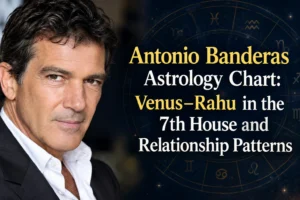
Antonio Banderas Astrology Chart: Venus–Rahu in the 7th House & Relationship Patterns
Astrology, Marriage and Divorce Astrology

Antonio Banderas Astrology Chart: Rahu and Venus in the 7th House

Antonio Banderas — Venus–Rahu in the 7th House Rahu — Estrangement & Obsession Rahu in the 7th house can intensify desire, attraction and unconventional relationship patterns. It may create a strong fascination with relationships, public image, ambition or experiences outside conventional expectations. However, Rahu in the 7th does not automatically mean divorce or infidelity; the complete chart, Venus, the 7th lord, Navamsa and planetary periods must all be examined. A well-known example is Amitabh Bachchan, whose Vedic chart is commonly analysed with Rahu in the 7th house. His marriage to Jaya Bachchan has remained long-standing, despite the enormous public attention surrounding his personal and professional life. This is an important reminder that Rahu in the 7th can manifest not only through marital difficulty, but also through an unusually prominent public partnership, unconventional circumstances and intense relationship karma. Therefore, rather than saying “Rahu in the 7th always causes divorce,” it is more accurate to say that Rahu amplifies the themes of the 7th house. When Rahu simultaneously afflicts Venus, the 7th lord or the Navamsa marriage indicators—and the relevant Rahu, Venus or relationship-related dasha becomes active—the possibility of instability, obsession, emotional distance or sudden changes in relationships can become stronger. Antonio Banderas — Rahu + Venus in the 7th house Antonio Banderas is a documented example used in Vedic astrology literature for Venus–Rahu together in the 7th house. A detailed Vedic astrology case study specifically states that Venus and Rahu are together in his 7th house and connects this placement with the beginning of his relationship with Melanie Griffith during his Venus–Rahu period. Birth data used by the Vedic chart source: A striking celebrity example of Venus–Rahu influencing relationships is actor Antonio Banderas. In the Vedic chart calculated with Aquarius Ascendant, Leo becomes the 7th house of marriage and partnership. Both Venus and Rahu are placed in Leo in the 7th house, creating a direct Venus–Rahu conjunction in the marriage house. The combination became particularly interesting during his Venus–Rahu period, which began in December 1994. According to a Vedic astrology case study, Banderas met actress Melanie Griffith shortly afterward, and their relationship eventually led to his divorce from his first wife and marriage to Griffith. This is an important example of how Venus–Rahu can intensify attraction and create a powerful, unconventional relationship experience. However, Venus–Rahu should not automatically be interpreted as divorce or infidelity. The complete horoscope, 7th lord, Navamsa, dasha and other marriage indicators must also be examined.

Antonio Banderas Astrology Chart: Rahu and Venus in the 7th House Read Post »

Hrithik Roshan Divorce Astrology: Marriage & Separation Analysis – astrology-based analysis of marriage and separation patterns
Astrology, Marriage and Divorce Astrology

Hrithik Roshan and Sussanne Khan Divorce: What Does Astrology Reveal About Their Separation?

1. First: the data For Hrithik Roshan , the commonly cited birth data are 10 January 1974, around 3:24 AM, Mumbai. For Sussanne Khan , the date is generally given as 26 October 1978, Mumbai, but her exact birth time is not reliably established. That matters enormously in Vedic astrology because her: all depend on birth time. 2. The basic relationship signature The first thing that jumps out is Scorpio. Hrithik’s commonly calculated Ascendant is Scorpio. Sussanne’s Sun is also in Scorpio in the tropical chart, and her chart has a substantial Scorpio concentration. So there is a powerful symbolic correspondence: Hrithik’s identity is expressed through Scorpio Ascendant.Sussanne’s identity is strongly Scorpio. This isn’t a weak compatibility signature. Scorpio relationships tend to be transformative. People can become deeply psychologically important to each other. That’s one reason I would not interpret this marriage as a superficial celebrity relationship. They reportedly began dating when they were young and married in 2000, after several years together. The relationship therefore had a long developmental arc: attraction → partnership → marriage → children → transformation → separation → continued family connection. 3. Hrithik’s 7th house is extremely important With Scorpio Lagna, Hrithik’s 7th house is Taurus. Taurus is ruled by Venus. So Venus becomes the natural significator of marriage/partnership for him. Taurus seeks: This is interesting because Hrithik’s public life is extraordinarily changeable, while the relationship side of his chart seeks something much more stable. That creates a fundamental tension: public life = change versus marriage instinct = stability. When those two stop being compatible, the relationship can reach a major restructuring point. 4. Hrithik’s Moon changes the interpretation His Moon is commonly placed in Cancer, in Pushya. That gives another strong family orientation. Cancer Moon wants emotional belonging. It wants: “This is my home. These are my people.” So there are actually two different forces in his chart pointing toward family: Cancer Moon → emotional family attachment Taurus 7th house → desire for stable partnership This makes the eventual divorce more interesting. A simplistic astrology reading might say: “If he values family so much, why divorce?” But that’s not how relationships work. A person can desperately value family while simultaneously concluding that the marriage itself cannot continue. And that’s essentially the distinction visible in their post-divorce lives. 5. Hrithik’s Scorpio-Cancer combination Scorpio rising + Cancer Moon produces a very emotionally intense personality. Both are water signs. That can create: One particularly important trait is that Scorpio doesn’t easily forget emotional experiences. So even when a relationship ends, the psychological imprint can remain. This helps explain why I would expect a relationship like this to transform rather than simply disappear. 6. Now look at Sussanne Sussanne’s available chart has a strong Scorpio emphasis. Her Sun, Mercury, Venus and Mars are reported in Scorpio in the commonly used chart. That is a huge concentration. And it means something fascinating happens between them: Hrithik Scorpio Ascendant Sussanne Scorpio-dominant personality So Sussanne’s fundamental psychological style resonates with the very sign through which Hrithik approaches the world. This can produce a feeling of: recognition. Not necessarily: “We’re similar in every way.” Rather: “You understand the part of me that most people don’t see.” That’s powerful relationship glue. 7. Venus + Mars in Sussanne’s Scorpio This is probably one of the strongest attraction signatures in her chart. Venus = love/relationship. Mars = sexuality/desire/assertion. Together in Scorpio, the relationship style becomes intense. This isn’t particularly detached romantic symbolism. It suggests: And there’s an important paradox: The same intensity that creates attraction can create exhaustion. In other words: high chemistry does not automatically equal long-term compatibility. Sometimes it’s precisely because the relationship is so emotionally powerful that conflicts become difficult to tolerate. 8. Venus-Uranus: the independence factor The available Sussanne chart also places Venus in a strong relationship with Uranus. In modern astrology, Venus-Uranus is associated with: Again, I would not say: Venus-Uranus = divorce. That’s bad astrology. Instead, I’d say: When a relationship becomes psychologically restrictive or inauthentic, Venus-Uranus symbolism tends to favor change rather than staying purely for convention. That becomes particularly interesting given Sussanne’s later public comments about not wanting to remain in a relationship that felt false. 9. Their relationship probably wasn’t destroyed by lack of attraction This is one of my strongest conclusions. The combined symbolism doesn’t look like: “There was never chemistry.” It looks almost opposite: strong attraction + emotional bonding + strong identity connection. The problem is more likely to have been the structure of the marriage. Think of it this way: Two people can have tremendous chemistry and still discover that they cannot live together indefinitely in very Scorpio-type relationship story the same psychological arrangement. That’s a very Scorpio-type relationship story. 10. Why the marriage lasted so long They married in December 2000. That means the marriage lasted approximately 14 years until the divorce was finalized in 2014, while their relationship itself stretched much longer. Astrologically, this is significant. If the charts were fundamentally incapable of sustaining attachment, you wouldn’t expect such longevity. The more plausible interpretation is: the relationship had genuine sustaining forces. Family, emotional attachment, attraction, shared history and children could hold it together for many years. But eventually the relationship entered a stage where those factors weren’t sufficient to preserve the marriage structure. 11. The children dramatically change the karmic interpretation They have two sons. From a Vedic perspective, children can become a powerful continuing bond between two people. And that’s exactly what happened. After the divorce: husband/wife ended but parents did not end. That distinction is extremely important. Their subsequent relationship appears to have evolved into: rather than complete estrangement. So if someone asked me: “Does the astrology indicate a total karmic severing?” I’d say no. The relationship appears much more like transformation than severance. 12. The 2013–2014 period Now we get to the most difficult part. There are two separate questions: A. Why did the relationship reach a crisis? B. Why did the legal divorce happen specifically in

Hrithik Roshan and Sussanne Khan Divorce: What Does Astrology Reveal About Their Separation? Read Post »

Aamir Khan divorce astrology analysis showing the planetary timings behind his divorces from Reena Dutta in 2002 and Kiran Rao in 2021.
Astrology, Marriage and Divorce Astrology

Aamir Khan – Understanding Divorce Timing Through Dasha

Aamir Khan – Understanding Divorce Timing Through Dasha Aamir Khan’s astto chart provides an example of how Mahadasha, Antardasha and marriage-related houses can be studied together when analysing relationship separation. Birth details used for this example:14 March 1965, 6:15 AM, Mumbai, India The 6:15 AM chart has Aquarius Ascendant. The important placements include: The 7th house represents marriage and partnership, while the 7th lord, Venus, its afflictions and the relevant Dasha periods are examined together. Mars occupying the 7th house is particularly important in this chart. It can bring strong passion, assertion, disagreements or conflict within partnership, although Mars alone can never be used to predict divorce. First Divorce – Reena Dutta Aamir Khan married Reena Dutta on 18 April 1986. The couple eventually separated, and they were living apart from around October 2001. A divorce petition was filed in 2002, with contemporary reports citing temperamental differences. The Economic Time This is an important combination to study. Why? Venus is the natural significator of marriage, relationships and marital happiness. Therefore, when Venus Mahadasha operates, relationship matters can become highly prominent. However, Venus is associated with Saturn in Aquarius in this chart, while Rahu during its Antardasha can bring unusual circumstances, dissatisfaction, detachment, changes in relationship patterns or disruption, depending on the complete horoscope. The timing becomes particularly interesting because the marital difficulties became visible during the Venus–Rahu period, with the couple living separately in 2001 and the divorce proceedings occurring in 2002. Astrology therefore does not simply say: “Venus Mahadasha = divorce.” Instead, we examine: Venus Mahadasha + Rahu Antardasha + 7th house/7th lord + transits + existing relationship combinations. That combination provides a much stronger timing framework. Second Marriage and Second Separation Aamir Khan married Kiran Rao in December 2005. They announced their separation in July 2021, after approximately 15 years of marriage. India Today This provides an even more interesting Dasha example. According to the same recorded Vimshottari sequence, Aamir entered: Moon Mahadasha – September 2019 to September 2029 The 2021 separation occurred during: Moon Mahadasha – Rahu Antardasha The recorded Dasha table places Moon Mahadasha from approximately September 2019 to September 2029, with Moon–Rahu operating during the period that includes July 2021. AstroSage This gives us a useful teaching principle: The same type of relationship event can become activated under a different Mahadasha–Antardasha combination when the underlying marriage indicators already exist in the birth chart. Why Moon–Rahu Is Important Moon represents the mind, emotional security and inner satisfaction. Rahu can intensify dissatisfaction, create unconventional circumstances and produce a desire for change or a break from an established pattern. Therefore, in this case study, Moon–Rahu can be examined as a period of emotional and relational restructuring. However, it would be incorrect to say that Moon–Rahu automatically causes divorce. The complete chart must support the event. A Very Important Lesson for Divorce Prediction A professional astrologer should not predict divorce simply because: Instead, several indicators should converge. For example: 1. Birth chart:7th house and 7th lord should show some vulnerability. 2. Marriage significator:Venus should be examined for strength, affliction and association. 3. Mahadasha:The running Mahadasha should activate marriage, separation or relationship-related houses. 4. Antardasha:The Antardasha often gives the more specific timing of the event. 5. Transit:Major transits of Saturn, Jupiter, Rahu/Ketu and sometimes Mars should be checked against the 7th house, 7th lord and relevant planets. 6. Navamsa (D9):The Navamsa should be examined to understand the deeper strength and condition of marriage. Aamir Khan – Timing Summary Relationship Event Approx. Period Dasha Indication Marriage with Reena Dutta 1986 Pre-Venus Mahadasha period Living separately 2001 Venus–Rahu Divorce proceedings 2002 Venus–Rahu Marriage with Kiran Rao 2005 Venus Mahadasha Second separation announced July 2021 Moon–Rahu The first separation occurred during Venus–Rahu, while the second was announced during Moon–Rahu. This makes Aamir Khan’s horoscope a useful case study for explaining why Antardasha is often crucial when narrowing down the timing of relationship events. The Economic Times The Main Astrological Lesson Mahadasha shows the broader life chapter, while Antardasha can help identify when that theme becomes activated. In divorce analysis, we should therefore ask: Which Mahadasha is operating? Which Antardasha is operating? What are they doing to the 7th house, 7th lord and Venus? Are the same indications repeated in the Navamsa and supported by transits? Only when multiple independent indicators converge should an astrologer consider a period highly sensitive for separation or divorce. Aamir Khan’s case demonstrates this principle particularly well: the two major relationship separations occurred in different Mahadasha–Antardasha periods, but both periods activated themes that can be examined through the underlying marriage indicators of the chart.

Aamir Khan – Understanding Divorce Timing Through Dasha Read Post »

accurate predictions with kp astrology
Astrology, KP Astrology

Accurate Predictions with KP Astrology: When You Want a Clear Answer, Not a Guess

Accurate Predictions with KP Astrology: When You Want a Clear Answer, Not a Guess Have you ever asked an astrologer a simple question and received an answer that left you even more confused? “Your time is going to change.” “You may get a good opportunity.” “Marriage is possible soon.” “Something positive can happen.” But when you ask the question that actually matters — “When?” — the answer suddenly becomes unclear. This is exactly why many people in India are becoming interested in accurate predictions with KP astrology. You are not always looking for a long explanation about planets and zodiac signs. Sometimes, you simply want to know whether something is likely to happen, whether it is worth waiting for, and when the situation may move. That is where KP Astrology can feel very different. You Want an Answer That Relates to Your Actual Question Think about the questions people really carry in their minds. “Will I get this job?” “Will my marriage happen this year?” “Is this relationship going to continue?” “Will I buy a house?” “Will I get an opportunity to go abroad?” “Should I wait for this business deal?” “Will my pending matter get resolved?” These are not casual questions. Usually, there is a real situation behind them — a job interview you are waiting for, a marriage proposal that has come into your family, a business decision involving money, or a relationship where you simply don’t know what to do next. This is where accurate predictions with KP astrology become especially interesting. KP Astrology, or Krishnamurti Paddhati, was developed by K.S. Krishnamurti and is known for its structured approach to judging specific events. Instead of depending only on broad interpretations, KP gives considerable importance to house cusps, nakshatras, significators and sub-lords. For someone asking a specific question, that level of detail can make the reading much more focused. Why KP Astrology Appeals to People Who Want Clarity Traditional astrology can sometimes give you a broad picture of life. KP takes a more question-oriented approach. The difference becomes noticeable when you are not asking, “What kind of person am I?” Instead, you are asking: “Will this particular event happen?” That is why people looking for accurate predictions with KP astrology often prefer consultations that focus on one specific matter rather than giving a long list of general predictions. For example, instead of simply saying that your career looks favourable, a KP astrologer may examine whether the chart supports a particular employment-related event and then study the relevant periods for timing. The same approach can be applied to questions involving marriage, education, property, business, foreign travel and other important areas of life. And honestly, that is what most people want. Not more astrology terminology. They want an answer they can understand. Timing Is Often the Real Question Suppose someone tells you: “You will get a job.” That sounds positive. But what if you have already been searching for six months? You want to know whether it could happen next month, later this year, or much further away. This is where the timing aspect becomes important in accurate predictions with KP astrology. KP practitioners use planetary periods and other timing techniques along with significators and sub-lord analysis to narrow down when an event may materialise. The system is particularly associated with event-specific prediction and timing. Of course, no responsible astrologer should promise that a prediction is guaranteed to happen exactly as stated. The quality of a reading depends on the astrologer’s understanding, the correctness of the birth information and the way the chart is judged. That is an important point when you are searching for accurate predictions with KP astrology. The name of the system alone does not make a prediction accurate. The person applying the system matters. Your Birth Time Can Make a Big Difference This is something many people don’t realise before consulting a KP astrologer. If your birth time is incorrect, even by a small amount, the house cusps and sub-lords can change. Since KP places significant importance on these finer calculations, accurate birth information becomes especially important. So if you have your birth certificate, family records or another reliable source for your birth time, keep it ready before your consultation. If you don’t know your exact birth time, don’t immediately assume that astrology cannot help. KP also has horary or Prashna approaches in which a question can be judged without depending entirely on a conventional birth chart. The exact method used depends on the astrologer and the type of question being asked. This is one reason accurate predictions with KP astrology can be appealing to people who have very specific questions but incomplete birth information. Marriage, Career, Business or Property — Ask the Question Clearly A common mistake is going into an astrology consultation with ten unrelated questions at once. Instead, start with the matter that is troubling you most. If it is marriage, ask about marriage. If it is your career, explain your current career situation. If it is a business decision, describe what you are actually considering. The more clearly you explain the question, the easier it becomes to understand what the astrologer is addressing. For people seeking accurate predictions with KP astrology, this makes the consultation much more useful because the reading stays connected to a real situation rather than becoming a general horoscope. For example, instead of asking: “Tell me about my future.” You could ask: “Will I change my job within the next year?” That is a much more useful question. Similarly: “Is marriage likely during this period?” “Will I purchase property?” “Is foreign travel indicated for this opportunity?” “Will this business partnership work out?” The question becomes the starting point. Don’t Choose an Astrologer Only Because They Promise 100% Accuracy This deserves attention. When you search online, you may find claims about “100% accurate predictions,” guaranteed results and exact future dates. Be careful. Astrology is an interpretive practice, and even within KP, accuracy depends on correct data, proper calculations

Accurate Predictions with KP Astrology: When You Want a Clear Answer, Not a Guess Read Post »

Ut elit tellus, luctus nec ullamcorper mattis, pulvinar dapibus leo.

Work Hours

Oh to talking improve produce in limited offices fifteen an. Wicket branch to answer do we.

© 2026 All right reserved – Gitu Divine Touch Healing Academy | Designed by PREPelite.IN