Snānādi 27 Avastha & Graha-Samaya System – 27 Planetary States in Vedic Astrology | Gitu Divine Touch
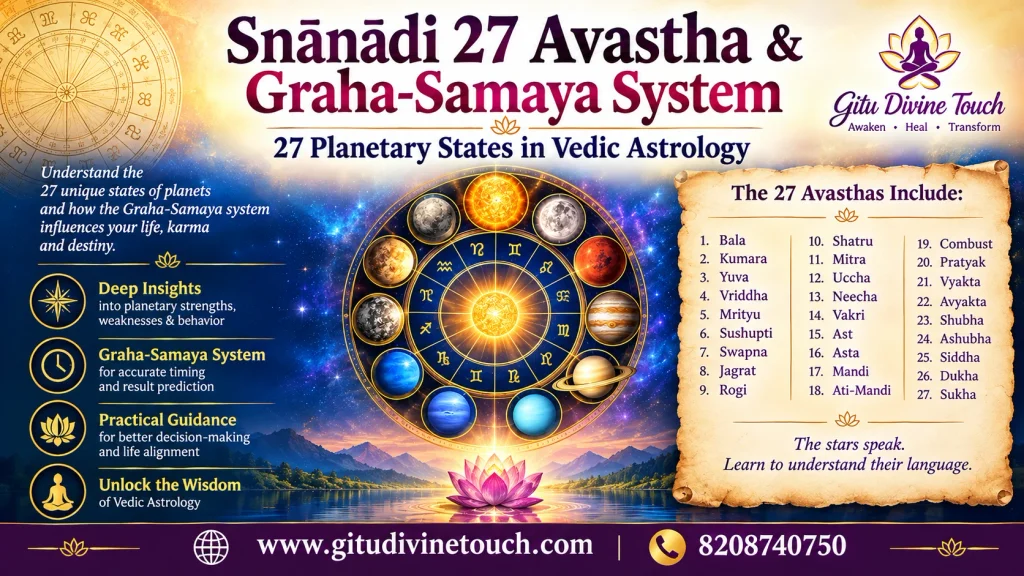
- Snana (स्नान) – Bathing; purification, renewal, relief
- Abhushana (आभूषण) – Wearing ornaments; recognition, comfort, prosperity
- Vastra (वस्त्र) – Wearing clothes; dignity, resources, social presentation
- Chhatra (छत्र) – Receiving protection; support, authority, shelter
- Gamana (गमन) – Movement/travel; activity, journeys, change
- Bhojana (भोजन) – Eating; enjoyment, nourishment, material gains
- Nritya (नृत्य) – Dancing; happiness, celebration, social activity
- Kautuka (कौतुक) – Curiosity/interest; enthusiasm and new experiences
- Nidra (निद्रा) – Sleep; inactivity, rest, delays
- Krodha (क्रोध) – Anger; conflict, frustration, disputes
- Dukha (दुःख) – Sorrow; difficulties and dissatisfaction
- Roga (रोग) – Illness; obstacles, weakness, health-related difficulties
- Shayana (शयन) – Lying/resting; passivity or reduced activity
- Vichesta (विचेष्टा) – Effort/activity; struggle and action
- Netrapani / Netrabandha – Eye-related condition; limitations in perception or expression
- Prakasha (प्रकाश) – Illumination; visibility, recognition, clarity
- Upaveshana (उपवेशन) – Sitting; waiting, stagnation or contemplation
- Gamana/Vilamba – Movement with delay; slow progress
- Sabha (सभा) – Assembly; social recognition and public interaction
- Agamana (आगमन) – Arrival; opportunities and developments
- Bhojana-related state – Enjoyment/material experience
- Nritya-related state – Celebration and activity
- Kautuka-related state – Interest and enthusiasm
- Prakasha-related state – Exposure/manifestation
- Kopa-related state – Irritation or conflict
- Vikala (विकल) – Disturbed/impaired; instability
- Mrita (मृत) – Inactive/dead; severe weakness or obstruction
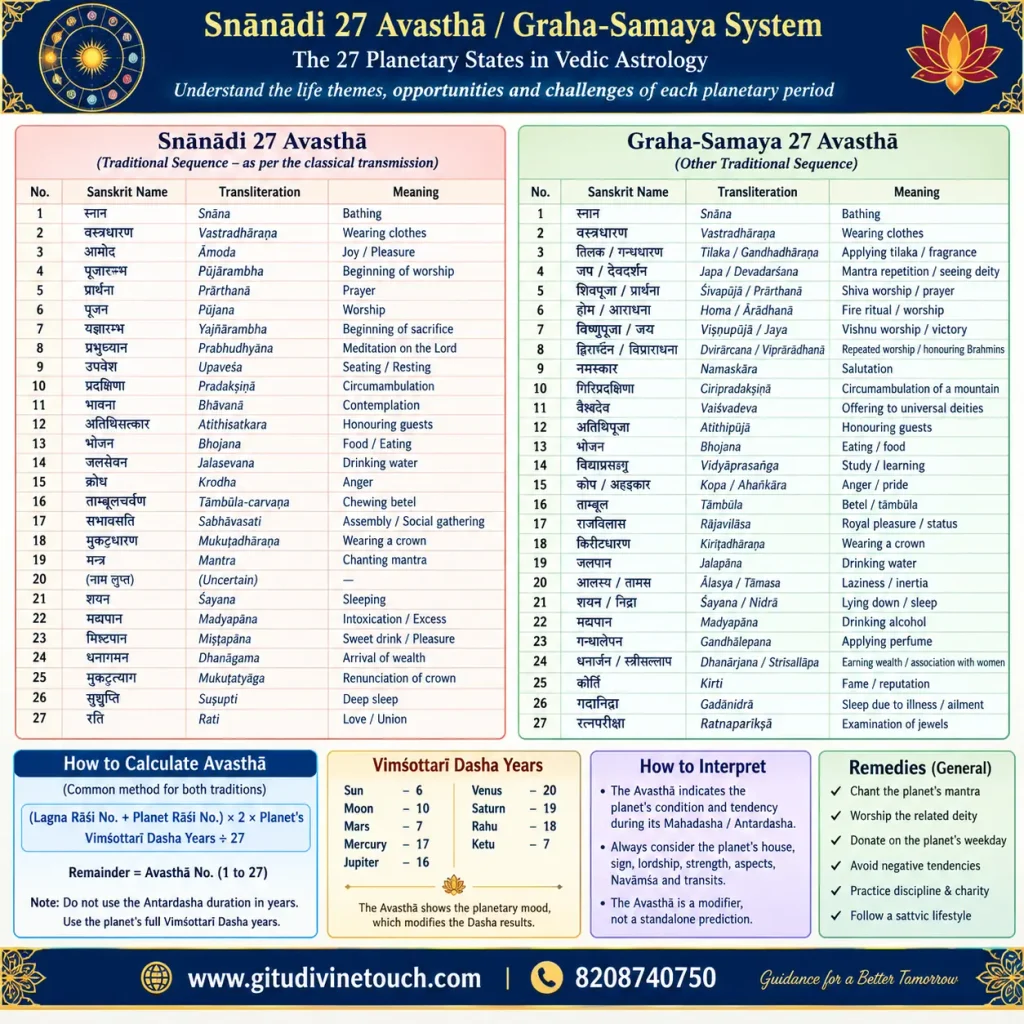
27 Snānādi Avasthās
The sequence given in the traditional source is:
| No. | Sanskrit name | Meaning | Traditional Dasha indication |
|---|---|---|---|
| 1 | स्नान (Snāna) | Bathing | Success in undertakings, servants/support, children, wealth and honour |
| 2 | वस्त्रधारण (Vastradhāraṇa) | Wearing clothes | Clothes, gems, influence, position and wealth |
| 3 | आमोद (Āmoda) | Pleasure/fragrance | Gain through foreign/ distant places, fame and honour |
| 4 | पूजारम्भ (Pūjārambha) | Beginning worship | Land, honour and vehicles |
| 5 | प्रार्थना (Prārthanā) | Prayer | Government-related difficulties, blame/loss; inclination toward agriculture |
| 6 | पूजन (Pūjana) | Worship | Honour, wealth; association with harsh/difficult people |
| 7 | यज्ञारम्भ (Yajñārambha) | Beginning a yajña | Paternal/“pitta” ailments, difficulties, but educational gain |
| 8 | प्रभुध्यान (Prabhudhyāna) | Meditation on the Lord | Wealth, destruction of enemies, gain through land |
| 9 | उपवेश (Upaveśa) | Sitting | Vehicle, cleverness/deception and pleasant speech |
| 10 | प्रदक्षिणा (Pradakṣiṇā) | Circumambulation | Blame, cardiac/chest problems and digestive illness |
| 11 | भावना (Bhāvanā) | Contemplation | Success, family happiness and good conduct |
| 12 | अतिथिसत्कार (Atithisatkara) | Honouring guests | Pride, occult/abhichāra-related matters and hidden wealth |
| 13 | भोजन (Bhojana) | Eating | Family/social difficulties, deceit, illness and adharmic tendencies |
| 14 | जलसेवन (Jalasevana) | Drinking water | Improper conduct and unsuitable food |
| 15 | क्रोध (Krodha) | Anger | Public criticism and self-pride |
| 16 | ताम्बूलचर्वण (Tāmbūla-carvaṇa) | Chewing tāmbūla | Deep learning, prosperity, fame and good position |
| 17 | सभावसति (Sabhāvasati) | Staying in an assembly | Completion of work, inclination toward dharma, honour and reputation for integrity |
| 18 | मुकुटधारण (Mukuṭadhāraṇa) | Wearing a crown | Learning, courage in conflict, victory and wealth |
| 19 | मन्त्र (Mantra) | Mantra | Laziness and carelessness |
| 20 | [Textual variation] | — | The particular source consulted omits the name of No. 20 |
| 21 | शयन (Śayana) | Lying down | Harshness in the home, weakness/inactivity and disease |
| 22 | मद्यपान (Madyapāna) | Drinking alcohol | Carelessness, destructive tendencies, betrayal by friends and humiliation |
| 23 | मिष्टपान (Miṣṭapāna) | Sweet drink/consumption | Good children, attractive/loving spouse, good health, good food and respect from friends |
| 24 | धनागमन (Dhanāgama) | Arrival of wealth | Humility and profit through trade |
| 25 | मुकुटत्याग (Mukuṭatyāga) | Removal of crown | Disrespect from one’s own people, sorrow and financial loss |
| 26 | सुषुप्ति (Suṣupti) | Deep sleep | Long illness, drinking-related tendencies and fear of authority |
| 27 | रति (Rati) | Sexual/romantic enjoyment | Anxiety, sinful thoughts, mistrust, poor judgement and enmity |
Calculation Formula
The calculation given for the Snānādi 27 Avasthā is:
Formula
[(Lagna Rāśi number + Planet’s Rāśi number) × 2 × Planet’s Vimśottarī Daśā years] ÷ 27
The remainder gives the Avasthā number.
Use:
| Planet | Vimshottari years |
|---|---|
| सूर्य | 6 |
| चन्द्र | 10 |
| मंगल | 7 |
| बुध | 17 |
| गुरु | 16 |
| शुक्र | 20 |
| शनि | 19 |
| राहु | 18 |
| केतु | 7 |
Example
Suppose:
- Lagna = तुला (Libra) = 7
- Venus = मेष (Aries) = 1
- Venus Dasha = 20 years
Then:
7 + 1 = 8
8 × 2 = 16
16 × 20 = 320
Now divide by 27:
320 ÷ 27 = 11 remainder 23
Therefore:
Venus = 23rd Avasthā → मिष्टपान (Miṣṭapāna)
The traditional source gives a similar Libra-Lagna/Venus-in-Aries example and identifies the remainder as Miṣṭapāna.
What does the Avastha actually tell us?
It is primarily used to modify the results of that planet’s Dasha. For example:
- Snāna → success, prosperity, honour
- Vastradhāraṇa → wealth, status, possessions
- Āmoda → foreign/distant opportunities and recognition
- Krodha → criticism/conflict
- Tāmbūla-carvaṇa → knowledge, prosperity and status
- Mukuṭadhāraṇa → learning, victory and wealth
- Śayana → inactivity/difficulty/illness
- Miṣṭapāna → family, health, food and social respect
- Dhanāgama → financial gain, particularly through trade
- Mukuṭatyāga → loss of status and wealth
- Suṣupti → prolonged difficulties and fear of authority
These should not be interpreted in isolation. The planet’s sign, house, lordship, dignity, conjunctions/aspects, Navamsha, strength and the actual Dasha/Antardasha must also be considered. The traditional source itself discusses planetary strength and other Avasthās separately.
There are several different planetary-Avasthā systems:
- बालादि अवस्था – Bala, Kumara, Yuva/Taruna, Vriddha, Mrita
- दीप्तादि अवस्था – Deepta, Mudita, Swastha, Shanta, etc.
- लज्जितादि अवस्था – Lajjita, Garvita, Kshudhita, Trishita, Mudita, Kshobhita
- स्नानादि 27 अवस्था / ग्रह-समय – the system you are reading now.
or the Snānādi 27 Avasthā / Graha-Samaya system we were discussing, the traditional calculation is generally made for the planet whose Vimshottari Mahadasha is being considered. The formula uses that planet’s full Vimshottari Dasha years, not the duration of its Antardasha.
So, for example, if Venus Mahadasha is running and Saturn Antardasha is operating:
- Calculate the Snānādi Avasthā of Venus using Venus’s 20-year Vimshottari period.
- You can then judge Saturn Antardasha separately through Saturn’s normal Dasha factors.
- You should not simply replace Venus’s 20 years with Saturn Antardasha’s 3 years, 2 months, etc. in the same formula.
But there is a useful practical approach
For detailed Dasha analysis, you can consider:
Mahadasha planet’s Avasthā + Antardasha planet’s Avasthā + their mutual relationship + houses/signs + strength.
For example:
Venus MD → Madyapāna Avasthā
Saturn AD → another Avasthā