

Have you ever woken up from a dream and immediately wondered, “What did that dream mean?”
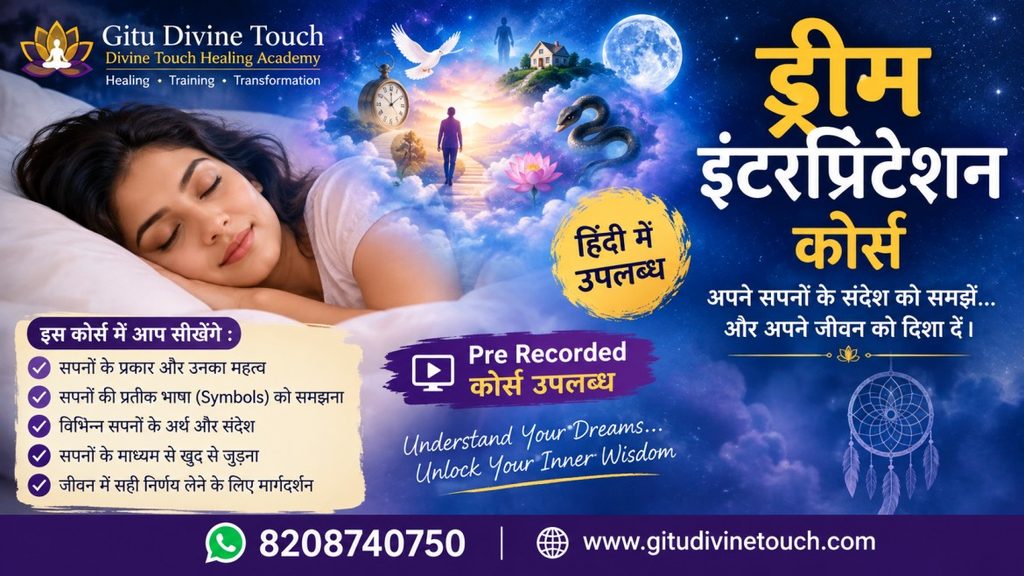
Perhaps you dreamed about someone you haven’t spoken to for years. Maybe you were flying, falling, running away from something, entering an unknown house, seeing water, animals, snakes, a temple or a deceased person. Sometimes a dream feels so real that its emotional effect stays with you long after you wake up.
That curiosity is one of the reasons people choose to learn dream interpretation.
Dreams have fascinated people for centuries, but understanding them requires more than opening a dream dictionary and searching for one symbol. The same image can mean something completely different to two people depending on their experiences, emotions, memories and circumstances.
A good dream interpretation course teaches you how to look at the complete dream rather than one isolated symbol.
At Gitu Divine Touch, the Dream Interpretation Course is designed for students who want to understand dreams in a simple, practical and structured way. The course is available as a pre-recorded course, making it convenient for students who want to learn at their own pace.
Dream interpretation can become an interesting skill for personal reflection, spiritual learning, journaling and understanding recurring dream patterns.
The important thing is to learn how to interpret thoughtfully rather than assuming every dream is a prediction.
What Is a Dream Interpretation Course?
A dream interpretation course teaches you methods for observing, recording and interpreting dreams.
Dream interpretation is not simply memorising a list such as:
- Water = emotions
- Snake = transformation
- Flying = freedom
- Falling = insecurity
- House = self
Those associations can sometimes be useful starting points, but they are not universal rules.
For example, imagine two people dream about a snake.
One person has always been afraid of snakes.
Another person grew up around snakes and considers them fascinating.
A third person may associate snakes with spiritual symbolism.
The same dream image could therefore have very different personal associations.
This is why proper dream analysis looks at the dreamer’s circumstances, emotions, relationships, memories, symbols and the complete dream story.
The American Psychological Association defines dream analysis as a technique in which dream content is interpreted for possible underlying motivations, symbolic meanings and representations.
At the same time, modern sleep research makes an important distinction: researchers still do not have a universally accepted scientific explanation for why we dream or a scientifically proven dictionary that assigns one fixed meaning to each dream symbol.
That distinction actually makes learning dream interpretation more interesting.
Instead of asking:
“What does this symbol always mean?”
you learn to ask:
“What could this symbol represent in this person’s dream and life context?”
That is a much more useful approach.
Why Are People So Interested in Dream Interpretation?
Dreams are personal.
They can bring up memories, emotions and situations that we may not consciously think about during the day.
The Sleep Foundation notes that dreams are normal experiences during sleep and are particularly vivid during REM sleep. It also notes that researchers continue to debate why we dream and whether dreams have a specific purpose.
This uncertainty has not reduced people’s curiosity.
If anything, it has made people more interested.
People commonly want to understand dreams involving:
- Falling
- Flying
- Water
- Snakes
- Animals
- Death
- Pregnancy
- Marriage
- Ex-partners
- Unknown people
- Old friends
- Family members
- Temples
- Gods and goddesses
- Money
- Houses
- Roads
- Travelling
- Being chased
- Being late
- Losing teeth
- Exams
- Fire
- Darkness
- Babies
- Mountains
- Natural disasters
- Recurring situations
Some people want to understand a single unusual dream.
Others notice the same type of dream repeatedly.
Some keep a dream journal and eventually realise that certain themes appear during particular emotional periods.
A dream interpretation course gives you a framework for studying those patterns instead of simply searching randomly on the internet every morning.
What Makes a Dream Interpretation Course Special?
The most valuable part of learning dream interpretation is developing a method.
You learn to slow down and examine the dream carefully.
1. Understanding the complete dream
A dream is a story, not merely a collection of symbols.
Suppose someone dreams:
“I am standing in an old house. The house is dark. I hear someone calling my name, but I cannot find the person.”
A beginner might immediately search:
Old house dream meaning
But a trained student asks additional questions:
- Whose house was it?
- Did the house feel familiar?
- Was the dream frightening or peaceful?
- Who was calling?
- Did the dreamer recognise the voice?
- What happened immediately before waking?
- Is the dream recurring?
- What is happening in the dreamer’s waking life?
These questions can completely change the interpretation.
2. Learning dream symbols
Symbols are an important part of dream interpretation.
You may study traditional and commonly reported associations involving:
- Water
- Fire
- Air
- Earth
- Animals
- Birds
- Snakes
- Houses
- Doors
- Windows
- Roads
- Vehicles
- Mountains
- Rivers
- Temples
- Jewellery
- Money
- Clothing
- Children
- Babies
- Death
- Birth
- Marriage
- Food
But symbols should be interpreted in context.
For example, water can appear as a calm lake, a swimming pool, heavy rain, a flood, a river or the ocean.
The emotional experience of the dream can be completely different in each case.
Dream Interpretation Course: Learn Beyond the Dream Dictionary
This is one of the biggest reasons to consider structured training.
A dream dictionary gives you information.
A course teaches you how to think about the information.
Imagine someone tells you:
“I dreamed that I was falling from a building.”
A simple dream dictionary might associate falling with fear or loss of control.
But a proper dream analysis asks:
What was happening before the fall?
Was the person:
- Excited?
- Terrified?
- Free?
- Being pushed?
- Jumping voluntarily?
- Trying to fly?
- Falling into water?
- Falling and waking suddenly?
Each detail matters.
The dreamer’s waking circumstances matter too.
Perhaps they have recently changed jobs.
Perhaps they are beginning a new relationship.
Perhaps they are worried about an important decision.
Perhaps they simply watched a film involving heights before sleeping.
There is no responsible reason to assume that one interpretation automatically applies to everyone.
Why a Dream Interpretation Course Online Can Be Convenient
A dream interpretation course online can be particularly useful because dream learning often benefits from personal observation and regular practice.
An online course allows you to study from your own space.
This can be valuable if you have:
- A full-time job
- Family responsibilities
- Irregular working hours
- Limited travel time
- Students or clients in different cities
- An interest in spiritual subjects alongside your regular profession
With a pre-recorded course, you can also revisit lessons when you want to refresh a concept.
You can pause.
Take notes.
Record your own dreams.
Return to a lesson.
Then practise again.
That flexibility is one of the strongest reasons many students prefer online learning.
Why Choose a Dream Interpretation Course in Hindi?
Not everyone wants to learn a spiritual or symbolic subject in complicated English terminology.
For many students, understanding the subject in Hindi makes the concepts much easier to absorb.
A Dream Interpretation Course in Hindi can make it easier to understand:
- Symbolic meanings
- Dream patterns
- Emotional associations
- Recurring dreams
- Dream journaling
- Different types of dreams
- Practical interpretation techniques
When the language is comfortable, students can focus on the actual subject rather than continuously translating terminology in their heads.
This is especially useful for beginners.
You do not need to be a psychologist or sleep researcher to start studying dream interpretation as a spiritual and personal-development subject.
What Can You Learn in a Dream Interpretation Course?
The exact curriculum differs between teachers, but a well-structured beginner course may introduce students to areas such as:
Understanding dreams
Learn what dreams are and why people experience different types of dream content.
Dream symbols
Study commonly encountered symbols and learn why context matters.
Dream emotions
Understand why the emotion experienced in a dream can be as important as the visual symbol.
Recurring dreams
Learn how to observe dreams that repeat similar situations, people or themes.
Positive and disturbing dreams
Understand different types of dream experiences without automatically treating every disturbing dream as a prediction.
Dream journaling
Learn how recording dreams immediately after waking can improve your ability to remember details.
The Sleep Foundation specifically recommends dream journaling as one way to improve dream recall.
Personal interpretation
Learn to connect dream details with the dreamer’s personal associations and circumstances.
Symbolic thinking
Develop the ability to look at a dream from more than one possible perspective.
Dream Interpretation and the Importance of Emotions
One of the most overlooked aspects of dream interpretation is emotion.
Imagine two people dreaming about the same ocean.
Person A feels peaceful.
Person B feels terrified.
The visual symbol is identical.
The experience is not.
Research discussed by the American Psychological Association indicates that emotional waking experiences can be reflected in dream content, although the relationship between waking life and dreams is complex and scientists continue to study it.
This is why a dream interpretation course should teach students to ask:
“How did I feel in the dream?”
Was it:
- Fear?
- Happiness?
- Anger?
- Love?
- Confusion?
- Excitement?
- Loneliness?
- Relief?
- Curiosity?
- Peace?
The emotional tone may provide an important clue when considering a dream.
Different Types of Dreams You May Study
Dream interpretation is a broad subject.
A course may introduce you to different categories and experiences.
Recurring dreams
These are dreams or dream themes that repeat.
For example, a person may repeatedly dream about:
- Missing a train
- Returning to an old school
- Searching for a house
- Being chased
- Losing something important
The repetition itself can become an interesting subject for reflection.
Symbolic dreams
These dreams contain strong images or unusual situations that the dreamer wants to understand.
Emotional dreams
Some dreams are dominated by an intense emotional experience.
The actual storyline may be less important than the feeling.
Lucid dreamsLucid dreaming refers to becoming aware that you are dreaming while the dream is happening.
This is related to dream awareness but is not the same thing as ordinary dream interpretation.
NightmaresNightmares can be particularly disturbing.
Frequent nightmares can interfere with sleep quality, and persistent sleep problems may require professional attention.
A dream interpretation course should not encourage students to treat severe or persistent nightmares as proof of supernatural events or medical conditions.
Responsible learning means knowing the limits of interpretation.
Who Should Buy a Dream Interpretation Course?
This course can appeal to several types of learners.
Beginners
You do not need previous experience.
If you have always wondered about dreams, a structured beginner course can provide a starting point.
Tarot readers
Tarot practitioners often work with symbols and intuitive interpretation, so dream analysis can become an interesting additional area of study.
Astrologers
Astrology students may enjoy studying dreams alongside their existing interest in symbolism and traditional spiritual systems.
Reiki and energy healers
Dreams may become another area of personal reflection alongside meditation and energy practices.
Spiritual seekers
If you enjoy meditation, symbolism, spirituality or self-discovery, dream interpretation can become a fascinating subject.
Coaches and counsellors
People working in personal-development fields may be interested in understanding how people describe their dream experiences.
However, dream interpretation training should not be confused with professional psychological diagnosis or psychotherapy.
Anyone curious about their own dreams
This is perhaps the simplest reason.
If you regularly wake up thinking, “Why did I dream that?”, learning the basics can help you explore your dreams in a more organised way.
Where to Buy a Dream Interpretation Course Online
When searching for a dream interpretation course online, you will find many websites, videos, social-media lessons and downloadable materials.
Not all courses provide the same depth.
Before purchasing, look for:
- A clearly identified teacher
- A clear syllabus
- Course language
- Course format
- Beginner suitability
- Recorded or live lessons
- Course notes
- Student support
- Certificate details, if offered
- Contact information
- A genuine website
- Clear payment information
Do not choose a course only because it has a large number of symbols listed.
The quality of teaching matters more than the length of a symbol list.
A course containing 1,000 dream symbols is not automatically better than a course containing 100 symbols taught properly.
The question is:
Will you understand how to interpret what you learn?
How to Choose the Right Dream Interpretation Course
Before you buy, ask yourself what you actually want from the course.
If you want personal learning
Choose a beginner-friendly course with simple explanations and practical examples.
If you want to interpret dreams professionally
Look for more structured training, practice opportunities and clear boundaries around what dream interpretation can and cannot establish.
If you prefer Hindi
Confirm that the course is genuinely taught in Hindi rather than simply providing translated notes.
If you have limited time
A pre-recorded course may be more convenient.
If you prefer interaction
Look for a course that includes live question-and-answer sessions or teacher support.
Why Buy the Dream Interpretation Course at Gitu Divine Touch?
At Gitu Divine Touch, the Dream Interpretation Course is designed for students who want to explore dream meanings and symbolism in a practical and accessible way.
The course is available as a pre-recorded course, making it suitable for students who want flexibility in when and where they study.
The teaching approach focuses on understanding the basics of dream interpretation in a simple way, with examples that help students move beyond simply memorising dream meanings.
This is particularly useful for beginners.
Instead of feeling overwhelmed by complicated terminology, students can gradually develop an understanding of:
- Dream symbols
- Dream patterns
- Emotional context
- Recurring dreams
- Symbolic interpretation
- Dream journaling
- Practical dream analysis
If you already study tarot, astrology, Reiki, chakra healing or other spiritual subjects, dream interpretation can also complement your existing learning.
What Makes a Pre-Recorded Dream Interpretation Course Worth Buying?
A pre-recorded course should offer more than a collection of videos.
Before purchasing any recorded course, check whether the material is:
Structured
Lessons should follow a logical progression.
Practical
Examples should help you understand how the concepts are applied.
Rewatchable
You should be able to return to difficult topics.
Beginner-friendly
The teacher should explain terminology instead of assuming advanced knowledge.
Useful beyond the first viewing
The best learning materials are those you can return to when you encounter a new type of dream.
This is one reason a recorded format can be valuable for dream interpretation.
You may learn a concept today and understand its usefulness much better after maintaining a dream journal for several weeks.
How to Practise After Buying a Dream Interpretation Course
Buying the course is only the beginning.
Your real learning develops through observation.
Start a simple dream journal.
Keep a notebook beside your bed.
When you wake up, write down whatever you remember.
Include:
- Date
- Time of waking
- People
- Places
- Main events
- Important objects
- Colours
- Animals
- Words or conversations
- Emotions
- How the dream ended
- Anything happening in your waking life that feels relevant
Don’t worry if the dream seems meaningless.
Write it anyway.
After several weeks, look for patterns.
You may discover that certain people appear repeatedly.
Perhaps water appears during emotionally intense periods.
Perhaps you repeatedly dream about travelling when facing major changes.
Perhaps a particular childhood location appears whenever you feel uncertain.
The purpose of journaling is not to force an interpretation.
It is to collect information.
Common Mistakes Beginners Make in Dream Interpretation
Mistake 1: Treating every dream as a prediction
Not every dream is a prediction of the future.
Dreams can incorporate memories, emotions, recent experiences and unusual combinations of information. Researchers continue to debate their purpose and meaning.
Mistake 2: Using only a dream dictionary
A dictionary can provide possible associations.
It cannot know the dreamer’s personal history.
Mistake 3: Ignoring emotions
A symbol without emotional context can be misleading.
Mistake 4: Taking every dream literally
A dream about death does not automatically mean literal death.
A dream about marriage does not necessarily mean an upcoming marriage.
A dream about money does not automatically predict financial gain.
Context matters.
Mistake 5: Frightening people with interpretations
This is particularly important for anyone who wants to work with other people’s dreams.
A responsible interpreter should avoid creating unnecessary fear.
Mistake 6: Making medical or psychological diagnoses
Dream interpretation is not a substitute for professional mental-health or medical assessment.
If someone has severe sleep problems, frequent nightmares or significant distress, they should seek an appropriate qualified professional.
Why Buying a Dream Interpretation Course Online Can Be a Smart Choice
There is a practical advantage to learning online: flexibility.
You don’t have to travel to a classroom.
You can study around your schedule.
You can pause a lesson.
You can take notes.
You can replay a difficult explanation.
And you can practise immediately with your own dream journal.
For someone who wants to learn dream interpretation as a personal or spiritual skill, this can make the learning process much easier to maintain.
A good dream interpretation course online also allows students outside Pune to access training from home.
That means your location does not necessarily have to determine which teacher you can learn from.
Dream Interpretation as a Spiritual and Personal-Development Skill
Dream interpretation has a long history across different cultures and traditions.
Modern psychology has also developed theories about dream content and its relationship to waking life.
The APA notes that psychologists have studied dreams in relation to memory, emotions and waking experiences, while acknowledging that there is no single simple explanation for why dreams occur.
For a spiritual learner, dreams can therefore be approached from several perspectives.
You might explore:
- Psychological symbolism
- Personal associations
- Emotional patterns
- Cultural symbolism
- Spiritual traditions
- Intuitive reflection
- Recurring themes
- Meditation and journaling
The important thing is to keep the distinction clear.
A symbolic interpretation can be meaningful to a person without being scientifically proven as an objective prediction.
That balanced approach makes dream study more useful and responsible.
If you are interested in symbolic systems, you may also explore our Tarot Card Reading Course and Astrology Courses.
Students interested in meditation and energy awareness may also explore the 7 Chakra Healing Course at Gitu Divine Touch.
External Authority References for Dream Interpretation
Dream interpretation is a subject where responsible information matters.
The American Psychological Association describes dream analysis as a practice involving interpretation of dream content for possible underlying motivations and symbolic meanings.
The Sleep Foundation explains that dreams occur during sleep, are particularly vivid during REM sleep, and that researchers still debate why we dream and whether dreams have a specific universal meaning.
The Cleveland Clinic similarly notes that there is no consistent, scientifically proven theory linking specific dream content to a fixed meaning.
These perspectives are useful because they allow students to enjoy dream interpretation without making claims that science cannot currently establish.
Frequently Asked Questions About Dream Interpretation Course
What is a dream interpretation course?
A dream interpretation course teaches students how to study dream content, symbols, emotions, recurring themes and personal associations. The goal is to develop a structured approach to understanding dreams rather than relying only on a dream dictionary.
Can I learn dream interpretation online?
Yes. A dream interpretation course online can be a convenient way to study from home. Pre-recorded lessons can be especially useful because you can learn at your own pace and revisit lessons when required.
Can beginners learn dream interpretation?
Yes. Beginners can start with the fundamentals of dream symbols, emotions, dream journaling and practical interpretation. Previous knowledge of psychology or spirituality is not necessarily required for introductory learning.
Is dream interpretation scientifically proven?
There is scientific research into dreaming, sleep and the relationship between dreams and waking experiences. However, there is no universally accepted scientific system assigning one fixed meaning to every dream symbol.
Is the Gitu Divine Touch Dream Interpretation Course available in Hindi?
Yes. Gitu Divine Touch offers a pre-recorded Dream Interpretation Course designed for accessible learning, including learning the basics of dream interpretation in Hindi.
Start Learning Dream Interpretation with Gitu Divine Touch
If you regularly wake up wondering what your dreams mean, you already have the most important starting point: curiosity.
You don’t need to memorise hundreds of dream symbols overnight.
You need to learn how to observe.
Learn how to record.
Learn how to recognise patterns.
Learn how to consider emotions.
And learn how to interpret a dream without immediately jumping to a frightening or overly literal conclusion.
The Dream Interpretation Course at Gitu Divine Touch is designed to help you develop that foundation in a simple and practical format.
Because the course is pre-recorded, you can learn according to your own schedule and return to the material whenever you want to revise.
Whether you are completely new to dream interpretation or already interested in tarot, astrology, Reiki, chakra healing or spiritual practices, this course can add another interesting dimension to your learning journey.
Don’t keep searching for the meaning of every dream separately. Learn the method behind dream interpretation.
Ready to Start?
Learn Dream Interpretation with Gitu Divine Touch
📚 Pre-Recorded Course Available
🪷 Learn dream symbols, patterns and interpretation techniques
🇮🇳 Learn in Hindi
📱 Enquire on WhatsApp: 8208740750
🌐 www.gitudivinetouch.com
WhatsApp message:
“DREAM INTERPRETATION COURSE”
Start learning today and turn your curiosity about dreams into a structured skill you can continue developing through practice.
Conclusion
Dreams can be confusing, fascinating, emotional and sometimes surprisingly memorable.
But learning to understand them does not mean assuming that every dream is a prediction or that every symbol has one universal meaning.
A good dream interpretation course teaches you to look deeper.
It teaches you to consider the dream as a whole, pay attention to emotions, understand symbols, recognise recurring patterns and connect dream content with personal experiences.
For beginners, an online course can be an easy way to start. A pre-recorded dream interpretation course online gives you the freedom to learn at your own pace, revisit lessons and practise through your own dream journal.
At Gitu Divine Touch, the Dream Interpretation Course is designed to make the subject accessible, particularly for students who want to learn the basics in Hindi and explore dream interpretation through practical examples.
If you have always been curious about your dreams, this is a good time to stop relying on random searches and start learning a structured approach.
Learn the basics. Keep a dream journal. Observe your patterns. Develop your understanding.
Join the Dream Interpretation Course at Gitu Divine Touch and begin exploring the fascinating language of your dreams.