spiritual healing

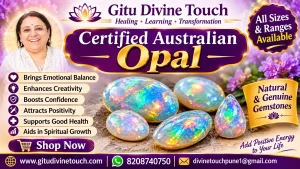
Certified and energized Opal gemstone showing beautiful rainbow colours and spiritual significance
Ceritified and Energized Gemstones, Opal Gemstones

Certified and Energized Opal Gemstone: Benefits & Guide

Opal Gemstone – Certified and Energized: Meaning, Benefits, Healing Properties and How to Choose the Right Opal Gitu Divine Touch | Gemstones, Crystal Healing and Spirituality Opal is one of the most beautiful and fascinating gemstones, admired for its colourful flashes, unique patterns and mystical appearance. A certified and energized Opal gemstone is often chosen by people who appreciate gemstones for their beauty and also wish to explore their traditional spiritual and astrological associations. Opal is traditionally associated with love, beauty, creativity, emotional expression and prosperity. In crystal healing traditions, it is also connected with emotional balance, self-expression and positive energy. However, choosing an Opal gemstone requires attention. You should understand its quality, authenticity, treatments, certification, suitability and proper care before purchasing one. At Gitu Divine Touch, we believe that gemstone selection should combine awareness, correct information and respect for individual spiritual beliefs. In this guide, you will learn about Opal gemstone meaning, its traditional benefits, certification, energization, how to wear it and how to select a genuine gemstone. 1. What Is an Opal Gemstone?iow Bla oOpal is a gemstone known for its beautiful play of colours. Unlike many other gemstones, Opal can display several colours within the same stone. When light interacts with its internal structure, flashes of colours such as blue, green, orange, red and yellow may become visible. This optical effect is known as play-of-colour. Opal is a hydrated form of silica. Its water content and internal structure make it different from many other gemstones. Simple meaning of Opal Opal is traditionally considered a gemstone of: In spiritual and crystal healing traditions, Opal is often regarded as a stone that encourages emotional awareness and positive self-expression. These associations are traditional beliefs and should not be understood as scientifically proven effects. 2. History and Significance of Opal Opal has been admired for centuries because of its extraordinary colours. Ancient cultures associated its changing colours with beauty, mystery and good fortune. Australia is particularly famous for precious Opals and remains an important source of this gemstone. Opal is also popular in jewellery because no two natural Opals have exactly the same colour pattern. Its beauty makes it a meaningful choice for people who appreciate unique gemstones. 3. Different Types of Opal Gemstones WThre hUndrstanding them helps you select the gemstone according to your preference and budget. Type Appearance White Opal Light or milky body colour with colourful flashes Black Opal Dark body tone with vibrant play-of-colour Fire Opal Yellow, orange or reddish body colour Boulder Opal Opal attached to its natural host rock Crystal Opal Transparent or translucent appearance Common Opal Usually lacks visible play-of-colour Important: Not every Opal displays the same play-of-colour. Some varieties are valued for their body colour, while precious Opals are especially appreciated for their colourful optical effect. 4. What Does Certified Opal Gemstone Mean?australianopaldirect.com When purchasing an Opal, certification is an important consideration. A certified Opal gemstone generally means that the stone has been examined by a gemological laboratory and accompanied by a report describing its identification and relevant characteristics. A proper gemstone report may include: Why should you buy certified Opal? Remember that a certificate does not automatically mean that a gemstone is high quality, astrologically suitable or spiritually energized. Always check the issuing laboratory, report number and whether the report can be independently verified. 5. Opal Gemstone Benefitsltura Opal is traditionally associated with Venus (Shukra) in some Indian astrological gemstone traditions. Venus represents beauty, love, relationships, comfort, artistic interests and luxury. People interested in Opal often explore it for the following traditional associations. A. Spiritual benefits of Opal B. Emotional and personal benefits In crystal healing traditions, Opal is associated with: These are spiritual and traditional associations, not clinically established outcomes. C. Opal and love relationships Opal is popularly associated with love, romance and affection. Traditionally, it is believed to symbolise: Wearing Opal should not be considered a guarantee of marriage, relationship success or reconciliation. D. Opal and prosperity In some gemstone traditions, Opal is associated with Venus-related qualities such as luxury, artistic talent, comfort and refinement. Some people choose it with the intention of attracting opportunities, abundance and a more positive approach to life. However, gemstones cannot guarantee financial success. 6. Opal Gemstone and Planet Venus (Shukra) ms In Vedic astrology, Venus is known as Shukra. Venus is traditionally associated with: Opal is sometimes recommended as an alternative gemstone associated with Venus. However, gemstone recommendations differ among astrological traditions and practitioners. Opal should not be prescribed solely on the basis of someone’s zodiac sign or birth month. Who should consider wearing Opal according to astrology? A qualified astrologer may consider: A gemstone recommendation should consider the complete birth chart rather than one planetary placement. Important: Opal is not automatically suitable for everyone. Seek an individual astrological assessment before wearing it as a remedial gemstone. 7. What Is an Energized Opal Gemstone? healing-sounds.com An energized Opal gemstone is a gemstone that has undergone a spiritual ritual or intention-setting process before being given to its wearer. In traditional spiritual practices, energization is performed with the intention of preparing the gemstone for personal use. The process may involve: Why do people prefer energized Opal? Some gemstone buyers prefer energized stones because they want their gemstone to be more than an ornament. They may wish to associate it with: Energization is a spiritual practice. There is no established scientific evidence that it changes the gemstone’s physical properties or guarantees astrological results. 8. How Is an Opal Gemstone Energized? The exact method varies according to the spiritual tradition and practitioner. A general intention-setting procedure may include: Step 1: Select the gemstone Choose an Opal after checking its authenticity, quality and suitability. Step 2: Clean the gemstone safely Use a soft cloth and, if appropriate for the particular Opal, gentle warm soapy water. Avoid harsh chemicals, steam and ultrasonic cleaners. Step 3: Prepare a peaceful space Sit in a clean and quiet place. You may light a lamp or incense if this is part of your

Certified and Energized Opal Gemstone: Benefits & Guide Read Post »
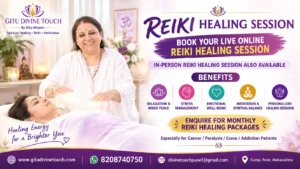
Online Reiki session and guided relaxation from home with Gitu Divine Touch.
Healing sessions, reiki session

Online reiki sessions: Benefit Process and Guide

Online Reiki Session – A Complete Guide to Reiki Healing from Home Introduction: Discover the Experience of an Online Reiki Session Have you ever wished to experience Reiki healing from the comfort of your home? An online Reiki session allows you to connect with a Reiki practitioner remotely, without travelling to a healing centre. You can sit or lie down in a peaceful space, relax your body, focus on your breathing and receive a guided complementary spiritual wellness experience. An online Reiki session is an option for people who are curious about Reiki, want to include relaxation in their routine, or wish to explore energy healing from a distance. It can be particularly convenient for people with busy schedules, those living in another city, and individuals who prefer receiving a session in a familiar environment. At Gitu Divine Touch in Pune, Reiki is part of a broader approach to spiritual education, meditation and healing practices. Reiki is also taught through structured learning programmes for people interested in understanding its principles and developing their own practice. In this guide, you will learn what an online Reiki session means, how distance Reiki is traditionally practised, what happens during a session, its potential benefits, how to prepare, and how to explore Reiki sessions or training with Gitu Divine Touch. What Is an Online Reiki Session? An online Reiki session is a remote Reiki practice in which a practitioner and recipient are in different physical locations. Depending on the practitioner’s approach, the session may include a video or telephone conversation, relaxation guidance, meditation, and a distance Reiki practice. Reiki is a Japanese-origin complementary practice associated with the concept of working with universal life energy. In traditional Reiki understanding, practitioners use specific hand positions during in-person sessions and may use distance-healing methods in systems that teach them. In an online session, physical contact is not required. Some practitioners work at an agreed time while the recipient rests quietly at home. Others combine the practice with a live video call. Simple definition: An online Reiki session is a remotely conducted Reiki wellness practice intended to support relaxation, calmness and personal reflection. It is not a substitute for medical diagnosis, prescribed treatment or professional mental health care. What Does Distance Reiki Mean? Distance Reiki refers to a method of Reiki practice in which the practitioner and recipient are not physically together. Some Reiki traditions teach that focused intention, prayer, symbols and meditation can be used to direct Reiki across distance. These are traditional spiritual explanations rather than scientifically established mechanisms of energy transmission. A person may choose to experience distance Reiki because they are unable to visit a practitioner in person or simply prefer a quiet session at home. For example, someone living in Pune may arrange a remote session with a practitioner while travelling or staying with family in another city. The recipient can follow the agreed instructions and relax in a comfortable environment. The experience varies from person to person. Some people report feeling peaceful or sleepy, while others notice no unusual sensation. Neither a particular sensation nor its absence proves that healing has occurred. How Does an Online Reiki Session Work? The precise process depends on the practitioner, Reiki tradition and session format. A typical session may include the following steps. 1. Discuss your intention Before the session, the practitioner may ask what you hope to gain from the experience. Your intention might be to: You do not need to disclose private information that you are uncomfortable sharing. 2. Choose a quiet place Find a comfortable room where you can sit or lie down without interruption. Keep your phone on silent unless it is being used for the session. You may keep a cushion, blanket or glass of water nearby. 3. Begin with relaxation The session may start with slow breathing, a short meditation or a moment of silence. Allow yourself to settle without expecting a special sensation. You can keep your eyes open or closed, whichever feels comfortable. 4. Participate in the Reiki practice The practitioner conducts the agreed Reiki practice remotely, according to their training and tradition. You may be asked to rest quietly, follow guided relaxation or maintain a simple intention. If the session is conducted through a video call, you can communicate with the practitioner when needed. If it is conducted without a continuous call, the practitioner should explain the timing and process beforehand. 5. Return gently to your routine At the end, take a few moments to notice how you feel. Stretch gently, drink water if you wish, and resume your activities at a comfortable pace. The practitioner may invite you to share your experience or suggest a simple relaxation practice for later. What Are the Benefits of an Online Reiki Session? People explore Reiki for different personal and spiritual reasons. Some value the quiet time, some appreciate the ritual, and others are interested in Reiki as part of their spiritual journey. The following are possible subjective benefits, not guaranteed outcomes. 1. Relaxation and quiet time Setting aside time for a session can offer a break from work, household responsibilities and digital distractions. The quiet environment and relaxation practices may help some people feel calmer. 2. Support for a meditation routine An online session can encourage you to create a regular period of stillness. If you find it difficult to meditate alone, having an agreed session time may provide structure. 3. Convenience from home One of the most practical advantages is that there is no need to travel to a centre. You can participate from your home, subject to the session arrangements. 4. Personal reflection Quiet time can give you an opportunity to reflect on your feelings, daily habits and personal intentions. Journalling after a session may help you notice patterns in your experience. 5. Spiritual exploration People who are interested in Reiki philosophy may appreciate exploring its traditional concepts, meditation methods and approach to mindful living. 6. Access across locations Remote sessions can make it easier to

Online reiki sessions: Benefit Process and Guide Read Post »

Navdurga and Seven Chakras – Spiritual Energy and Inner Balance
Spiritual sadhana, Uncategorized

Navdurga and Chakras

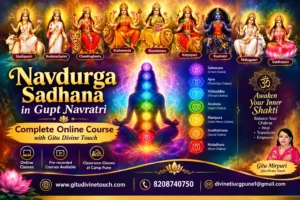
In Hinduism, the seven primary chakras are energy centers in the human body, each associated with specific qualities, elements, colors, and, in some traditions, Hindu deities or goddesses. These goddesses symbolize the divine feminine energy (Shakti) that activates and sustains each chakra. Below is an elaboration on how these chakras are linked to particular Hindu goddesses: 1. **Muladhara Chakra (Root Chakra)** – **Location**: Base of the spine – **Color**: Red – **Element**: Earth – **Goddess**: **Goddess Shailaputri** – **Details**: Shailaputri, a form of Goddess Parvati, is associated with the Muladhara Chakra. She represents stability, grounding, and the foundational energy of life. Just as the root chakra forms the foundation for the energy body, Shailaputri is considered the root form of Shakti, signifying the awakening of consciousness. 2. **Swadhisthana Chakra (Sacral Chakra)** – **Location**: Lower abdomen, about two inches below the navel – **Color**: Orange – **Element**: Water – **Goddess**: **Goddess Brahmacharini** – **Details**: Brahmacharini, another form of Goddess Parvati, is linked with the Swadhisthana Chakra. She embodies purity, devotion, and the power of transformation. This chakra governs emotions, creativity, and sexuality, and Brahmacharini’s energy helps to purify and channel these forces constructively. 3. **Manipura Chakra (Solar Plexus Chakra)** – **Location**: Above the navel, in the stomach area – **Color**: Yellow – **Element**: Fire – **Goddess**: **Goddess Chandraghanta** – **Details**: Chandraghanta is associated with the Manipura Chakra, symbolizing courage, power, and the ability to overcome fear. The solar plexus chakra is the center of personal power, self-esteem, and determination, and Chandraghanta’s energy activates these qualities, leading to greater self-confidence and the ability to manifest one’s desires. 4. **Anahata Chakra (Heart Chakra)** – **Location**: Center of the chest, near the heart – **Color**: Green – **Element**: Air – **Goddess**: **Goddess Kushmanda** – **Details**: Kushmanda, revered as the creator of the universe, is linked to the Anahata Chakra. This chakra is the center of love, compassion, and balance. Kushmanda’s energy fosters unconditional love, harmony, and a sense of interconnectedness with all beings, promoting emotional healing and spiritual growth. 5. **Vishuddha Chakra (Throat Chakra)** – **Location**: Throat region – **Color**: Blue – **Element**: Ether (Space) – **Goddess**: **Goddess Skandamata** – **Details**: Skandamata, the mother of Lord Skanda (Kartikeya), is associated with the Vishuddha Chakra. This chakra governs communication, expression, and truth. Skandamata’s energy enhances one’s ability to speak and live truthfully, promoting clarity in thought and speech, and encouraging the expression of higher wisdom. 6. **Ajna Chakra (Third Eye Chakra)** – **Location**: Forehead, between the eyebrows – **Color**: Indigo – **Element**: Light – **Goddess**: **Goddess Katyayani** – **Details**: Katyayani, a fierce form of Goddess Durga, is connected with the Ajna Chakra. This chakra is the center of intuition, insight, and spiritual vision. Katyayani’s energy aids in the awakening of inner wisdom, enhancing psychic abilities, and leading to a deeper understanding of the self and the universe. ### 7. **Sahasrara Chakra (Crown Chakra)** – **Location**: Top of the head – **Color**: Violet or White – **Element**: Cosmic Energy – **Goddess**: **Goddess kalratri** – **Details**: She is known for her fierce, destructive form, which represents the powerful force that removes darkness and negativity. Kaalratri’s fierce form is symbolic of the destruction of ignorance and the ego, paving the way for the ultimate realization of truth and unity with the cosmos. Her energy is believed to dissolve the barriers that separate the individual soul from the divine, leading to a state of pure consciousness ###8. – **Sahasrara Chakra**: Located at the top of the head, the Sahasrara Chakra is associated with the highest state of consciousness, spiritual enlightenment, and the connection to the divine. – **Devi Mahagauri**: She symbolizes purity, serenity, and the energy that leads to spiritual liberation. Mahagauri is often depicted in white, representing the purity of consciousness. Her association with the Sahasrara Chakra indicates her role in guiding the soul towards enlightenment and union with the divine. When the Sahasrara Chakra is activated and balanced, it brings about a sense of oneness with the universe and deep spiritual bliss, qualities embodied by Mahagauri. **Devi Mahagauri** is predominantly associated with the **Sahasrara Chakra (Crown Chakra)**, symbolizing the purity and spiritual enlightenment that comes with the awakening of this chakra. ###9. **Ajna Chakra (Third Eye Chakra)** or **Sahasrara Chakra (Crown Chakra)** – **Details**: – **Ajna Chakra**: Located between the eyebrows, the Ajna Chakra is the center of intuition, insight, and inner wisdom. It is often called the “Third Eye” and is associated with psychic abilities and spiritual vision. – **Devi Siddhidhatri**: Siddhidhatri is known as the giver of supernatural powers (siddhis) and is often depicted as sitting on a lotus, symbolizing spiritual perfection. Her connection to the Ajna Chakra signifies her ability to bestow wisdom and clarity, helping one develop intuitive abilities and higher perception. – **Sahasrara Chakra**: In some traditions, Siddhidhatri is also associated with the Sahasrara Chakra, as she represents the culmination of spiritual practice and the attainment of divine powers and consciousness – **Devi Siddhidhatri** is associated with both the **Ajna Chakra (Third Eye Chakra)**, where she bestows wisdom and psychic abilities, and the **Sahasrara Chakra (Crown Chakra)**, where she represents the ultimate realization and attainment of siddhis or divine powers. These goddesses embody different aspects of spiritual energy and assist in the awakening, balancing, and mastering of the higher chakras, leading to spiritual growth and enlightenment. Each of these goddesses personifies the energies and qualities associated with their respective chakras. They represent the Shakti (divine feminine energy) that is essential for the activation and balance of these energy centers, guiding the practitioner on a journey of spiritual growth and self-realization. https://gitudivinetouch.com/navdurga-sadhana-in-gupt-navratri-complete-online-course/ To learn more about Navdurga spiritual course online and classroom:

Navdurga and Chakras Read Post »

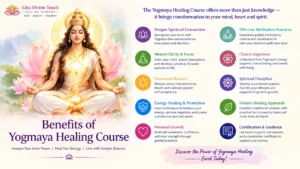
Benefits of Yogmaya Healing Course at Gitu Divine Touch Healing Academy, showing spiritual connection, mental clarity, emotional balance, energy healing, chakra alignment, spiritual discipline and personal guidance.
Yogmaya Healing

Yogmaya healing benefits

Yogmaya Healing Course: Benefits, Training & Guide Yogmaya healing course: Benefits, Spiritual Practice, Training and How to Choose the Right Course There are moments in life when you feel that you are doing everything you can, yet something still seems difficult to understand. You may feel emotionally stuck, repeatedly face the same patterns, struggle to move forward, or simply feel that you want a deeper connection with your spiritual practice. This is where many seekers begin exploring Devi traditions, meditation, energy work and different forms of spiritual healing. Yogmaya healing course training is becoming an area of interest for students who want to explore Yogmaya Devi through spiritual learning, meditation, mantra-oriented practices and energy work. Yogmaya has a significant place in Hindu traditions. In the Bhagavata tradition, Yogamaya is associated with the divine power of the Lord and with the story surrounding the birth of Krishna. Hindupedia, drawing on the Bhagavata Purana and Bhagavad Gita, describes Yogamaya as a divine power and an aspect of Durga. For a serious student, however, learning about Yogmaya should not mean simply memorising a story or repeating a mantra without understanding its context. A good course should give you a structured approach to spiritual practice while respecting the traditional background of the deity. That is what makes choosing the right Yogmaya healing course important. What Is Yogmaya? Before enrolling in any Yogmaya training, it is worth understanding who Yogmaya is and why she is spiritually significant. The name Yogamaya is associated with the Sanskrit concept of divine or spiritual power. Different Hindu traditions interpret the term and the goddess in somewhat different ways. In Vaishnava traditions, Yogamaya is connected with the divine power of Vishnu and the earthly pastimes of Krishna. In Shakta traditions, Yogamaya can be understood in relation to the Divine Mother and forms of Shakti. One of the best-known stories appears around the birth of Krishna. According to the Bhagavata tradition, Yogamaya was born to Yashoda on the same night Krishna was born to Devaki. Vasudeva carried Krishna to Gokul and brought Yashoda’s daughter back to Mathura. When Kamsa attempted to kill the infant, she escaped his grasp and revealed her divine nature. This story gives Yogmaya an important symbolic dimension. She is associated with divine power, protection, transformation and the mystery of maya. For a spiritual student, the story is not simply mythology to be memorised. It can become a starting point for reflection on attachment, perception, divine will, fear, protection and the difference between what appears to be reality and what lies beyond ordinary perception. What Makes a Yogmaya Healing Course Special? A Yogmaya healing course is different from a general meditation course because its spiritual focus is connected with the Yogmaya tradition. The exact teaching method varies from one teacher to another, so students should always check the syllabus before enrolling. A well-structured course may introduce students to areas such as: The important word here is structured. Anyone can find a mantra online. Anyone can watch a five-minute meditation video. But learning a spiritual practice properly requires context. You need to know what you are doing, why you are doing it and how to practise consistently. Learning with intention Imagine a student who has recently started exploring Devi practices. She may have watched several videos about Yogmaya, saved a few mantras and read different interpretations online. She has plenty of information, but no clear routine. A structured course changes that. Instead of jumping from one practice to another, she can study the tradition, learn the meditation method, practise regularly and gradually develop confidence. That is the real value of training. Yogmaya Healing Benefits: What Do Practitioners Traditionally Seek? People searching for Yogmaya healing benefits are often looking for personal transformation rather than a simple list of spiritual claims. It is important to approach these benefits responsibly. Yogmaya practices belong to a spiritual and religious context. They should not be presented as medically proven treatments for physical or mental illness. Instead, practitioners may experience the practice as a form of meditation, prayer, spiritual reflection and personal discipline. 1. A deeper spiritual connection For devotees and spiritual seekers, Yogmaya practice can create a regular relationship with the Divine Mother. Prayer and meditation can become a dedicated time to step away from everyday distractions. 2. Greater self-awareness Spiritual practice encourages you to observe your thoughts and reactions. Instead of immediately reacting to every emotion, you learn to notice what is happening within you. That awareness can become valuable in everyday life. 3. A sense of inner grounding Regular meditation and prayer can provide a quiet period during a busy day. Some practitioners use spiritual practices specifically to create a feeling of steadiness and inner focus. 4. Devotional discipline A spiritual course can help students develop consistency. Rather than practising only when they are emotionally overwhelmed, they learn to create a regular routine. 5. Reflection on maya and perception The concept of maya is particularly relevant to Yogmaya discussions. It encourages students to reflect on how perception, attachment and assumptions influence their experience of life. 6. Personal spiritual growth Many students are not looking for a “quick fix.” They want to understand themselves better. They want to meditate more regularly. They want to deepen their connection with Devi. They want a spiritual practice they can continue after completing the course. These are meaningful reasons to study Yogmaya. Why Many People Prefer to Buy a Yogmaya Healing Course Online Online spiritual education has made specialised subjects accessible to students who may not have a teacher or academy nearby. A student in Pune, Delhi, Mumbai or Bengaluru can potentially learn from an experienced teacher without travelling every day. The advantages include several practical factors. Learn from home You can create a dedicated learning space at home. For spiritual practices, this can actually be beneficial because you can practise in the same environment where you intend to continue your routine. Flexible learning If the course includes recorded material, you can revisit lessons. A mantra,

Yogmaya healing benefits Read Post »

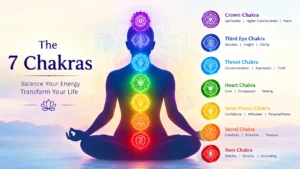
7 Chakra Healing Course at Gitu Divine Touch Healing Academy, Pune, featuring Root, Sacral, Solar Plexus, Heart, Throat, Third Eye and Crown Chakras.
Chakra Healing, Energy Healing

Chakras: Seven Chakras, Healing, Balancing and How to Choose the Right Chakra Healing Course

Chakras: Seven Chakras, Healing, Balancing and How to Choose the Right Chakra Healing Course Have you ever felt that something is “off” even when everything seems fine on the outside? Perhaps you feel tired without understanding why, struggle to express your feelings, lack confidence, find it difficult to stay focused, or simply feel disconnected from yourself. Many people who begin exploring meditation, Reiki, yoga and energy healing eventually come across the concept of chakras. The chakra system gives spiritual practitioners a way to understand the relationship between different areas of the body, emotions, thoughts and spiritual awareness. The commonly taught system describes seven chakras, beginning at the base of the spine and moving upward toward the crown of the head. For many people, learning about chakras is not simply about memorising seven names and seven colours. It becomes a personal journey of awareness. A structured chakra healing course can help you understand the traditional chakra system, meditation, visualisation, affirmations, breathing techniques, energy awareness and practical methods for working with each chakra. If you have been searching for chakra healing courses online, chakra balancing techniques or a practical way to understand the seven chakras, choosing the right training can make your learning much more meaningful. What Makes Chakras Special? The word chakra comes from Sanskrit and is commonly translated as “wheel” or “circle.” Chakra concepts have roots in South Asian spiritual traditions, including Hindu and Buddhist traditions. The modern wellness world often discusses the seven chakras as energy centres associated with different areas of the body, emotional themes, colours and elements. Cleveland Clinic notes that chakras are part of traditional South Asian systems and that Western science does not recognise them as physical structures. At the same time, practices associated with chakra work, such as meditation, breathwork and yoga, can be used as wellness practices. (Cleveland Clinic) This distinction is important. A responsible chakra practitioner does not need to claim that a chakra is a physical organ or promise that chakra balancing can cure a disease. Instead, chakra work can be approached as a traditional spiritual and self-awareness practice. Why are people attracted to chakra healing? One reason is that the chakra system gives people a simple framework for self-reflection. For example: These associations can provide useful themes for meditation and personal reflection. Imagine someone who constantly says, “I don’t feel confident enough to speak.” Instead of simply telling that person to “be confident,” a chakra practitioner might use the Solar Plexus and Throat Chakra themes as starting points for meditation, breathing, affirmations and self-observation. That gives the person a structured practice. Understanding the Seven Chakras If you are considering purchasing a chakra healing course, one of the first things you should check is whether the course teaches the chakra system in a structured way. A good course should not simply give you a list of chakra names. It should help you understand how to work with each one. 1. Root Chakra – Muladhara The Root Chakra is traditionally associated with the base of the spine. Its themes include: When working with the Root Chakra, practitioners often use grounding exercises, breathwork, visualisation and meditation. The colour traditionally associated with it is red, and Earth is commonly identified as its element. A Root Chakra meditation may focus on feeling physically grounded and secure. 2. Sacral Chakra – Svadhisthana The Sacral Chakra is associated with the lower abdomen. Its traditional themes include: People who have difficulty expressing emotions may find Sacral Chakra meditation an interesting self-reflection practice. Water is traditionally associated with this chakra, making flowing imagery particularly useful during meditation. 3. Solar Plexus Chakra – Manipura The Solar Plexus Chakra is associated with the upper abdomen. It is traditionally connected with: This is often one of the most popular chakras for people interested in personal growth. Someone who constantly doubts their decisions may choose Solar Plexus-focused meditation and affirmations as part of their personal development routine. 4. Heart Chakra – Anahata The Heart Chakra is traditionally located around the centre of the chest. Its themes include: Heart Chakra meditation can be particularly meaningful for people who are working through emotional experiences or trying to develop greater compassion toward themselves and others. 5. Throat Chakra – Vishuddha The Throat Chakra is associated with communication and expression. Its themes include: A person may be highly intelligent but still struggle to communicate what they actually feel. Throat Chakra practices can provide a symbolic framework for exploring that issue. 6. Third Eye Chakra – Ajna The Third Eye Chakra is traditionally associated with the area between the eyebrows. It is linked with: Third Eye meditation often involves visualisation and concentration. It is important, however, not to confuse the traditional Third Eye concept with a literal physical organ or claim that activating it provides guaranteed supernatural abilities. 7. Crown Chakra – Sahasrara The Crown Chakra is traditionally associated with the top of the head. It is connected with themes such as: For many practitioners, Crown Chakra work is less about physical sensation and more about contemplative and spiritual practice. Together, these seven centres form the commonly taught chakra framework. Why People Choose to Buy a Chakra Healing Course Online Searching for information about chakras is easy. Actually learning how to work with them is different. This is why many students eventually move from watching random videos to purchasing a structured chakra healing course. 1. A structured learning path Online information is scattered. One video may discuss the Root Chakra. Another may teach a completely different meditation. A third may use different terminology. A structured course brings the information together. You know: 2. Learn from home An online course is especially convenient for students who cannot attend a physical academy every day. You can learn from: 3. Repeat the lessons This is a major advantage of recorded learning. If a meditation technique takes time to understand, you can revisit it. You don’t have to remember everything after hearing it once. 4. Combine online learning with live guidance

Chakras: Seven Chakras, Healing, Balancing and How to Choose the Right Chakra Healing Course Read Post »

Ut elit tellus, luctus nec ullamcorper mattis, pulvinar dapibus leo.

Work Hours

Oh to talking improve produce in limited offices fifteen an. Wicket branch to answer do we.

© 2026 All right reserved – Gitu Divine Touch Healing Academy | Designed by PREPelite.IN