
astrology remedies

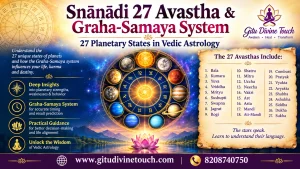
Snānādi 27 Avastha and Graha-Samaya system chart showing 27 planetary states, calculation method, Vimshottari Dasha years, interpretation and remedies by Gitu Divine Touch.
Astrology

27 Avasthas of a Planet

Snānādi 27 Avastha & Graha-Samaya System – 27 Planetary States in Vedic Astrology | Gitu Divine Touch 27 Snānādi Avasthās The sequence given in the traditional source is: No. Sanskrit name Meaning Traditional Dasha indication 1 स्नान (Snāna) Bathing Success in undertakings, servants/support, children, wealth and honour 2 वस्त्रधारण (Vastradhāraṇa) Wearing clothes Clothes, gems, influence, position and wealth 3 आमोद (Āmoda) Pleasure/fragrance Gain through foreign/ distant places, fame and honour 4 पूजारम्भ (Pūjārambha) Beginning worship Land, honour and vehicles 5 प्रार्थना (Prārthanā) Prayer Government-related difficulties, blame/loss; inclination toward agriculture 6 पूजन (Pūjana) Worship Honour, wealth; association with harsh/difficult people 7 यज्ञारम्भ (Yajñārambha) Beginning a yajña Paternal/“pitta” ailments, difficulties, but educational gain 8 प्रभुध्यान (Prabhudhyāna) Meditation on the Lord Wealth, destruction of enemies, gain through land 9 उपवेश (Upaveśa) Sitting Vehicle, cleverness/deception and pleasant speech 10 प्रदक्षिणा (Pradakṣiṇā) Circumambulation Blame, cardiac/chest problems and digestive illness 11 भावना (Bhāvanā) Contemplation Success, family happiness and good conduct 12 अतिथिसत्कार (Atithisatkara) Honouring guests Pride, occult/abhichāra-related matters and hidden wealth 13 भोजन (Bhojana) Eating Family/social difficulties, deceit, illness and adharmic tendencies 14 जलसेवन (Jalasevana) Drinking water Improper conduct and unsuitable food 15 क्रोध (Krodha) Anger Public criticism and self-pride 16 ताम्बूलचर्वण (Tāmbūla-carvaṇa) Chewing tāmbūla Deep learning, prosperity, fame and good position 17 सभावसति (Sabhāvasati) Staying in an assembly Completion of work, inclination toward dharma, honour and reputation for integrity 18 मुकुटधारण (Mukuṭadhāraṇa) Wearing a crown Learning, courage in conflict, victory and wealth 19 मन्त्र (Mantra) Mantra Laziness and carelessness 20 [Textual variation] — The particular source consulted omits the name of No. 20 21 शयन (Śayana) Lying down Harshness in the home, weakness/inactivity and disease 22 मद्यपान (Madyapāna) Drinking alcohol Carelessness, destructive tendencies, betrayal by friends and humiliation 23 मिष्टपान (Miṣṭapāna) Sweet drink/consumption Good children, attractive/loving spouse, good health, good food and respect from friends 24 धनागमन (Dhanāgama) Arrival of wealth Humility and profit through trade 25 मुकुटत्याग (Mukuṭatyāga) Removal of crown Disrespect from one’s own people, sorrow and financial loss 26 सुषुप्ति (Suṣupti) Deep sleep Long illness, drinking-related tendencies and fear of authority 27 रति (Rati) Sexual/romantic enjoyment Anxiety, sinful thoughts, mistrust, poor judgement and enmity Calculation Formula The calculation given for the Snānādi 27 Avasthā is: Formula [(Lagna Rāśi number + Planet’s Rāśi number) × 2 × Planet’s Vimśottarī Daśā years] ÷ 27 The remainder gives the Avasthā number. Use: Planet Vimshottari years सूर्य 6 चन्द्र 10 मंगल 7 बुध 17 गुरु 16 शुक्र 20 शनि 19 राहु 18 केतु 7 Example Suppose: Then: 7 + 1 = 8 8 × 2 = 16 16 × 20 = 320 Now divide by 27: 320 ÷ 27 = 11 remainder 23 Therefore: Venus = 23rd Avasthā → मिष्टपान (Miṣṭapāna) The traditional source gives a similar Libra-Lagna/Venus-in-Aries example and identifies the remainder as Miṣṭapāna. What does the Avastha actually tell us? It is primarily used to modify the results of that planet’s Dasha. For example: These should not be interpreted in isolation. The planet’s sign, house, lordship, dignity, conjunctions/aspects, Navamsha, strength and the actual Dasha/Antardasha must also be considered. The traditional source itself discusses planetary strength and other Avasthās separately. There are several different planetary-Avasthā systems: or the Snānādi 27 Avasthā / Graha-Samaya system we were discussing, the traditional calculation is generally made for the planet whose Vimshottari Mahadasha is being considered. The formula uses that planet’s full Vimshottari Dasha years, not the duration of its Antardasha. So, for example, if Venus Mahadasha is running and Saturn Antardasha is operating: But there is a useful practical approach For detailed Dasha analysis, you can consider: Mahadasha planet’s Avasthā + Antardasha planet’s Avasthā + their mutual relationship + houses/signs + strength. For example: Venus MD → Madyapāna AvasthāSaturn AD → another Avasthā

27 Avasthas of a Planet Read Post »

Saturn in astrology representing coldness, emotional distance, karmic lessons and withdrawal
Astrology, Marriage and Divorce Astrology

Saturn — Coldness, Distance & Karmic Withdrawal

In Vedic astrology, Saturn represents time, karma, responsibility, restriction, endurance, delay and detachment. Saturn — Coldness, Distance & Karmic Withdrawal In Vedic astrology, Saturn represents time, karma, responsibility, restriction, endurance, delay and detachment. When Saturn strongly influences the 7th house of marriage—either by occupying the 7th house, aspecting it, influencing its lord, or becoming strongly connected with Venus—it can give relationships a distinctly Saturnian character. Saturn does not usually create the kind of relationship crisis that happens overnight. Mars fights.Rahu confuses.Ketu disconnects.But Saturn slowly creates distance. This is why Saturn-related marital problems can be particularly difficult to recognize in their early stages. There may be no dramatic betrayal, no constant arguments and no obvious reason for the relationship to end. Instead, the emotional connection gradually becomes weaker. The couple may continue to live together, fulfil family responsibilities, raise children, attend social functions and maintain the appearance of a normal marriage—while internally, the relationship has become increasingly cold. Saturn’s Divorce Pattern: The Marriage That Slowly Dies Saturn’s version of separation is often erosion rather than explosion. The conversations become shorter. Affection becomes less spontaneous. Emotional vulnerability disappears. The couple starts functioning more like partners managing responsibilities than two people sharing intimacy. There can be a feeling of: “We are together, but we are no longer emotionally connected.” This is one of the deepest expressions of Saturn in relationship astrology. Saturn is the planet of duty. Therefore, even when emotional satisfaction decreases, the native may continue the marriage for years because of children, family responsibilities, social reputation, financial considerations, tradition or a sense of obligation. This is why Saturn can sometimes produce a marriage that lasts for a very long time—but does not necessarily feel emotionally warm. Saturn in the 7th House The 7th house represents marriage, spouse, committed relationships and one-to-one partnerships. Saturn placed here makes the individual approach relationships seriously and cautiously. It can give: Importantly, Saturn in the 7th house is not automatically a divorce placement. Saturn is also the planet of endurance and commitment, and because it gains directional strength in the 7th house, this placement can actually produce long-lasting marriages. The difficulty is often not the absence of commitment, but the absence of emotional warmth. Parasara Jyotish Therefore, the astrologer should never say: “Saturn in the 7th means divorce.” The correct approach is to examine the entire marriage picture. When Saturn Mahadasha Becomes Important The situation becomes more significant when Saturn Mahadasha activates the marriage axis. During Saturn Mahadasha, the native may be forced to confront the reality of the relationship. A marriage that is structurally strong may become more mature and stable. But a marriage that has already developed deep emotional cracks may enter a period of distance, separation, restructuring or legal closure. Saturn tends to ask one uncompromising question: “What is the reality of this relationship after all the illusions have disappeared?” If the relationship has substance, Saturn can strengthen it through responsibility and maturity. If the relationship has survived only through habit, social pressure or obligation, Saturn Mahadasha can expose that weakness. The result may be a gradual separation rather than a sudden breakup. Example: Emmanuelle Béart A particularly interesting example is French actress Emmanuelle Béart. Her recorded birth data is 14 August 1963, 5:15 AM, Gassin, France. Her natal chart places Saturn at approximately 19° Aquarius in the 7th house, directly emphasizing the house of marriage and committed partnerships. (Astrodienst) This makes her chart an interesting case study for the Saturnian relationship theme. In her personal life, Béart married actor Michaël Cohen in 2008. The couple later separated/divorced in 2011, after a relatively short marriage. From a Vedic-dasha perspective, one published calculation places Béart in Saturn Mahadasha from approximately 2003 to 2022. That means her 2008 marriage and the subsequent 2011 separation occurred within the Saturn Mahadasha period. This creates an interesting symbolic correspondence: Natal Saturn → 7th houseSaturn Mahadasha → activation of Saturn’s karmic themesMarriage → 2008Separation/divorce → 2011 The important point, however, is not to claim that Saturn alone “caused” the divorce. Astrologically, Saturn’s 7th-house placement describes the relationship climate, while the dasha provides a period in which Saturn’s themes can become more prominent. A complete prediction would require examination of the 7th lord, Venus, Navamsa (D9), Upapada Lagna and the specific Antardasha operating at the time. The Deeper Saturn Lesson Saturn teaches through time. Sometimes it does not take a relationship away immediately. Instead, it allows the relationship to continue until both people clearly understand what it has become. That is why Saturn-related separation can feel very different from a sudden Mars or Rahu breakup. There may be years of trying. Years of adjustment. Years of silence. Years of fulfilling responsibilities. And then, finally, a realization: “We have fulfilled our responsibilities, but we are no longer living the same emotional life.” That is Saturn’s karmic withdrawal. It is not necessarily hatred. It is not necessarily scandal. It is not even necessarily a dramatic conflict. Sometimes it is simply two people gradually moving into separate emotional worlds. And when Saturn Mahadasha activates an already weakened marriage, the final separation may simply be the legal or physical expression of a distance that began much earlier. The Key Principle Saturn in the 7th does not guarantee divorce. It indicates that relationships become an arena of karma, responsibility, maturity, delay and endurance. Divorce or separation becomes a stronger possibility when Saturn’s influence combines with other indicators involving the 7th house, 7th lord, Venus, 6th/8th/12th houses and the Navamsa, and when the appropriate dasha activates those combinations. (Jagannath Hora) So the real Saturn story is not simply: “Saturn destroys marriage.” It is more profound: “Saturn removes what can no longer be sustained.” And sometimes what remains after Saturn’s test is a stronger marriage. At other times, what remains is the courage to walk away from a relationship that has already ended emotionally.

Saturn — Coldness, Distance & Karmic Withdrawal Read Post »

Ut elit tellus, luctus nec ullamcorper mattis, pulvinar dapibus leo.

Work Hours

Oh to talking improve produce in limited offices fifteen an. Wicket branch to answer do we.

© 2026 All right reserved – Gitu Divine Touch Healing Academy | Designed by PREPelite.IN