
Tarot Card Reading Session – Complete Guide for Beginners
Introduction: Discover the Meaning of Tarot Card Reading
A Tarot Card Reading Session is a guided session in which a tarot reader interprets symbolic cards to help a person explore questions, understand different perspectives and reflect on possible choices. People often seek tarot readings for guidance about relationships, career decisions, personal growth, emotional clarity and spiritual development.
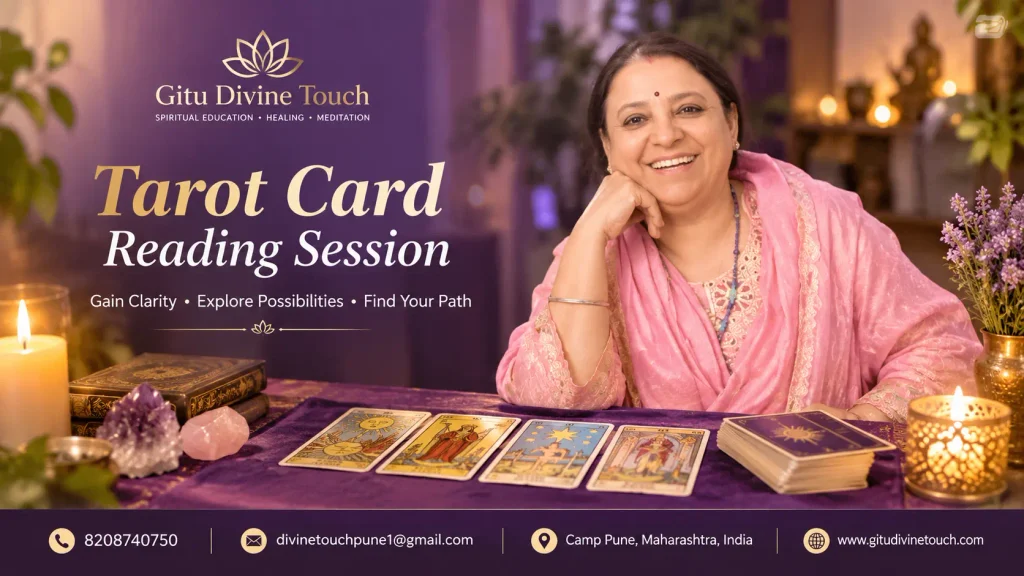
At Gitu Divine Touch, Pune, tarot is a subject that can be explored as a spiritual practice, a symbolic language and a method of self-reflection. Whether you are completely new to tarot or already familiar with the cards, understanding how a tarot card reading session works can help you approach it with curiosity and realistic expectations.
A tarot reading does not have to be about predicting an unavoidable future. Many people use it as an opportunity to pause, examine their circumstances and consider possibilities they may not have noticed before.
In this guide, you will learn what tarot card reading means, how a session works, what questions you can ask, the benefits and limitations of tarot, and how to prepare for a tarot card reading session in Pune or online.
1. What Is a Tarot Card Reading Session?
A tarot card reading session is an appointment in which a reader uses a deck of tarot cards to interpret symbols, imagery and traditional meanings in relation to a question or situation.
A conventional tarot deck contains 78 cards:
- 22 Major Arcana cards: Often associated with significant life themes, transitions, personal lessons and archetypal experiences.
- 56 Minor Arcana cards: Commonly associated with everyday circumstances, thoughts, emotions, practical matters and actions.
During a reading, the reader selects or draws cards and interprets them using the question, the card imagery, the card positions and the chosen reading method.
For example, someone who feels uncertain about a career decision may ask, “What should I consider before choosing my next professional step?”
The reader might use a three-card spread to explore the person’s present situation, a possible challenge and a constructive next step. The interpretation can encourage reflection, but it should not replace practical research, professional advice or the person’s own judgment.
2. Tarot Card Reading Meaning in Simple English
Tarot card reading means interpreting tarot cards to explore a question, situation or personal concern.
Each card has a collection of traditional interpretations and symbols. The reader considers these meanings alongside the question and the arrangement of the cards.
For example:
- The Fool: New beginnings, curiosity, openness and taking a step into the unknown.
- The Magician: Initiative, resourcefulness and making use of available skills.
- The Hermit: Reflection, solitude and seeking inner understanding.
- The Star: Hope, renewal and inspiration.
- The World: Completion, integration and the closing of a cycle.
These are common interpretations, not fixed rules. Meanings may vary according to the deck, the reading tradition, the question and the surrounding cards.
A card should not automatically be treated as a literal prediction. Its imagery can provide a starting point for discussion and reflection.
3. History and Background of Tarot Cards
Tarot cards have a documented history that goes back to fifteenth-century Europe. Early tarot decks were used primarily for card games in Italy. Their use for divination developed later, becoming particularly prominent in eighteenth-century France. The Rider–Waite–Smith deck, first published in 1909, helped popularise the illustrated imagery familiar to many modern readers. See the historical overview from the Victoria and Albert Museum: https://www.vam.ac.uk/articles/tarot-cards.
Over time, different readers and spiritual traditions developed interpretations connecting tarot imagery with philosophy, astrology, numerology and other symbolic systems.
Today, tarot is used in different ways. Some readers approach it as a spiritual or intuitive practice, while others use the cards as prompts for storytelling, journaling or personal reflection.
Claims that tarot originated as an ancient Egyptian divination system are not established by the historical evidence described by the museum source above.
Understanding this background helps readers distinguish the documented history of tarot from later spiritual interpretations.
4. How Does a Tarot Card Reading Session Work?
A tarot card reading session usually follows a simple process.
Step 1: Identify the question
The person attending the session shares the subject they want to explore.
Examples include:
- What should I consider when changing careers?
- What patterns should I reflect on in my relationship?
- How can I approach a difficult conversation?
- What might help me feel more confident about my next step?
Clear, open-ended questions generally encourage more useful reflection than questions demanding a guaranteed yes-or-no prediction.
Step 2: Select a suitable spread
A spread is the arrangement of cards used during a reading.
A beginner-friendly session may use one card or three cards. A longer session may use a more detailed spread if the question requires it.
Step 3: Draw the cards
Depending on the reader’s method, the person may shuffle and draw the cards, or the reader may do so.
There is no single universal procedure that every tarot reader must follow.
Step 4: Interpret the cards
The reader considers the traditional meanings, illustrations, card positions and relationship between the cards.
For instance, The Hermit may invite reflection, while the Eight of Pentacles may suggest practising a skill or improving one’s work. Together, these cards might prompt a discussion about taking time to develop professional expertise.
Step 5: Discuss practical insights
The reader explains the interpretation and may ask questions that help the person relate the symbols to their circumstances.
Step 6: Summarise possible next steps
The session may conclude with a short summary of the themes discussed and practical questions to consider.
The final decision remains with the person receiving the reading.
5. Different Types of Tarot Card Reading Sessions
Tarot readings can focus on different areas of life. The following are common formats rather than separate, universally standardised systems.
Love and relationship tarot reading
A relationship reading may explore communication, personal expectations, recurring patterns, boundaries and areas that need attention.
For example, a person experiencing misunderstandings with a partner might use the session to reflect on how they communicate and what they need to discuss honestly.
Tarot cannot reliably establish another person’s private thoughts, prove infidelity or guarantee marriage.
Career tarot reading
A career reading can help someone explore professional priorities, confidence, workplace challenges and possible choices.
A person considering a new job might reflect on their skills, financial needs, work environment and long-term goals.
Finance and abundance tarot reading
This type of session may explore a person’s attitudes towards security, opportunities, discipline and decision-making.
Cards cannot guarantee wealth, investment returns or business success. Financial decisions should be based on evidence, careful planning and qualified financial advice where appropriate.
Personal growth tarot reading
A personal development session focuses on self-awareness, habits, strengths, challenges and goals.
For example, someone who repeatedly postpones a project might use a reading to reflect on motivation, fear of failure and manageable next steps.
Spiritual tarot reading
A spiritual reading may explore symbolism, personal values, meditation, life transitions and questions of meaning.
These interpretations reflect a spiritual framework and should not be presented as scientifically verified messages from supernatural sources.
General guidance tarot reading
A general reading explores the main themes the person wishes to consider without focusing on only one area.
It can be useful when someone feels uncertain about what to discuss but wants time for broader reflection.
6. Understanding the Major and Minor Arcana
Knowing the two main divisions of a tarot deck makes a reading easier to follow.
Major Arcana
The Major Arcana contains 22 cards, commonly numbered from 0 to 21 in many decks. Examples include The Fool, The Empress, The Chariot, The Tower, The Star and The World.
Readers often associate these cards with significant themes, transitions and personal lessons.
For example, The Chariot is commonly associated with determination, direction and managing opposing forces. In a career reading, it might prompt reflection on whether a person has a clear goal and a realistic plan.
Minor Arcana
The Minor Arcana contains 56 cards divided into four suits.
| Suit | Common symbolic themes |
|---|---|
| Cups | Emotions, relationships and connections |
| Swords | Thoughts, communication, decisions and conflict |
| Wands | Initiative, creativity, motivation and action |
| Pentacles | Practical matters, work, resources and material life |
These associations are common in modern tarot traditions. Interpretations differ between decks and schools of reading.
Court cards
The Page, Knight, Queen and King in each suit are known as court cards. Depending on the context, a reader may interpret them as personality patterns, roles, approaches or aspects of a situation.
For example, the Queen of Swords is often associated with clear thinking, discernment and direct communication.
7. Benefits of a Tarot Card Reading Session
People approach tarot with different expectations. The following benefits are best understood as possible reflective or personal-development outcomes, not guaranteed results.
Self-reflection
Tarot imagery can help people think about circumstances from a different angle. A card may prompt a question they had not previously considered.
Clarifying priorities
A reading can create time to identify what matters most when several choices are available.
Exploring emotions
Symbolic discussion may help a person put feelings, concerns or hopes into words.
Considering alternative perspectives
A structured conversation can encourage someone to examine assumptions and think about possible responses to a situation.
Supporting personal development
A reading may inspire journaling, goal-setting or a plan to practise a useful habit.
Spiritual exploration
For people who value spiritual symbolism, tarot may become part of a personal reflective routine or meditation practice.
Encouraging constructive action
A session may help translate a broad concern into manageable questions and practical steps.
Important: Tarot reading is not a scientifically established method for predicting future events, diagnosing health conditions or treating mental health disorders. It should complement—not replace—medical, psychological, legal or financial support when needed.
8. How to Prepare for a Tarot Card Reading Session
Preparation does not need to be complicated.
- Choose a topic. Decide whether you want to discuss a relationship, career, personal goal or general concern.
- Write down your question. Keep it clear and focused.
- Think about your expectations. Consider whether you want reflection, a different perspective or help organising your thoughts.
- Bring relevant context. Share only the information you feel comfortable discussing.
- Remain open-minded. You do not need to accept every interpretation as correct.
- Use your judgment. Evaluate any suggestions in the context of your real circumstances.
- Write down useful insights. After the session, record any questions or practical steps that seem helpful.
For example, instead of asking, “Will I become successful?”, you might ask, “What strengths can I develop to move towards my professional goals?”
The second question creates room for meaningful discussion and action.
9. A Simple Three-Card Tarot Reading Example
A three-card spread is a common introductory method.
You can assign the cards these positions:
- Card 1: Present situation
- Card 2: Challenge or factor to consider
- Card 3: Possible constructive next step
Imagine that a person is thinking about starting a new course.
Card 1 — The Magician: The person might reflect on the skills, experience and resources they already possess.
Card 2 — Two of Swords: This card is often associated with indecision or difficulty weighing alternatives. It could prompt the person to identify the information they still need.
Card 3 — Eight of Pentacles: Commonly associated with practice and developing expertise, this card could invite the person to create a realistic study schedule.
The overall interpretation might encourage the person to review the available options, gather missing information and practise consistently.
This is an illustrative example, not an actual client reading or a prediction. Another reader or tarot tradition might interpret the same cards differently.
10. A Beginner’s Tarot Reflection Exercise
You can use a single card as a journaling prompt.
Step 1: Sit comfortably and take a few slow, natural breaths.
Step 2: Choose one question, such as, “What quality would I like to bring into my day?”
Step 3: Draw one card from your deck.
Step 4: Observe the image before reading the guidebook. Notice the people, colours, objects, actions and emotions shown.
Step 5: Write down three things you notice.
Step 6: Read the card’s traditional interpretation and compare it with your first impressions.
Step 7: Finish with a practical question: “What is one useful action I can take today?”
This exercise combines observation, symbolic interpretation and journaling. It does not require you to believe that the card predicts your future.
11. Common Mistakes to Avoid During Tarot Reading
Treating every card as a literal prediction
Tarot meanings are symbolic and context-dependent. Avoid assuming that a card guarantees a particular event.
Asking the same question repeatedly
Repeated readings about the same concern may create confusion rather than clarity. Consider taking time to reflect before returning to the question.
Ignoring real-world evidence
A reading should not replace direct communication, research, professional advice or practical planning.
Becoming dependent on readings
Tarot is best approached as an optional reflective activity. You should feel free to make decisions without consulting cards.
Using frightening interpretations
Cards such as Death or The Tower can have dramatic imagery, but their traditional meanings are not necessarily literal. Death is often interpreted as transformation or an ending, while The Tower may represent disruption or a change in perspective.
Making decisions out of fear
No card should be used to threaten, shame or pressure someone into spending money or making a major decision.
12. Dos and Don’ts of a Tarot Card Reading Session
Do:
- Ask clear, open-ended questions.
- Respect your personal boundaries.
- Treat interpretations as possibilities to consider.
- Keep your own judgment and agency.
- Seek professional support for specialised problems.
- Choose a reader who communicates respectfully and transparently.
Don’t:
- Expect guaranteed predictions.
- Assume a card proves what another person thinks or feels.
- Make urgent medical or financial decisions solely because of a reading.
- Share sensitive information unless you are comfortable doing so.
- Continue a session that makes you feel threatened or pressured.
- Treat tarot as a substitute for qualified professional help.
13. Online vs Offline Tarot Card Reading Sessions
Both formats can provide a structured opportunity for discussion.
| Feature | Online session | Offline session |
|---|---|---|
| Location | Attend from home or another suitable place | Travel to the reader’s location |
| Convenience | Useful for people in different cities | Useful for those who prefer meeting in person |
| Card display | Cards may be shown on camera or through images | Cards can be viewed directly on the table |
| Interaction | Usually through video or another agreed format | Face-to-face conversation |
| Preparation | Arrange a quiet space and stable connection | Arrange travel and appointment time |
The quality of a session depends on factors such as communication, the reader’s approach, clear expectations and respectful boundaries—not simply whether it is online or offline.
14. Who Can Attend a Tarot Card Reading Session?
A tarot session may interest:
- Beginners who want to understand tarot.
- People exploring a personal decision.
- Individuals interested in symbolism and spiritual practices.
- Students learning about tarot interpretation.
- People who enjoy reflective journaling and personal development.
No particular religious belief is required to explore tarot as a symbolic practice. However, people should be comfortable with the nature of the session and free to decline interpretations that do not resonate with them.
If someone is experiencing a mental health crisis, severe distress or difficulty distinguishing symbolic interpretations from reality, a tarot reading is not an appropriate substitute for qualified mental health care.
15. Tarot Card Reading Session in Pune
If you are searching for a Tarot Card Reading Session in Pune, consider what you want from the appointment before choosing a reader.
Look for a session that explains its format, duration, fees and scope clearly. A responsible reader should welcome reasonable questions, respect confidentiality and avoid promises of guaranteed outcomes.
Gitu Divine Touch is a spiritual education, healing and meditation academy based in Camp Pune, Maharashtra. If you are interested in tarot as part of your spiritual learning journey, you can enquire about available tarot-related sessions or learning opportunities.
Website: https://www.gitudivinetouch.com/
Phone: 8208740750
Email: divinetouchpune1@gmail.com
Contact the academy to confirm current availability, session format and fees before making an appointment.
16. How to Choose a Tarot Reader
Before booking a tarot card reading session, consider these questions:
- Does the reader explain what the session includes?
- Are the fees and duration clear before booking?
- Does the reader avoid frightening or coercive claims?
- Can you ask questions about the interpretation?
- Does the reader respect your privacy?
- Are you encouraged to make your own decisions?
- Does the reader acknowledge the limitations of tarot?
A trustworthy session should leave you feeling informed and able to think independently—not pressured to book repeated readings or purchase additional services.
17. Tarot Card Reading Course and Training
A tarot course can help students develop a systematic understanding of card meanings, spreads and interpretation techniques.
A structured learning programme may cover:
- The Major and Minor Arcana.
- The four suits and court cards.
- Traditional upright and, where applicable, reversed meanings.
- How to formulate useful questions.
- One-card, three-card and larger spreads.
- Symbolism and visual observation.
- Practice readings and reflective journaling.
- Ethical boundaries and responsible communication.
- How to explain interpretations without making unsupported promises.
Beginners may benefit from learning a few cards at a time and practising with simple spreads before attempting complex readings.
Before enrolling in a tarot course in Pune or online, check the curriculum, teaching format, practice opportunities, fees and whether a certificate is included. Do not assume that every tarot course provides professional accreditation.
18. Frequently Asked Questions About Tarot Card Reading Sessions
Q1. What is a Tarot Card Reading Session?
A Tarot Card Reading Session is an appointment in which a reader interprets tarot cards in relation to a question or situation. It can be used for spiritual exploration, symbolic discussion and personal reflection.
Q2. What can I ask during a tarot reading?
You can ask open-ended questions about career choices, relationships, personal development, priorities or challenges. Focus on what you can understand, evaluate or influence.
Q3. Can tarot cards predict the future accurately?
Tarot is not an established scientific method for reliably predicting future events. Many people use it for reflection or within a spiritual belief system, but specific outcomes cannot be guaranteed.
Q4. How long does a tarot card reading session take?
The duration depends on the reader and the type of appointment. Confirm the session length with the provider before booking.
Q5. Can beginners attend a tarot reading?
Yes. You do not need previous knowledge of tarot to attend a session. The reader can explain the cards and their interpretations in simple language.
Q6. Can I attend a tarot reading online?
Many readers offer online sessions using video calls or other communication methods. Confirm the format, payment terms and appointment details in advance.
Q7. What is the difference between a tarot reading and a tarot course?
A tarot reading is a session focused on a person’s question or situation. A tarot course is a learning programme designed to teach card meanings, spreads and reading techniques.
Q8. Can tarot help with relationship questions?
Tarot may offer symbolic prompts for reflecting on communication, expectations and personal boundaries. It cannot reliably reveal another person’s private thoughts or guarantee a relationship outcome.
Q9. Is tarot reading a form of healing?
Some people find tarot reflective or emotionally meaningful. However, tarot is not a substitute for evidence-based medical treatment or qualified mental health care.
Q10. Where can I enquire about tarot in Pune?
You can contact Gitu Divine Touch in Camp Pune to enquire about available tarot-related sessions or training. Confirm current services, fees and appointment availability directly with the academy.
Q11. How much does a tarot card reading session cost?
Fees vary by reader, duration and session format. Contact the provider to confirm the current price before booking.
Q12. How should I prepare for my first tarot reading?
Choose a topic, write down one or two clear questions and arrive with an open mind. Treat the interpretation as a perspective to consider rather than an instruction you must follow.
19. Conclusion
A Tarot Card Reading Session can offer a structured opportunity to explore questions, consider alternative perspectives and reflect on personal choices. Understanding the Major and Minor Arcana, asking useful questions and approaching interpretations thoughtfully can make the experience more meaningful.
Tarot is most responsibly approached with curiosity, realistic expectations and respect for personal decision-making. It should not replace professional advice or be used to guarantee future events.
If you are interested in tarot reading or tarot learning opportunities in Pune, contact Gitu Divine Touch to enquire about current availability.
Learn Tarot with Gitu Divine Touch
Gitu Divine Touch — Spiritual Education, Healing and Meditation Academy
- Website: https://www.gitudivinetouch.com/
- Phone: 8208740750
- Email: divinetouchpune1@gmail.com
- Location: Camp Pune, Maharashtra, India
Enquire about available tarot-related sessions and learning opportunities, and choose the format that best suits your interests.
About Gitu Divine Touch
Gitu Divine Touch is a spiritual education, healing and meditation academy based in Camp Pune, Maharashtra. The academy provides spiritual learning resources and information about its courses and services.
Visit https://www.gitudivinetouch.com/ or contact 8208740750 to learn more about current offerings.
Historical source
Victoria and Albert Museum, “A history of tarot cards”: https://www.vam.ac.uk/articles/tarot-cards
This museum resource provides background on the development of tarot cards from Renaissance-era games to their later use in divination. Tarot interpretations in this article are presented as traditional or reflective perspectives, not as scientifically verified predictions.