Spiritual Learning

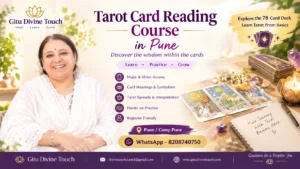
Tarot Card Reading Course in Pune at Gitu Divine Touch, teaching tarot card meanings, Major and Minor Arcana, and tarot spreads
tarot card reading

Tarot Card Reading Course in Pune | Gitu Divine Touch

Tarot Card Reading Course in Pune – Complete Guide for Beginners Have you ever looked at a tarot card and wondered what its pictures, symbols, colours, and numbers mean? Would you like to learn how to interpret tarot cards, understand different card spreads, and conduct a reading with confidence? A Tarot Card Reading Course in Pune can help you develop these skills step by step. Whether you are a complete beginner, a spiritual seeker, or someone who wants to add tarot reading to an existing spiritual practice, structured learning can help you understand the cards and practise their interpretation. At Gitu Divine Touch, Pune, students can explore tarot card reading through a structured learning approach covering card meanings, symbolism, Major and Minor Arcana, tarot spreads, and practical reading techniques. In this guide, you will learn what tarot card reading is, how tarot cards are organised, how to begin reading them, what you can learn in a course, and how to choose tarot training in Pune. What Is Tarot Card Reading? Tarot card reading is a practice in which a reader interprets illustrated cards using their traditional meanings, symbols, positions, and relationships with other cards in a spread. A tarot deck commonly contains 78 cards, divided into two main groups: During a reading, the reader shuffles and selects cards, places them in a particular layout, and interprets their meanings in relation to a question or topic. For example, a person asking about a career change might use a three-card spread representing their current situation, a challenge to consider, and a possible direction. The interpretation is symbolic rather than a guaranteed prediction of what will happen. Tarot reading is commonly used for spiritual exploration, personal reflection, and divination. Its predictive claims are not scientifically established, so readings should not replace practical judgment or qualified professional advice. What Is a Tarot Card Reading Course? A tarot card reading course is a structured learning programme that teaches students how to understand tarot cards and interpret them in a reading. Instead of trying to memorise all 78 cards at once, students can learn the deck in manageable stages. They begin with the structure of the cards, learn their symbolism, practise simple spreads, and gradually explore combinations of cards. A comprehensive beginner course may cover: The exact syllabus, teaching format, schedule, and course inclusions can vary. Contact Gitu Divine Touch to confirm the current batch details before enrolling. History and Background of Tarot Cards Tarot cards have a fascinating history. Although they are now widely associated with divination, the earliest tarot decks appeared in Renaissance Italy during the fifteenth century and were used for card games. Their association with fortune-telling developed later, particularly from the eighteenth century onward. The Victoria and Albert Museum provides a helpful overview of this history. <Cite refs={[“turn339147search0″,”turn339147search5”]} /> Modern tarot decks use illustrated scenes and symbols to represent themes such as choice, change, hope, responsibility, relationships, and personal challenges. Different decks may interpret these themes through different artistic styles and traditions. Understanding this background helps students distinguish the historical development of tarot from the spiritual interpretations that developed around it. Understanding the 78 Tarot Cards 1. Major Arcana: 22 Cards The Major Arcana includes cards such as The Fool, The Magician, The High Priestess, The Empress, The Emperor, The Lovers, The Chariot, Strength, The Hermit, Wheel of Fortune, Death, The Tower, The Star, The Moon, The Sun, Judgement, and The World. These cards are often interpreted as representing significant themes, transitions, choices, or stages of experience. For example: Card meanings are not fixed predictions. The question, position, surrounding cards, deck tradition, and reader’s approach all affect the interpretation. 2. Minor Arcana: 56 Cards The Minor Arcana explores everyday situations, feelings, decisions, actions, and practical experiences. It contains four suits, each with 14 cards. Suit Common symbolic themes Wands Energy, creativity, ambition, action Cups Feelings, relationships, emotional experiences Swords Thoughts, communication, decisions, conflict Pentacles Practical matters, work, resources, material life Each suit usually includes Ace through Ten, along with four court cards: Page, Knight, Queen, and King. Example: If a question concerns starting a new project, a Wands card might be interpreted through themes of enthusiasm or action. A Pentacles card might bring attention to planning, resources, or practical steps. These are common interpretive associations; meanings vary by deck and reading context. How Does Tarot Card Reading Work? Tarot readers follow different traditions, but a basic reading often involves five steps. Step 1: Choose a Clear Question Decide what you want to explore. Open-ended questions often allow more thoughtful interpretation than questions that demand an absolute yes-or-no prediction. Instead of asking, “Will I definitely get the job?”, you could ask, “What should I consider as I prepare for this career opportunity?” Step 2: Shuffle the Cards Many readers shuffle the deck while focusing on the question. Some invite the person receiving the reading to shuffle or select cards. There is no single scientifically established method that proves one shuffling technique is more accurate than another. Follow the method taught in your chosen tarot tradition. Step 3: Select a Tarot Spread A spread is the arrangement of cards used for a reading. Each position has a purpose. Beginners can start with a one-card reading or a simple three-card spread before moving to larger layouts. Step 4: Interpret Each Card Look at the card’s imagery, traditional meaning, suit, number, and position in the spread. Consider how the card relates to the question. Step 5: Interpret the Cards Together A reading is not simply a list of separate meanings. The reader considers how the cards relate to each other and to the question. Present interpretations as possibilities for reflection, not as unquestionable facts or guaranteed future events. Common Tarot Card Spreads for Beginners One-Card Spread Draw one card to reflect on a topic, intention, or daily theme. Example: You draw The Hermit when reflecting on how to approach a busy week. You might use it as a prompt to make time for quiet thinking

Tarot Card Reading Course in Pune | Gitu Divine Touch Read Post »
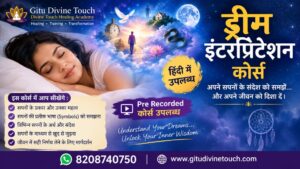
Dream Interpretation Course at Gitu Divine Touch, teaching dream symbols, dream analysis, recurring dreams and understanding dream meanings.
Dream interpretations

Dream Interpretation Course:Learn to Understand Dreams, Symbols & Hidden Meanings

Have you ever woken up from a dream and immediately wondered, “What did that dream mean?” Perhaps you dreamed about someone you haven’t spoken to for years. Maybe you were flying, falling, running away from something, entering an unknown house, seeing water, animals, snakes, a temple or a deceased person. Sometimes a dream feels so real that its emotional effect stays with you long after you wake up. That curiosity is one of the reasons people choose to learn dream interpretation. Dreams have fascinated people for centuries, but understanding them requires more than opening a dream dictionary and searching for one symbol. The same image can mean something completely different to two people depending on their experiences, emotions, memories and circumstances. A good dream interpretation course teaches you how to look at the complete dream rather than one isolated symbol. At Gitu Divine Touch, the Dream Interpretation Course is designed for students who want to understand dreams in a simple, practical and structured way. The course is available as a pre-recorded course, making it convenient for students who want to learn at their own pace. Dream interpretation can become an interesting skill for personal reflection, spiritual learning, journaling and understanding recurring dream patterns. The important thing is to learn how to interpret thoughtfully rather than assuming every dream is a prediction. What Is a Dream Interpretation Course? A dream interpretation course teaches you methods for observing, recording and interpreting dreams. Dream interpretation is not simply memorising a list such as: Those associations can sometimes be useful starting points, but they are not universal rules. For example, imagine two people dream about a snake. One person has always been afraid of snakes. Another person grew up around snakes and considers them fascinating. A third person may associate snakes with spiritual symbolism. The same dream image could therefore have very different personal associations. This is why proper dream analysis looks at the dreamer’s circumstances, emotions, relationships, memories, symbols and the complete dream story. The American Psychological Association defines dream analysis as a technique in which dream content is interpreted for possible underlying motivations, symbolic meanings and representations. At the same time, modern sleep research makes an important distinction: researchers still do not have a universally accepted scientific explanation for why we dream or a scientifically proven dictionary that assigns one fixed meaning to each dream symbol. That distinction actually makes learning dream interpretation more interesting. Instead of asking: “What does this symbol always mean?” you learn to ask: “What could this symbol represent in this person’s dream and life context?” That is a much more useful approach. Why Are People So Interested in Dream Interpretation? Dreams are personal. They can bring up memories, emotions and situations that we may not consciously think about during the day. The Sleep Foundation notes that dreams are normal experiences during sleep and are particularly vivid during REM sleep. It also notes that researchers continue to debate why we dream and whether dreams have a specific purpose. This uncertainty has not reduced people’s curiosity. If anything, it has made people more interested. People commonly want to understand dreams involving: Some people want to understand a single unusual dream. Others notice the same type of dream repeatedly. Some keep a dream journal and eventually realise that certain themes appear during particular emotional periods. A dream interpretation course gives you a framework for studying those patterns instead of simply searching randomly on the internet every morning. What Makes a Dream Interpretation Course Special? The most valuable part of learning dream interpretation is developing a method. You learn to slow down and examine the dream carefully. 1. Understanding the complete dream A dream is a story, not merely a collection of symbols. Suppose someone dreams: “I am standing in an old house. The house is dark. I hear someone calling my name, but I cannot find the person.” A beginner might immediately search: Old house dream meaning But a trained student asks additional questions: These questions can completely change the interpretation. 2. Learning dream symbols Symbols are an important part of dream interpretation. You may study traditional and commonly reported associations involving: But symbols should be interpreted in context. For example, water can appear as a calm lake, a swimming pool, heavy rain, a flood, a river or the ocean. The emotional experience of the dream can be completely different in each case. Dream Interpretation Course: Learn Beyond the Dream Dictionary This is one of the biggest reasons to consider structured training. A dream dictionary gives you information. A course teaches you how to think about the information. Imagine someone tells you: “I dreamed that I was falling from a building.” A simple dream dictionary might associate falling with fear or loss of control. But a proper dream analysis asks: What was happening before the fall? Was the person: Each detail matters. The dreamer’s waking circumstances matter too. Perhaps they have recently changed jobs. Perhaps they are beginning a new relationship. Perhaps they are worried about an important decision. Perhaps they simply watched a film involving heights before sleeping. There is no responsible reason to assume that one interpretation automatically applies to everyone. Why a Dream Interpretation Course Online Can Be Convenient A dream interpretation course online can be particularly useful because dream learning often benefits from personal observation and regular practice. An online course allows you to study from your own space. This can be valuable if you have: With a pre-recorded course, you can also revisit lessons when you want to refresh a concept. You can pause. Take notes. Record your own dreams. Return to a lesson. Then practise again. That flexibility is one of the strongest reasons many students prefer online learning. Why Choose a Dream Interpretation Course in Hindi? Not everyone wants to learn a spiritual or symbolic subject in complicated English terminology. For many students, understanding the subject in Hindi makes the concepts much easier to absorb. A Dream Interpretation Course in Hindi can

Dream Interpretation Course:Learn to Understand Dreams, Symbols & Hidden Meanings Read Post »

Ut elit tellus, luctus nec ullamcorper mattis, pulvinar dapibus leo.

Work Hours

Oh to talking improve produce in limited offices fifteen an. Wicket branch to answer do we.

© 2026 All right reserved – Gitu Divine Touch Healing Academy | Designed by PREPelite.IN