

personal growth

Inner Child Healing concept showing an adult reflecting compassionately on childhood emotions.
Energy Healing

Inner Child Healing Course

Inner Child Healing is a gentle self-reflection practice that helps people understand childhood experiences, emotional patterns, unmet needs, and beliefs that may continue to influence their adult lives. At Gitu Divine Touch, Pune, this topic can be explored through guided reflection, meditation, affirmations, and practical self-awareness exercises. This guide explains the meaning of Inner Child Healing, its potential benefits, beginner-friendly techniques, daily practices, and how to learn through a structured course. Explore Inner Child Healing, its benefits, simple techniques and meditation practices. Discover inner child healing training at Gitu Divine Touch, Pune. Inner Child Healing – Complete Guide for Beginners Introduction: What is Inner Child Healing? Have you ever felt unusually hurt when someone criticised you? Do you sometimes fear rejection, struggle to say no, feel that you are not good enough, or worry excessively about disappointing others? Sometimes, our reactions in adult life are influenced by earlier experiences. These may include feeling unheard, being compared with siblings, experiencing harsh criticism, facing family conflict, or not receiving the reassurance we needed as children. Inner Child Healing is a self-reflection approach that helps us recognise and respond compassionately to these emotional patterns. The term inner child is a metaphor for the childhood experiences, feelings, needs, memories and beliefs that may remain meaningful to us as adults. The purpose is not to blame parents or relive every painful memory. It is to understand ourselves better, develop healthier responses, and learn to offer ourselves the care, safety and encouragement we may need today. Inner Child Healing can be explored through journaling, visualisation, mindfulness, affirmations and, when appropriate, professional therapeutic support. In this article, you will learn: 1. What is Inner Child Healing? Inner Child Healing is a process of understanding the younger parts of ourselves and responding to their emotional needs with greater compassion. In everyday language, imagine that the younger version of you still carries memories of times when you felt frightened, lonely, ignored, misunderstood or not accepted. As an adult, you may notice similar feelings when situations remind you of those experiences. Inner Child Healing invites you to pause and ask: These questions can help you move from automatic reactions towards greater self-awareness. A simple example Imagine that a manager says, “Please improve this report.” One employee considers the feedback and makes the changes. Another feels deeply ashamed and thinks, “I am useless. Everyone will reject me.” The second person may have learned earlier in life to associate mistakes with criticism, punishment or loss of approval. This is only one possible explanation; the reaction could have other causes too. Inner Child Healing encourages the person to separate the present situation from old beliefs. A more balanced response might be: “I have received feedback about one piece of work. This does not define my worth. I can learn and improve.” The goal is not to eliminate every uncomfortable emotion. It is to respond with greater understanding and flexibility. 2. Inner Child Healing meaning: Understanding the inner child The inner child is not a separate person living inside your body. It is a psychological and reflective metaphor used in some therapeutic and personal development approaches. It can represent: Your inner child is not necessarily associated only with painful experiences. It may also represent the joyful, imaginative and playful parts of your personality. The different experiences we may carry The unheard child A person who often felt that their opinions did not matter may find it difficult to express needs or speak up in adult relationships. The perfectionist child Someone who received approval mainly for achievements may become afraid of making mistakes or disappointing others. The playful child This represents curiosity, imagination, humour and the ability to enjoy simple activities without constantly judging oneself. These are illustrative patterns, not diagnoses. Different people have different histories, and the same childhood experience can affect people in different ways. 3. Why do childhood experiences matter in adult life? Childhood is an important period for learning about relationships, emotions, boundaries and self-worth. Experiences with caregivers, teachers, family members and peers can influence how a person understands themselves and others. However, childhood does not determine your entire future. People continue to learn, develop supportive relationships and change their responses throughout life. Some patterns worth exploring include: Fear of rejection: You may feel anxious when someone takes longer than usual to reply to a message. People-pleasing: You may agree to requests even when you are exhausted because saying no feels uncomfortable. Harsh self-criticism: You may speak to yourself more cruelly than you would ever speak to a friend. Difficulty trusting others: You may expect people to disappoint you, even when there is little evidence that they will. Difficulty accepting appreciation: Compliments may make you uncomfortable because you have trouble believing positive things about yourself. Fear of mistakes: A small error may feel like proof that you are not capable. These patterns can have many causes. Inner Child Healing offers one way to explore them without assuming that every difficulty originates in childhood. Example: The fear of saying no Suppose a woman grew up believing that a good daughter should never disagree with family members. As an adult, she may accept every family request, even when it interferes with her own needs. She may then feel frustrated or resentful. An inner child reflection could help her recognise the belief: “If I disagree, people will stop loving me.” She can begin replacing it with a more balanced understanding: “I can care about my family and still have reasonable boundaries. Disagreement does not automatically mean rejection.” She can practise saying no respectfully, starting with small, manageable situations. This is a practical example of self-awareness and behaviour change, not a promise that one exercise will resolve a long-standing pattern. 4. What are the main principles of Inner Child Healing? Inner Child Healing can be approached through several practical principles. 4.1 Awareness before change You cannot change a pattern easily if you do not recognise it. Start by noticing your feelings, thoughts and reactions

Inner Child Healing Course Read Post »
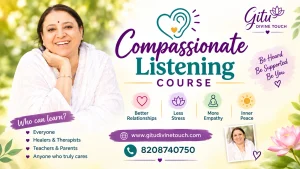
Compassionate Listening techniques for empathetic communication and better relationships at Gitu Divine Touch
Compassioante listening, Personal Development & Communication

Compassionate Listening – Meaning, Benefits, Techniques and Course in Pune

Compassionate Listening – Meaning, Benefits, Techniques and Course in Pune Have you ever shared a problem with someone and felt that they were listening only to reply, judge, or offer advice? Or have you ever wanted to help someone but struggled to understand what they were really feeling? These situations show why Compassionate Listening is an important life skill. In our busy lives, conversations often become rushed. We may interrupt others, make assumptions, compare their experiences with our own, or immediately suggest solutions. Although we may have good intentions, the other person may feel unheard or misunderstood. Compassionate Listening teaches us to give another person our attention, understand their feelings, and respond with kindness instead of judgment. This skill can be useful in personal relationships, family life, teaching, counselling, coaching, healing sessions and everyday communication. At Gitu Divine Touch in Pune, the Compassionate Listening Course focuses on practical learning through listening exercises, emotional awareness and real-life examples. The aim is to help students develop more thoughtful communication and healthier human connections. In this guide, you will learn the meaning of compassionate listening, its principles, benefits, practical techniques, common mistakes and ways to develop this skill. What Is Compassionate Listening? Compassionate Listening is the practice of listening to another person with attention, empathy, patience and an open mind. It involves trying to understand what someone is expressing without immediately judging, interrupting, criticizing or taking control of the conversation. It does not mean agreeing with everything a person says. It means respecting their experience and allowing them to express themselves while maintaining your own boundaries. For example, if a friend says, “I feel that nobody understands me,” you might immediately reply, “You should stop thinking negatively.” A compassionate listener may instead say, “It sounds like you have been feeling very alone. Would you like to tell me what has been happening?” The second response gives the person an opportunity to share more. Compassionate Listening is not about having the perfect answer. It is about being genuinely present and trying to understand before responding. What Is the Meaning of Compassionate Listening? The meaning of compassionate listening becomes clearer when we understand its two parts. Compassion means recognizing another person’s difficulties or feelings and responding with care. Listening means giving attention to what another person communicates through words, tone, pauses and expressions. Together, compassionate listening means listening with the intention to understand rather than simply waiting for your turn to speak. It includes three important attitudes: A compassionate listener does not need to solve every problem. Sometimes, allowing someone to speak freely is already a meaningful form of support. Why Is Compassionate Listening Important? Communication is not only about exchanging information. It also helps people feel understood, respected and connected. When someone is experiencing stress, disappointment, confusion or sadness, they may not need immediate advice. They may first need a safe opportunity to express what they are experiencing. Compassionate listening can help create that opportunity. It is particularly useful when: Listening with compassion can improve the quality of conversations, although it cannot guarantee that every disagreement will be resolved. The Difference Between Hearing, Active Listening and Compassionate Listening Type Meaning Example Hearing Receiving sounds without necessarily paying attention Hearing someone speak while scrolling on your phone Active listening Paying attention and checking your understanding Summarizing what the person has said Compassionate listening Listening actively while approaching the person’s experience with empathy and non-judgment Acknowledging the person’s feelings and allowing them time to share These approaches can overlap. Compassionate listening builds on careful attention and understanding, while placing particular emphasis on empathy, respect and emotional sensitivity. The Main Principles of Compassionate Listening 1. Be Fully Present When someone speaks to you, try to give them your attention. Put aside distractions, maintain comfortable eye contact when appropriate, and avoid planning your response while the other person is still speaking. Being present communicates that the conversation matters. 2. Listen Without Immediate Judgment People have different experiences, values, fears and ways of expressing themselves. Instead of immediately deciding whether someone is right or wrong, try to understand why the situation feels important to them. Non-judgmental listening does not mean abandoning your own values. It means delaying unnecessary criticism so you can understand the situation more clearly. 3. Understand Feelings, Not Only Words Sometimes, the emotion behind a statement is more important than the statement itself. For example, “You never have time for me” may express disappointment, loneliness or a desire for connection. Rather than arguing about the word “never,” you could ask, “Have you been feeling that we are not spending enough time together?” This creates space for clarification. 4. Allow Silence Silence is not always uncomfortable or unproductive. A person may need time to understand their own feelings or find the right words. Resist the temptation to fill every pause with advice or another question. Give the speaker enough time to continue when they are ready. 5. Avoid Unsolicited Advice When someone shares a problem, we may instinctively suggest a solution. However, advice offered too quickly can make the person feel that their emotions have been overlooked. Instead, ask, “Would you like me to listen, or would you like help thinking about possible solutions?” This simple question respects the person’s needs. 6. Respect Boundaries Compassion does not require you to tolerate disrespect, accept harmful behaviour or become responsible for another person’s emotions. You can listen with kindness while setting appropriate boundaries. For example: “I want to understand your concerns, but I would like us to speak without shouting.” Benefits of Compassionate Listening Compassionate listening may support personal growth and more constructive communication. The results depend on the people, situation and consistency of practice. 1. Better Personal Relationships When people feel heard, conversations can become more open and respectful. Compassionate listening can help family members, friends and partners understand each other’s concerns more clearly. Example: Instead of interrupting your partner during an argument, you allow them to explain their concern and then summarize what you understood before

Compassionate Listening – Meaning, Benefits, Techniques and Course in Pune Read Post »

Cord Cutting Course online by Gitu Divine Touch Healing Academy with Gitu Mirpuri
CORD CUTTING COURSE, Energy Healing

Cord Cutting Course Online | Learn Energy Cord Cutting

Cord Cutting Course: Learn Spiritual Cord Cutting Online for Emotional Release Have you ever felt emotionally connected to a person, relationship, memory, or situation long after you wanted to move forward? Sometimes a relationship ends, but the emotional attachment seems to remain. You may keep thinking about someone, replaying old conversations, feeling drained after certain interactions, or finding it difficult to create a sense of inner distance. This is one reason many people become interested in a cord cutting course. Cord cutting is a spiritual and energy-healing practice traditionally used by practitioners as a symbolic way of releasing unwanted energetic or emotional attachments. It is not about harming another person, erasing memories, or forcing somebody to leave your life. Instead, the practice focuses on your own sense of boundaries, emotional release, awareness, and moving forward. A properly structured course can help students understand the concept of energetic cords, learn preparation and grounding practices, and develop a consistent personal spiritual routine. For someone looking for flexibility, a cord cutting course online can be particularly convenient. You can learn from home, revisit lessons, practise privately, and progress according to your own schedule. If you have been searching for a practical spiritual course that focuses on letting go and creating healthier energetic boundaries, learning cord cutting may be worth exploring. What Makes a Cord Cutting Course Special? The appeal of cord cutting is often very personal. Imagine someone who has spent months trying to move beyond a difficult relationship. Logically, they know the relationship has ended. Yet certain memories continue returning. A particular place, photograph, conversation, or even a person’s name can trigger a strong emotional reaction. Spiritual practices can provide a structured ritual for acknowledging those feelings and consciously choosing to release attachment. A good cord cutting course should not simply teach a ritual and send students away. It should explain the ideas behind the practice and help students understand when and how to use it responsibly. What you may learn in a structured course Depending on the school’s methodology, training may cover: The exact techniques differ between spiritual traditions and teachers. Therefore, prospective students should always ask what the course actually teaches rather than choosing a course solely because the words “cord cutting” appear in its title. Is cord cutting about another person? This is an important question. A responsible spiritual approach focuses primarily on your own energy, emotions, attachments and boundaries. It should not be presented as a technique for controlling another person’s thoughts, decisions, behaviour, relationships or free will. For example, if you have experienced a difficult breakup, the intention may be: “I choose to release unhealthy attachment and reclaim my emotional space.” That is very different from an intention such as trying to force another person to return, disappear, suffer, or behave in a particular way. This distinction matters when selecting a course. Why Many People Prefer to Buy a Cord Cutting Course Online One of the biggest advantages of online spiritual education is flexibility. A classroom course requires you to be available at a particular place and time. An online programme can give you the opportunity to study from your home. A cord cutting course online may be especially useful for students who live outside Pune or who cannot regularly attend an in-person class. Learn at your own pace Pre-recorded lessons can be paused, replayed and reviewed. This is valuable when learning meditation, visualisation or energy-healing techniques because students may want to repeat a particular section several times before practising independently. Study from home You don’t necessarily need to travel to a healing centre for every lesson. You can create a quiet corner at home and develop your own practice routine. More flexibility for working students People with jobs, family responsibilities or irregular schedules can often fit online learning around their existing commitments. Easy access to course materials Depending on the programme, students may receive: Always check exactly what is included before purchasing. You can revisit the training This is one of the strongest reasons to consider a pre-recorded course. Instead of relying on memory after a single workshop, students can return to the lessons whenever they need a refresher. Where to Buy the Best Cord Cutting Course Online When searching for a cord cutting course online, don’t choose solely because a course appears first in a search result. Look at the teacher, syllabus, teaching format, student support and course accessibility. For a spiritual training programme, the credibility and teaching approach of the practitioner are particularly important. Look for an established teacher or academy Check: Consider the official course platform If a teacher provides the course through an established learning platform such as Graphy, students may have a more organised learning experience than receiving random videos through messaging applications. For a pre-recorded course, check whether you receive a personal login, how long you have access to the course, and whether you can watch lessons on mobile and desktop devices. Ask questions before purchasing A trustworthy course provider should be comfortable answering questions such as: These questions can prevent disappointment after purchase. How to Choose the Right Cord Cutting Course Not every course will suit every student. Someone who has never studied energy healing may need more foundational guidance than an experienced Reiki or spiritual practitioner. Before buying, look beyond attractive promotional claims. 1. Check the syllabus A detailed syllabus is a positive sign because you know what you are purchasing. Look for clear modules rather than vague promises. A useful course may cover: 2. Check whether beginners are welcome If you are completely new to energy healing, choose a programme that explains terminology rather than assuming you already understand chakras, aura, energy fields or meditation. 3. Consider the teacher’s experience Experience does not automatically guarantee that a particular teaching style will suit you, but it is useful information when making your decision. Read the teacher’s biography and look for details about their training and teaching background. 4. Understand what “certification” means Some spiritual courses provide certificates

Cord Cutting Course Online | Learn Energy Cord Cutting Read Post »

Ut elit tellus, luctus nec ullamcorper mattis, pulvinar dapibus leo.

Work Hours

Oh to talking improve produce in limited offices fifteen an. Wicket branch to answer do we.

© 2026 All right reserved – Gitu Divine Touch Healing Academy | Designed by PREPelite.IN