Kundali Analysis

Learn Horary Astrology and Vedic Prashna Kundali with Gitu Divine Touch. Explore question-based astrology, the twelve houses, planetary lords and traditional Prashna chart interpretation. Contact us to enquire about course details.
Astrology

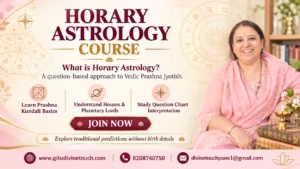
Horary Astrology course

1. What is Horary Astrology? Horary Astrology is a branch of astrology that interprets a chart created for the time a particular question is asked or accepted for analysis, according to the astrologer’s chosen tradition. In Vedic astrology, this method is commonly called Prashna Kundali or Prashna Jyotish. The word Prashna means “question” in Sanskrit. Kundali refers to a horoscope or astrological chart. Together, Prashna Kundali means a horoscope used for analysing a question. A birth chart represents the planetary positions at a person’s birth. A Prashna chart, by contrast, represents planetary positions at a relevant question time. A simple example Suppose a person asks: “I have attended a job interview. Will I receive an offer?” A Prashna astrologer may cast a chart for the relevant question time and examine traditional indicators associated with: The astrologer then interprets these factors within the chosen school of astrology. This process is different from simply giving a yes-or-no answer based on one planet. A careful traditional analysis considers the whole question chart, its context and the limitations of the method. Important: Astrology is a traditional belief system, and its predictive accuracy has not been established as a reliable scientific method. Major decisions about employment, health, finances or relationships should also be based on practical evidence and appropriate professional advice. 2. Prashna Kundali meaning in Vedic astrology Prashna Kundali is a traditional branch of Jyotish that uses a question chart to interpret a specific matter. It is often used by practitioners for questions about: Different lineages use different rules and interpretive methods. Some rely primarily on the twelve houses, planetary lords and aspects. Others incorporate specialised Prashna techniques, additional charts or traditional omens. The purpose of learning Prashna Jyotish is to understand the logic of the chosen tradition, rather than memorising isolated planetary combinations without considering the question. 3. History and background of Prashna Jyotish Prashna Jyotish belongs to the wider tradition of Indian astrology, or Jyotisha. Question-based astrology also has a long history in other astrological traditions, where it is commonly called horary astrology. Within Indian astrology, Prashna methods have been transmitted through classical texts, commentaries, regional practices and teacher-student traditions. One important traditional source is Prashna Marga, a Sanskrit work associated with Kerala’s astrological tradition. Other classical Jyotisha works provide principles relevant to planetary interpretation, houses and astrological judgement. When studying historical sources, it is important to distinguish a text’s traditional claims from modern scientific evidence. Historical influence and cultural importance do not, by themselves, establish the accuracy of predictions. Prashna Jyotish versus Western Horary Astrology Both traditions use a chart associated with a question, but their methods are not identical. Feature Vedic Prashna Jyotish Western Horary Astrology Tradition Indian Jyotisha Western astrological tradition Zodiac Commonly sidereal Commonly tropical Planetary interpretation Often uses Vedic house lords, planetary dignity, aspects and yogas Often emphasises significators, receptions, aspects and traditional horary rules Timing Depends on the particular school and method Depends on the particular school and method Special techniques May include specialised Prashna rules and traditional omens May include horary-specific rules and considerations Relationship to natal astrology Can be used alongside birth chart analysis Can be used alongside natal astrology These are general distinctions. Individual practitioners may use different combinations of techniques. 4. Difference between Prashna Kundali and birth chart astrology One of the most important concepts for beginners is the difference between a natal horoscope and a question horoscope. Janma Kundali — Birth chart Prepared using the person’s birth date, birth time and birthplace. Traditionally interpreted for broad life themes, personality, relationships, education, career and planetary periods. Prashna Kundali — Question chart Prepared for a relevant question time and location according to the practitioner’s method. Traditionally used to examine one specific concern or situation. Does Prashna Kundali require birth details? In many Prashna methods, the person’s birth time and birthplace are not required because the analysis uses the question chart rather than the natal chart. However, the astrologer must establish the relevant question time and location and use a consistent chart calculation method. Some practitioners may also request birth details for additional context or comparison. Prashna astrology should not be confused with a method that needs no time or location information at all. 5. Basic principles of Vedic Horary Astrology A traditional Prashna analysis generally begins with five questions: 5.1 The ascendant or Lagna The ascendant is the zodiac sign rising on the eastern horizon at the chart time and location. In many Prashna methods, the Lagna and its lord represent the person asking the question. The condition of the ascendant lord is therefore an important part of the traditional interpretation. For example, a strong ascendant lord may traditionally be read as indicating greater agency or capacity to deal with a situation. The exact judgement depends on the entire chart and the specific question. 5.2 The twelve houses The twelve houses represent different areas of life in Vedic astrology. The correct house selection depends on what the person is asking. The twelve houses in Prashna analysis House Traditional significations 1st Questioner, self, condition of the querent 2nd Money, possessions, speech, family resources 3rd Communication, effort, siblings, short journeys 4th Home, property, mother, emotional foundations 5th Children, learning, creativity, intelligence 6th Work-related difficulties, disputes, debts, illness 7th Partner, spouse, other party, agreements 8th Hidden matters, obstacles, sudden changes 9th Higher learning, teachers, fortune, long journeys 10th Career, profession, status, actions 11th Gains, fulfilment of aims, networks 12th Expenses, losses, isolation, foreign residence These are broad traditional significations. The same house can have different applications depending on the question and the interpretive school. 5.3 House lords Each zodiac sign is ruled by a planet in the standard Vedic planetary rulership scheme. The planet ruling the sign on a house cusp is called that house’s lord. For example, if Aries is the ascendant, Mars is the ascendant lord. If Libra occupies the seventh house in that chart, Venus is the seventh-house lord. The astrologer examines the relevant house lord’s placement, dignity, associations, aspects and relationship

Horary Astrology course Read Post »

Positive qualities of Manglik people showing Mangal Dosha, Mars energy, courage, confidence, leadership and determination in Vedic astrology.
Astrology

Positve qualities of manglik people

Understanding Mangal Dosha and Kuja Dosha Positive qualities of Manglik people are often overlooked when discussing Mangal Dosha or Kuja Dosha in a birth chart. In traditional Vedic astrology, Manglik people are frequently described mainly in terms of marital challenges, anger, aggression or conflict. However, Mars is also a planet of energy, courage, confidence, determination, initiative, leadership and action. Therefore, understanding the positive qualities of Manglik people is just as important as understanding the challenges traditionally associated with Mangal Dosha. According to traditional Vedic astrology, Mangal Dosha, also known as Kuja Dosha or Bhauma Dosha, is considered when Mars is placed in particular houses of the horoscope, commonly the 1st, 2nd, 4th, 7th, 8th or 12th house depending on the astrological tradition and reference chart being used. Some astrologers specifically assess Mangal Dosha from the Ascendant/Lagna and Moon chart, along with other factors. A person whose horoscope is considered to have Mangal Dosha is commonly called Manglik. However, having Mangal Dosha does not mean that a person is necessarily destined for an unhappy marriage. A complete horoscope analysis considers the 7th house, 7th lord, Venus, Jupiter, Navamsa chart, planetary aspects, conjunctions, strength of Mars, cancellation or balancing factors and the relevant planetary periods. This is where the positive qualities of Manglik people become important. As a senior astrologer, Gitu Mirpuri, founder of Gitu Divine Touch, approaches Mangal Dosha by looking at the complete birth chart rather than judging a person from Mars placement alone. What Is Mangal Dosha or Kuja Dosha? Mangal Dosha is one of the commonly discussed concepts in Vedic astrology. Mars, known as Mangal or Kuja, represents qualities such as: When Mars occupies certain houses, traditional astrology may classify the horoscope as having Mangal Dosha. The interpretation, however, depends on the complete horoscope. This is extremely important because Mangal Dosha should not be interpreted in isolation. A strong Mars can give tremendous drive and determination. The same Mars, if poorly placed or afflicted and not balanced by other factors, may traditionally be associated with impatience, arguments, impulsiveness or relationship tension. Therefore, when discussing the positive qualities of Manglik people, we should understand that the same Martian energy can manifest constructively or destructively depending on how it is expressed. Positive Qualities of Manglik People The positive qualities of Manglik people are closely connected with the characteristics traditionally attributed to Mars. Manglik people are often described as energetic, action-oriented and determined. They may not be comfortable sitting idle for long periods. They usually want to do something, achieve something and move forward. Let us understand the major positive qualities of Manglik people. 1. Strong Willpower One of the important positive qualities of Manglik people is strong willpower. Mars represents determination and the ability to take action. A person with strong Martian energy may continue working toward a goal even when there are obstacles. This quality can be valuable in: The ability to keep moving forward can become one of the greatest positive qualities of Manglik people. 2. Courage and Confidence Another important characteristic among the positive qualities of Manglik people is courage. Manglik individuals are traditionally associated with a willingness to face challenges rather than constantly avoiding difficult situations. They may be prepared to take responsibility and make decisions when others hesitate. This Martian confidence can be particularly useful when a person needs to: Therefore, confidence is one of the important positive qualities of Manglik people that should not be ignored when analysing Mangal Dosha. 3. High Energy Levels Mars is traditionally considered a planet of energy and action. Many astrologers therefore associate Manglik people with a strong internal drive. This energy can be channelled into: This is why one of the major positive qualities of Manglik people can be their ability to remain active and productive. However, excessive energy without proper direction may sometimes manifest as impatience or irritation. The objective is therefore not to suppress Martian energy but to channel it constructively. 4. Fighting Spirit A strong fighting spirit is another important entry in the list of positive qualities of Manglik people. Here, “fighting spirit” does not necessarily mean fighting with other people. It can mean the determination to fight against: A Manglik person may be able to recover from setbacks because of a strong desire to try again. This quality can become extremely useful throughout life. 5. Positive Competitive Spirit Competition is another Mars-related quality. One of the positive qualities of Manglik people can be their desire to improve themselves and achieve higher standards. Healthy competition can encourage a person to: The important distinction is between healthy competition and destructive conflict. When Mars is channelled positively, competitive energy can become a powerful source of achievement. 6. Leadership Ability Leadership is another potential strength associated with strong Mars. Manglik people may naturally prefer taking initiative rather than waiting for someone else to make every decision. This can help in: Leadership is therefore another significant example of the positive qualities of Manglik people. 7. Good Driving and Mechanical Skills Traditional astrology associates Mars with machines, tools, physical activity and technical energy. For this reason, some astrologers associate strong Martian influence with an interest or ability in: These are among the practical positive qualities of Manglik people that may become visible in everyday life. 8. Interest in Sports and Outdoor Activities Mars has a strong association with physical activity. Another important group of positive qualities of Manglik people can therefore be seen in sports and outdoor activities. Manglik individuals may enjoy: A healthy physical routine can be particularly useful for people who experience strong Martian energy. Regular exercise may provide a constructive outlet for excess restlessness and help develop discipline. 9. Martial Arts and Physical Discipline Mars is traditionally connected with warriors, courage and physical strength. This makes martial arts another area frequently associated with the positive qualities of Manglik people. Activities such as martial arts can teach: This demonstrates an important principle in astrology: Strong energy needs direction. When Martian energy is disciplined, it can become a

Positve qualities of manglik people Read Post »

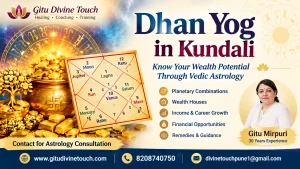
Dhan Yog in Kundali showing planetary combinations, wealth houses and financial prosperity in Vedic astrology.
Astrology, Yogas in astrology

Dhan yog in Kundli

Dhan Yog (Wealth Yoga) in Vedic astrology refers to specific planetary combinations that are believed to bring wealth, prosperity, and financial success to an individual. The presence of Dhan Yog in a horoscope indicates the potential for significant material gains. Here are some key Dhan Yogas and their effects: 1. **Combination of Wealth-Related Houses**: – 2nd House: Represents accumulated wealth, family, and speech. 11th House: Denotes gains, profits, and fulfillment of desires. 5th House: Indicates intelligence, speculative gains, and past life merits. 9th House: Represents luck, fortune, and long-distance travel. 1st House (Ascendant): Represents the self and overall life path. Beneficial combinations and connections between these houses and their lords can create powerful Dhan Yogas. 2. **Specific Dhan Yogas**: -Dhan Yoga: Formed when the lords of the 2nd and 11th houses are in conjunction, mutual aspect, or exchange houses. -Lakshmi Yoga: Occurs when the lord of the 9th house is in its own or exaltation sign and is placed in a Kendra (1st, 4th, 7th, 10th) or Trikona (1st, 5th, 9th) house, and the ascendant lord is strong. – **Chandra-Mangal Yoga**: Created when the Moon and Mars are in conjunction or mutual aspect, indicating potential for wealth through property, real estate, or business ventures. – **Gaja Kesari Yoga**: Formed when Jupiter is in a Kendra from the Moon, signifying wealth, intelligence, and good fortune. – **Parivartan Yoga**: Occurs when two planets exchange signs, such as the lords of the 2nd and 11th houses, enhancing the wealth potential. 3. **Impact of Benefic Planets**: – The presence of benefic planets (Jupiter, Venus, Mercury) in the 2nd and 11th houses, or their aspect on these houses, strengthens the Dhan Yogas. – The influence of the 5th and 9th house lords on the 2nd and 11th houses or their lords also boosts financial prospects. 4. **Raj Yogas**: – Certain Raj Yogas, which confer power and status, also contribute to wealth. These include combinations involving the lords of the Kendra and Trikona houses. 5. **Navamsa Chart Consideration**: – Analyzing the Navamsa (D9) chart for supportive combinations can confirm and enhance the predictions of Dhan Yogas in the main birth chart. ### Example of Dhan Yoga: Suppose an individual’s horoscope shows the following: – The lord of the 2nd house (wealth) is Venus, and it is placed in the 11th house (gains). – The lord of the 11th house is Mercury, and it is placed in the 2nd house. – This mutual exchange (Parivartan Yoga) between the 2nd and 11th houses indicates a strong Dhan Yoga, suggesting significant financial gains and wealth accumulation. ### Important Considerations: – The strength and placement of the involved planets should be analyzed for precise predictions. – The presence of malefic influences (such as Saturn, Mars, Rahu, Ketu) can impact the results of Dhan Yogas. – The overall Dasha (planetary periods) and transits should be favorable to experience the full benefits of Dhan Yogas. Consulting with an experienced astrologer Gitu Mirpuri can provide a detailed analysis of Dhan Yogas in your horoscope and offer personalized insights into your financial potential.

Dhan yog in Kundli Read Post »

Ut elit tellus, luctus nec ullamcorper mattis, pulvinar dapibus leo.

Work Hours

Oh to talking improve produce in limited offices fifteen an. Wicket branch to answer do we.

© 2026 All right reserved – Gitu Divine Touch Healing Academy | Designed by PREPelite.IN