
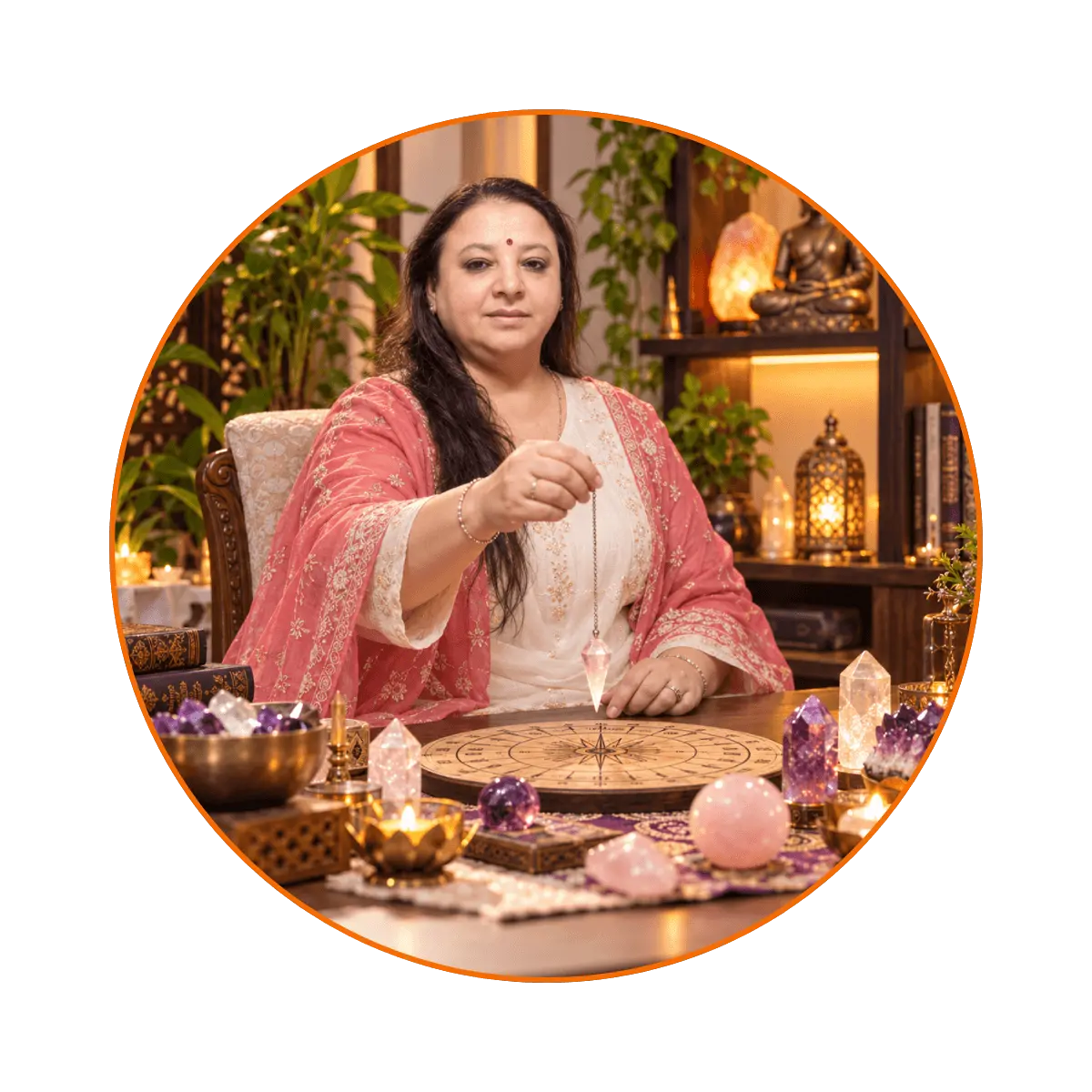
The Dowsing and Pendulum Course is designed for people who want to learn traditional dowsing methods and understand how pendulums are used in spiritual and intuitive practices. The course introduces basic techniques in a simple, organised manner so students can practise each step with greater familiarity.
Dowsing has been used in different traditions for purposes such as finding water, assessing locations and working with intuitive questions. Pendulum dowsing is a related practice where a weighted object suspended from a string or chain is observed for movement and used as a tool for asking questions.
The Dowsing and Pendulum Course can be suitable for beginners as well as people who already work with crystals, Reiki, meditation, Vastu, energy practices or other forms of spiritual study.
The course focuses on learning the method, practising consistently and understanding the limits of pendulum readings.
What Is Pendulum Dowsing?
Pendulum dowsing involves holding a pendulum by its chain or string and observing its movement. Practitioners traditionally assign meanings to different movements, such as yes, no or neutral.
In a Dowsing and Pendulum Course, students may learn how to hold the pendulum correctly, establish their personal movement signals and practise asking simple questions.
The pendulum may swing from side to side, move in a circle or remain relatively still. The interpretation depends on the method being taught and the individual’s chosen system.
Students should not assume that every movement has the same meaning. One of the first steps in learning dowsing is establishing a consistent method for interpreting the pendulum’s movements.
Choosing a Pendulum
A Dowsing and Pendulum Course may introduce students to different types of pendulums. Pendulums can be made from crystal, wood, metal, glass or other materials.
The material itself does not need to determine whether someone can learn dowsing. Many beginners simply choose a pendulum that feels comfortable to hold and is easy to see while moving.
A pendulum should have enough weight to swing freely without being difficult to control. The chain or cord should also be comfortable to hold.
Students who already own a pendulum can generally use their existing tool for practice if it is suitable for the exercises taught.
Preparing for Dowsing
Preparation is an important part of a Dowsing and Pendulum Course. Before beginning a session, students may be taught to sit comfortably, relax their hands and reduce unnecessary distractions.
Some practitioners begin with a few slow breaths or a short meditation. The purpose is to settle attention and create a consistent routine.
A clean table, comfortable chair and quiet room are enough for basic pendulum practice.
Students should also decide what they want to ask before beginning. Clear questions are easier to work with than questions that contain several different subjects at the same time.
Pendulum Calibration
Calibration is one of the basic skills covered in a Dowsing and Pendulum Course.
Before asking questions, the practitioner can hold the pendulum steadily and establish which movement represents “yes,” which represents “no” and which may represent “unclear” or “not ready.”
The exact movements are not universal. For one person, a clockwise circle may mean yes, while another person may use a forward and backward movement.
The important part is consistency within the chosen method.
Students can repeat the calibration process when starting a new practice session, especially when they are still learning.
Asking Clear Questions
Learning to ask useful questions is an important part of the Dowsing and Pendulum Course.
Questions should be simple enough to produce a clear response within the chosen system. Avoid combining several questions into one.
For example, instead of asking a complicated question about several possible outcomes, a student can divide it into smaller questions.
Students should also avoid asking the same question repeatedly until they receive the answer they prefer. This can introduce personal expectations into the process.
The aim of practice is to develop a consistent method rather than force a particular result.
Pendulum Charts
Some forms of dowsing use charts to provide a wider range of responses than simple yes or no movements.
A Dowsing and Pendulum Course may introduce students to charts containing numbers, letters, directions, percentages or other categories.
The pendulum is moved over the chart while the practitioner observes its direction or point of movement.
Charts can be used for practice, study and traditional dowsing exercises. Students should understand that the results are interpretive and should not be treated as objectively verified measurements.
Dowsing for Personal Reflection
A Dowsing and Pendulum Course can be studied as a personal reflection practice. Some people use a pendulum when thinking about habits, routines, preferences or personal intentions.
For example, a person may use a simple question as part of a journaling routine and then write down the pendulum response along with their own thoughts.
This can encourage a person to pause and consider a question from another perspective.
However, the pendulum should not be treated as an authority that makes personal decisions. Important choices should be based on reliable information, practical reasoning and appropriate professional advice.
Dowsing and Meditation
Meditation can be included alongside the Dowsing and Pendulum Course. A few minutes of quiet breathing before practice can help create a consistent setting.
Students may hold the pendulum after meditation and practise simple observation exercises.
The purpose is to develop familiarity with the process rather than to force movement.
Some students may prefer to practise in the morning, while others may find an evening routine more convenient. Regularity is generally more useful than long, irregular sessions.
Dowsing for Objects and Spaces
Traditional dowsing practices have been used for different purposes, including working with objects, locations and spaces.
A Dowsing and Pendulum Course may introduce exercises where students practise with known objects before attempting more complicated applications.
For example, students may compare several objects and observe how they respond within their chosen method.
These exercises should be regarded as traditional dowsing practice. They are not a substitute for professional testing, inspection, surveying or scientific measurement.
Dowsing and Vastu Practice
People interested in Vastu sometimes use pendulums as part of traditional space assessment or energy-related practices.
A Dowsing and Pendulum Course may be useful for students who want to understand pendulum methods before applying them to Vastu-related work.
If a pendulum is used during a property assessment, practical matters such as electrical wiring, plumbing, structural safety, ventilation and building condition should still be assessed through appropriate professional methods.
Pendulum dowsing should not be used as the sole basis for making structural or safety-related decisions.
Developing Better Practice Habits
A Dowsing and Pendulum Course can help students create a regular practice routine.
Keeping a dowsing journal is one useful method. Students can write down the question, date, pendulum response and later outcome.
The purpose of recording results is not to prove that pendulum movement predicts events. Instead, it can help students understand their own habits, expectations and interpretation style.
Students may also learn to recognise situations where they are too emotionally involved to conduct a useful session.
Ethical Use of Pendulum Readings
Responsible practice is an important part of the Dowsing and Pendulum Course.
When practising with another person, obtain permission before conducting a reading. Respect privacy and avoid making statements that could cause unnecessary fear or confusion.
Pendulum readings should not be presented as medical diagnoses, guaranteed predictions or professional assessments.
Do not use a pendulum as a replacement for doctors, lawyers, financial professionals, engineers, surveyors or other qualified experts.
Who Can Take the Course?
The Dowsing and Pendulum Course may be suitable for:
- Beginners interested in pendulum dowsing
- Crystal enthusiasts
- Reiki practitioners
- Meditation students
- Vastu practitioners
- Spiritual learners
- Tarot readers
- People interested in traditional dowsing
- Students exploring intuitive practices
No special ability is required to begin learning the basic techniques. Patience and regular practice are more useful than trying to achieve quick results.
Important Note
Dowsing and pendulum practices are traditional and spiritual methods. There is no established scientific evidence that pendulums can reliably detect hidden information, diagnose health conditions or predict future events.
The Dowsing and Pendulum Course should therefore be viewed as educational material for traditional practice, personal reflection and spiritual study.
It should not replace professional advice or reliable testing when dealing with health, finances, legal matters, property safety, engineering, water quality or other important decisions.
Why Choose Dowsing and Pendulum Course?
The Dowsing and Pendulum Course provides a structured introduction to pendulum practice, including preparation, calibration, questioning, charts, observation and practical exercises.
It can be useful for beginners who want to understand the basics as well as experienced spiritual practitioners who want to add pendulum work to their existing routine.
With regular practice, students can become familiar with holding the pendulum, establishing movement responses and recording their sessions. A careful approach also helps keep expectations realistic.
Whether your interest is personal reflection, traditional dowsing, Vastu-related study or spiritual practice, the Dowsing and Pendulum Course offers a straightforward way to learn the basic techniques and develop a consistent personal practice.


Reviews
There are no reviews yet.