

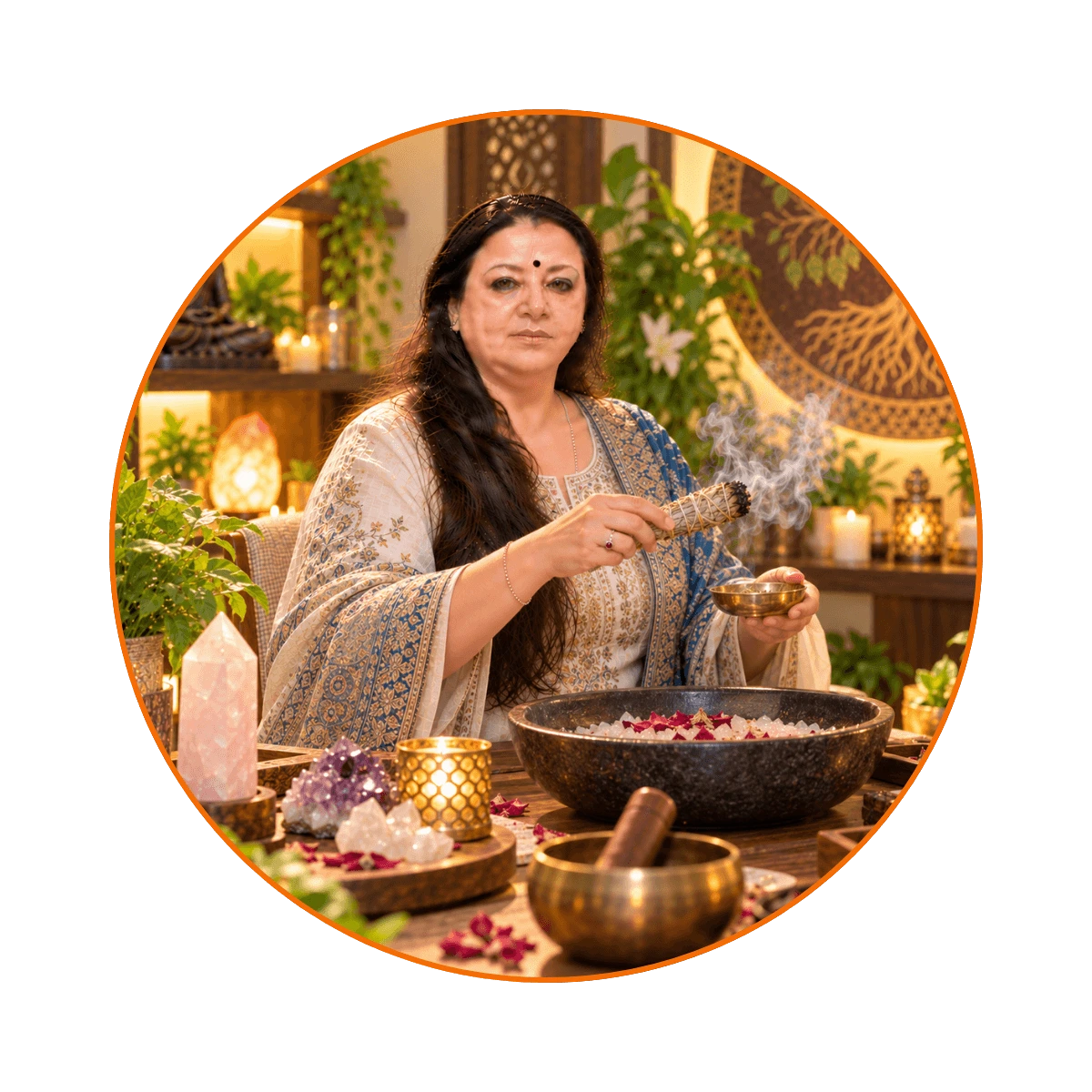
The Karmic Release Course is designed for people interested in karma, spiritual reflection, meditation and traditional practices related to personal patterns and life experiences. The idea of karma appears in several Indian philosophical and religious traditions, although its meaning differs between those traditions.
In modern spiritual practices, karma is sometimes described as a connection between actions, intentions and experiences. Some people use the idea of karmic patterns to reflect on repeated situations, relationships, habits or emotional experiences.
A Karmic Release Course provides a reflective approach to these ideas through meditation, journaling, forgiveness practices, intention setting and personal observation.
The term “karmic release” is used in modern spiritual settings to describe the process of letting go of beliefs, emotional attachments or patterns that a person feels are no longer useful. It should not be understood as a scientifically proven process or as a guaranteed way to change external circumstances.
Understanding Karma
Karma has a long history in Indian philosophical traditions. Its meaning is more complex than simply “what goes around comes around.” Different traditions discuss karma in different ways, including actions, intentions, consequences, ethical responsibility and cycles of experience.
A Karmic Release Course may explore these ideas from a spiritual and personal development perspective.
Students can reflect on their actions, choices and responses without assuming that every difficult event is caused by something they did in the past.
This distinction is important. Not every problem or hardship should be blamed on karma, and karmic beliefs should never be used to blame people for illness, abuse, loss or difficult life circumstances.
What Is Karmic Release?
Karmic release is a modern spiritual term often used for practices intended to help a person let go of old emotional patterns, attachments or beliefs.
A Karmic Release Course can approach this idea through meditation and personal reflection.
For example, a student may reflect on a repeated relationship pattern and ask what they can learn from it. They may then use journaling or meditation to consider what behaviour or belief they would like to change.
The focus is on personal responsibility and present choices rather than trying to prove the existence of a specific energetic or karmic connection.
Karmic Patterns and Repeated Experiences
People sometimes notice repeated themes in their lives. These may involve relationships, communication, work habits, self-confidence or personal boundaries.
A Karmic Release Course can provide a framework for examining these patterns without automatically assuming that they have a supernatural cause.
Students may keep a journal and record recurring situations, emotional reactions and personal responses.
This type of observation can help a person consider what they can change in the present.
Karmic interpretation is a matter of spiritual belief. Psychological, social and practical factors should also be considered when examining repeated experiences.
Meditation for Karmic Reflection
Meditation is commonly used in a Karmic Release Course. A quiet meditation can give students time to reflect on a particular pattern or relationship without immediately reacting to it.
A simple practice may involve comfortable breathing, focusing on the present moment and bringing one situation to mind.
Students can observe their thoughts and feelings without trying to force an answer.
After meditation, journaling can help record observations. The purpose is to create space for reflection rather than produce a guaranteed spiritual result.
Forgiveness Practices
Forgiveness is often discussed in relation to karmic release. A Karmic Release Course may introduce forgiveness as a personal process of reducing attachment to anger, resentment or repeated emotional reactions.
Forgiveness does not mean approving harmful behaviour or allowing someone to continue causing harm.
A person can forgive internally while still maintaining boundaries, limiting contact or taking appropriate practical action.
Students can also explore self-forgiveness. This may involve acknowledging past mistakes, accepting responsibility and deciding what they want to do differently in the future.
Letting Go of Emotional Attachments
Emotional attachments can sometimes remain long after a situation has ended. A Karmic Release Course can use visualization, meditation and journaling to explore these attachments.
Students may imagine releasing a past situation or placing an old concern aside while focusing on the present.
This is a symbolic exercise. It does not mean that a ritual physically removes another person’s influence or changes another person’s behaviour.
The value of the exercise comes from the individual’s intention and personal interpretation.
Karmic Release and Relationships
Relationships are a common subject in karmic spiritual practices. Some people describe difficult or intense relationships as karmic relationships.
A Karmic Release Course can encourage students to examine these ideas carefully.
Instead of assuming that another person is responsible for a karmic connection, students can consider practical questions such as:
- What pattern keeps repeating?
- What boundaries are needed?
- What have I learned from this experience?
- What can I change in my own behaviour?
- What kind of relationship do I want in the future?
This keeps the practice focused on personal awareness and practical choices.
Intention Setting
Intention is an important part of a Karmic Release Course. Students may begin a practice by identifying what they would like to release or understand.
An intention could involve letting go of resentment, changing a repeated habit, accepting the past or developing healthier boundaries.
The wording should be personal and realistic.
An intention does not guarantee an outcome. It serves as a reminder of the direction a person wants to take.
Visualization
Visualization can be used to represent karmic release symbolically. A student may imagine a closed door, a flowing river, a fading connection or another image that represents completion.
A Karmic Release Course can use these images during meditation.
The specific image does not matter as much as the meaning the student gives it.
Some people visualize clearly, while others may experience only thoughts or feelings. Both responses can be part of a personal reflective practice.
Journaling and Self-Observation
Journaling can make a Karmic Release Course practice more practical. Students can write about situations they want to understand, emotional reactions, personal beliefs and decisions they want to make.
A journal may include questions such as:
- What am I holding onto?
- What lesson do I believe I can take from this?
- What responsibility belongs to me?
- What is outside my control?
- What would letting go mean in practical terms?
These questions encourage reflection without requiring a fixed belief about karma.
Karmic Release and Personal Responsibility
A responsible Karmic Release Course should not encourage students to blame themselves or others for difficult circumstances.
Karmic beliefs can be meaningful to some people, but they should not be used to explain away abuse, illness, poverty, grief or other serious difficulties.
Personal responsibility means looking at choices that are actually within one’s control.
It can include apologising when appropriate, changing behaviour, setting boundaries, asking for support and making practical decisions.
Spiritual Rituals
Some people include candles, incense, prayer, crystals, written statements or symbolic objects in karmic release rituals.
A Karmic Release Course may discuss such practices as optional spiritual exercises.
No particular object is required for reflection. A simple meditation or written exercise can be enough.
If candles or incense are used, normal fire safety and ventilation should be followed.
Karmic Release and Daily Life
The ideas explored in a Karmic Release Course can be applied to everyday situations.
When an old emotional reaction appears, a person can pause and ask whether the response belongs entirely to the present situation or whether an older pattern may be influencing it.
This pause can create room for a more thoughtful response.
Practical steps may include changing communication habits, creating boundaries, seeking advice or choosing not to repeat an old behaviour.
Who Can Study a Karmic Release Course?
The Karmic Release Course can be suitable for beginners, meditation practitioners, spiritual learners and people interested in karma and personal reflection.
It may also appeal to students who already practise Reiki, energy work, astrology, chakra meditation or other spiritual traditions.
No particular background is necessarily required unless the course provider has specific requirements.
Students should approach karmic practices according to their own beliefs and remain open to practical explanations for life experiences.
Developing a Personal Practice
A regular Karmic Release Course practice does not need to be complicated. Students can spend a few minutes meditating, writing in a journal or reflecting on one personal pattern.
It can be useful to focus on one issue at a time rather than trying to resolve every concern at once.
Students can also review their notes after several weeks and observe whether their thinking or behaviour has changed.
The aim is personal awareness, not a race to achieve a particular spiritual result.
Important Note
Karmic release is a spiritual and reflective concept. Beliefs about karma, karmic connections and energetic release are not scientifically established.
The Karmic Release Course is intended for spiritual education, meditation and personal reflection. It should not replace medical care, psychological treatment, counselling, legal advice or other professional services.
Karma should never be used to blame people for illness, abuse, loss or other difficult circumstances. Individual experiences should be approached with care, compassion and practical judgment.
Why Choose a Karmic Release Course?
The Karmic Release Course provides a simple way to explore traditional karma concepts through meditation, forgiveness, journaling, visualization and personal reflection.
For beginners, it offers an accessible introduction to karmic ideas without requiring complicated rituals. For people already interested in spiritual practices, it can provide another framework for examining personal patterns and emotional attachments.
The Karmic Release Course keeps attention on present choices. Instead of focusing only on past events, students can consider what they can do differently now.
Practices such as forgiveness, journaling and meditation can provide quiet time to examine thoughts and feelings. Practical boundaries and responsible decisions remain important alongside spiritual reflection.
Whether approached from a traditional spiritual viewpoint or simply as a symbolic method for personal reflection, the Karmic Release Course can be studied at an individual pace.

Reviews
There are no reviews yet.