
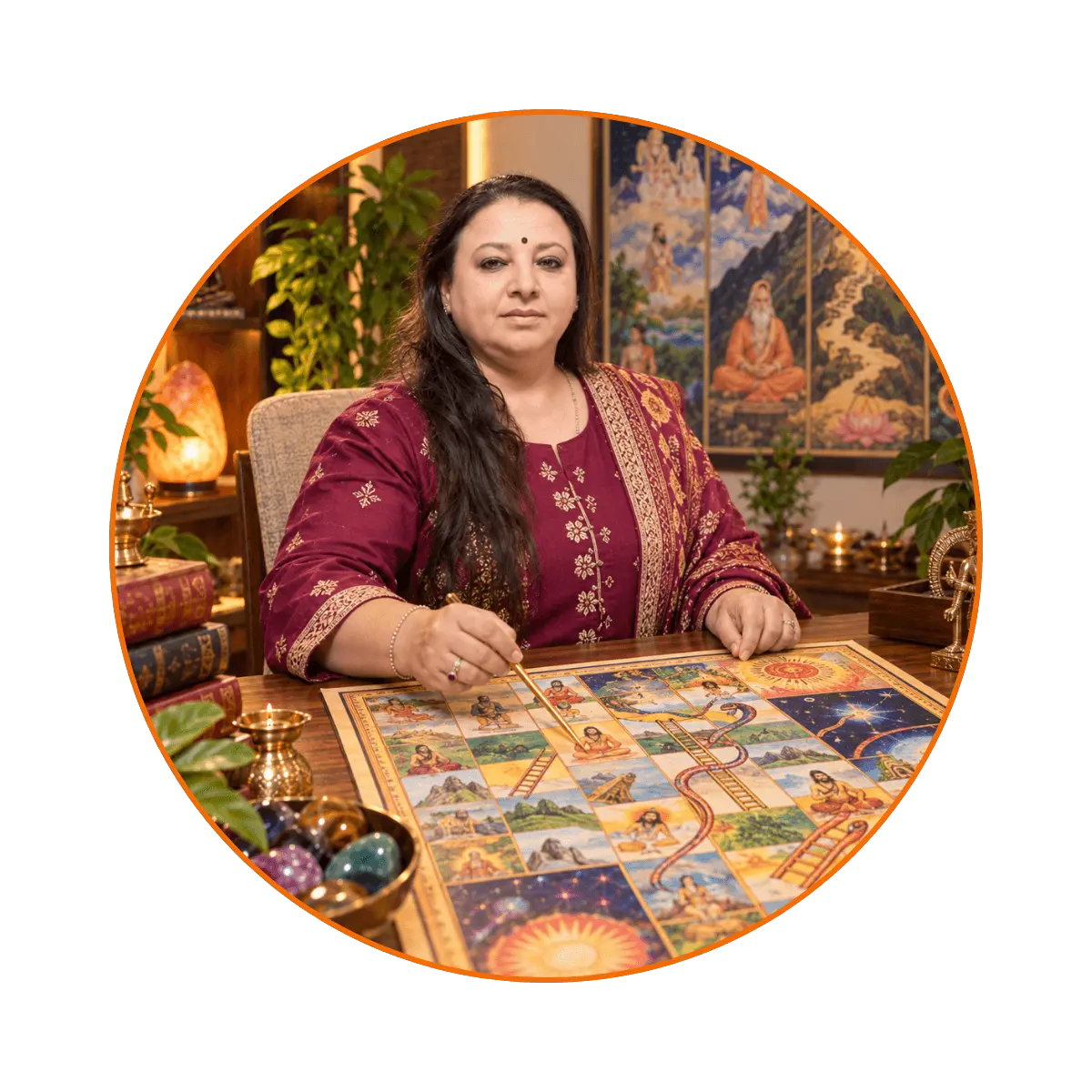
The Moksha Pattam Course introduces students to the traditional Moksha Pattam board, also known in different traditions as Gyan Chaupad, Gyan Chaupar or an early form of the snakes and ladders game. Historical versions of the board have been associated with moral teaching, spiritual ideas and the movement between different states of life.
In modern spiritual practice, Moksha Pattam is also used as a symbolic board for self-reflection and divination. A Moksha Pattam Course can teach students how to understand the meaning of the board, study its houses or boxes, and use traditional reading methods for personal questions.
The course is suitable for beginners as well as people already interested in astrology, numerology, tarot, meditation, chakras or other spiritual practices. Current course offerings commonly describe study of the board, its boxes, snakes and ladders, along with reading methods and practical exercises.
What Is Moksha Pattam?
Moksha Pattam is a traditional board system built around the idea of movement through different stages or states of life. The board uses squares, ladders and snakes as symbols. In historical versions, ladders have been connected with virtues or positive qualities, while snakes have represented actions or qualities that can lead to a downward movement.
A Moksha Pattam Course helps students study this symbolic structure in a more organised manner.
Modern versions of the board can differ in their number of spaces and presentation. Some contemporary courses use a 72-box format and teach each box as a particular state or theme.
Students should therefore follow the particular board and interpretation system provided with their course.
What Students Learn
The exact syllabus of a Moksha Pattam Course depends on the teacher and version of the board. A structured programme may include:
- Introduction to Moksha Pattam
- History and traditional background
- Understanding the board structure
- Study of individual boxes
- Meaning of snakes
- Meaning of ladders
- Symbolic interpretation
- Numerology connected with the board
- Colour associations
- Chakra connections
- Dharma and karma concepts
- Meditation and self-reflection
- Question-based readings
- Dice or finger-pointing methods
- Practical reading exercises
- Reading for self and others
Some contemporary courses specifically teach all 72 boxes, different spreads and practical methods for conducting readings.
Understanding the 72 Boxes
One of the main areas of study in a Moksha Pattam Course is the meaning of the individual boxes.
In contemporary 72-box versions, each position is given a particular name, theme or interpretation. Students may study the boxes one by one so they can understand the ideas connected with each stage.
Rather than trying to memorise everything at once, learners can make notes for each box. Recording the main theme, positive qualities, challenges and related symbols can make revision easier.
When conducting a reading, the box reached through the chosen method is then interpreted according to the system taught by the instructor.
Snakes and Ladders
Snakes and ladders are central features of a Moksha Pattam Course.
The ladder is traditionally associated with upward movement and qualities that support progress. The snake represents a downward movement and is often connected with habits, weaknesses or actions that create obstacles within the symbolic system.
Students can learn to look at these symbols as part of the larger board rather than treating them simply as good or bad signs.
A ladder can be studied as a reminder of a quality that supports progress, while a snake can encourage reflection on a pattern that may need attention.
This approach keeps the board focused on learning and self-observation.
Karma and Dharma Concepts
A Moksha Pattam Course may introduce traditional ideas about karma and dharma because these concepts are closely connected with the symbolic interpretation of the board.
Karma is commonly discussed in Indian philosophical traditions in relation to action and its consequences. Dharma can refer to duty, conduct, responsibility or a way of living according to one’s principles.
Students can study how these ideas are represented through the board’s symbols and stages.
These concepts should be understood within their philosophical and cultural context rather than as scientifically established explanations for individual events.
Chakra Connections
Some modern approaches to Moksha Pattam Course study connect the board with the seven chakra system. Course material may explain how particular sections or states are associated with different chakras.
Students may learn the traditional meanings of the root, sacral, solar plexus, heart, throat, third eye and crown chakras and then study how these ideas are applied to the board.
Chakra associations vary between teachers and systems. Students should follow the specific mapping used in their course rather than assuming that every Moksha Pattam board follows exactly the same system.
Numerology and the Board
Numerology can also be included in a Moksha Pattam Course. Some modern course formats discuss the numbers appearing on the board and give them additional symbolic meanings.
Students may learn how numbers are connected with different boxes, themes or stages.
Numerological interpretation can add another layer to a reading, but students should understand which calculation system their instructor is using.
Different numerology traditions use different rules, so combining methods without understanding them can create confusion.
Meditation and Self-Reflection
A Moksha Pattam Course may include meditation as part of learning the board.
Before a reading, students may sit quietly, focus on their breathing and think about the question they want to explore.
The board can then be used as a symbolic tool for reflection. The student can consider what the selected box represents and how its theme relates to the situation being discussed.
This approach can make the practice more reflective rather than treating the board as an unquestionable source of information.
Learning to Ask Questions
Knowing how to ask a clear question is useful when studying a Moksha Pattam Course.
A focused question gives the reading a clear subject. Students may learn to ask about a particular situation, personal concern or area of life rather than asking a broad question about everything at once.
Contemporary courses may teach different spreads or methods for questions involving areas such as relationships, career, personal growth and spirituality.
The interpretation should be treated as symbolic guidance and personal reflection, not as a guaranteed prediction.
Practical Reading Methods
A Moksha Pattam Course may teach different methods for selecting a box or beginning a reading.
Depending on the course, these can include dice-based methods, finger-pointing methods or specific spreads. Some current course descriptions also mention Yes/No, chakra, time, root-cause and solution-oriented spreads.
Students can practise each method separately before combining them.
A useful practice routine is to write down the question, method used, selected box and interpretation. This creates a record that can be reviewed later.
Reading for Yourself
Self-reading is often a convenient way to begin learning a Moksha Pattam Course.
Students can select a simple question, follow the course method and study the resulting box or sequence.
The purpose is to become familiar with the board and its symbolic language. Students should avoid repeatedly asking the same question until they receive an answer they prefer.
Keeping a balanced approach helps make the practice more useful as a tool for reflection.
Reading for Others
Advanced students may also learn how to conduct a Moksha Pattam reading for another person.
A Moksha Pattam Course can provide a framework for explaining the board, asking for a question and discussing the selected box.
Consent and privacy should always be respected.
The reader should make it clear that the session is based on a traditional symbolic system. It should not be presented as a medical diagnosis, legal opinion, financial prediction or guaranteed statement about another person’s future.
Who Can Take the Course?
The Moksha Pattam Course can be suitable for:
- Beginners interested in Moksha Pattam
- Astrology students
- Numerology learners
- Tarot readers
- Reiki practitioners
- Meditation students
- Spiritual learners
- Life-coaching practitioners
- People interested in traditional Indian board systems
No specific previous knowledge is necessarily required for a beginner-level course. Some current course offerings state that prior astrology or intuition experience is not required.
Practical Study and Revision
Regular practice can make a Moksha Pattam Course easier to understand.
Students can create notes for each box, record the meaning of snakes and ladders, and keep a separate section for numerology and chakra associations.
Working through sample questions can help students remember the reading sequence.
A physical or digital board can also be useful for practice. Some modern courses provide digital boards or reference charts as part of their learning materials, though the exact resources depend on the course provider.
Important Note
Moksha Pattam has historical roots as a teaching board associated with moral and spiritual ideas, while modern versions may be used for divination and personal reflection.
The predictive and spiritual interpretations taught in a Moksha Pattam Course are not scientifically established methods for forecasting future events or diagnosing personal conditions.
The course should therefore be viewed as educational material for traditional study, symbolic interpretation and personal reflection.
It should not replace medical, psychological, legal or financial advice. Important decisions should be made using reliable information and appropriate professional guidance.
Why Choose Moksha Pattam Course?
The Moksha Pattam Course provides a structured way to study the board, its symbols and its traditional interpretation methods.
Students can learn about the 72-box format used by several modern teaching systems, understand snakes and ladders, explore chakra and numerology associations, and practise question-based readings. Thy Healing Circle Been Hug
For beginners, the course can provide a clear starting point. For existing spiritual practitioners, it offers another traditional symbolic system for study.
With regular practice, students can become more familiar with the board and learn to conduct readings in an organised and responsible manner.
Whether your interest is personal self-reflection, traditional Indian spiritual study or learning a symbolic reading system, the Moksha Pattam Course offers a practical way to explore the board and understand the ideas traditionally connected with its snakes, ladders, numbers, chakras and stages of life.
Reviews
There are no reviews yet.