

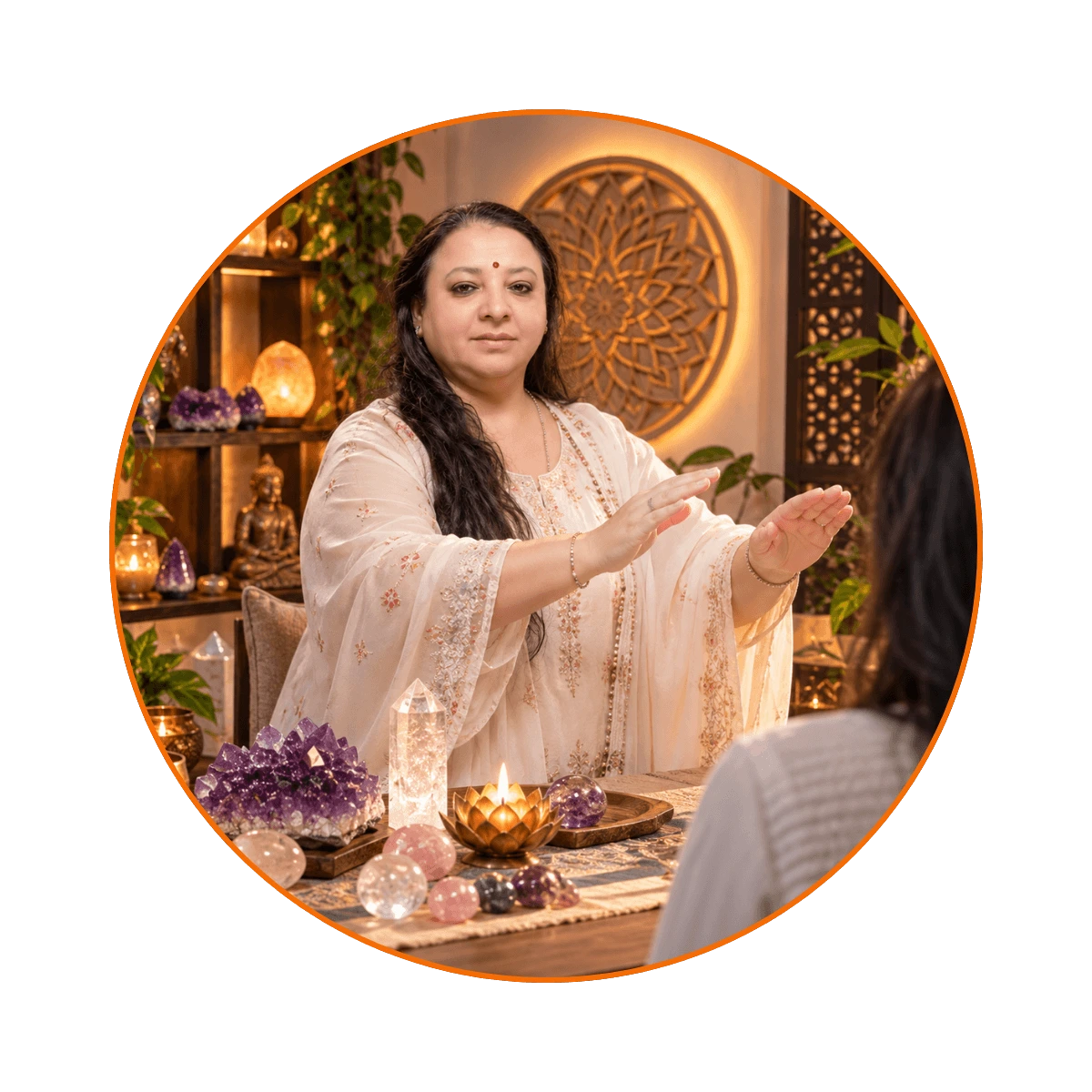
The Aura Scanning Course is designed for people who want to study traditional aura reading methods and develop a structured practice based on observation, meditation and personal awareness.
Aura is described in several spiritual and esoteric traditions as a subtle field believed to surround the human body. Different schools explain aura in different ways, and the methods used to observe or interpret it can vary.
An Aura Scanning Course provides students with a systematic way to learn these traditional concepts instead of depending on random information or personal assumptions. The course may cover preparation, meditation, observation, colour meanings, energy awareness and practical scanning exercises.
The course can be suitable for beginners as well as people who already have an interest in Reiki, meditation, yoga, crystals, chakras or other spiritual practices.
What Is Aura Scanning?
Aura scanning refers to traditional practices in which practitioners attempt to observe or interpret an energy field believed to surround a person. Some traditions associate different aura colours with emotional, mental or spiritual qualities.
An Aura Scanning Course introduces students to these ideas and provides exercises for developing observation and interpretation skills.
Aura scanning can be approached in different ways. Some practitioners describe seeing colours or shapes, while others use intuitive impressions or specialised aura photography equipment. The method taught in a particular course depends on the instructor and course format.
Students should understand that aura interpretation is a spiritual practice and is not scientifically established as a method for measuring a person’s health or emotional condition.
What Students Learn
The exact syllabus of an Aura Scanning Course can differ depending on the teacher and level of training. A structured course may include:
- Introduction to aura concepts
- Traditional energy field theories
- Meditation and preparation
- Developing focused observation
- Understanding aura colours
- Chakra and aura associations
- Practical scanning exercises
- Self aura observation
- Reading practice with another person
- Recording observations
- Understanding personal impressions
- Grounding and closing practices
- Ethical guidelines for aura reading
- Communication with clients or practice partners
The course may include demonstrations, guided exercises, written material or practice sessions depending on how the training is delivered.
Aura Scanning Course for Beginners
The Aura Scanning Course can be suitable for beginners who have little or no previous experience with energy practices.
Students can begin by learning basic meditation and observation exercises. These activities may help them become more comfortable with sitting quietly, maintaining attention and noticing subtle visual or intuitive experiences.
Beginners should not feel pressured to see colours or receive specific impressions immediately. Different people experience meditation and visualisation differently.
Regular practice can help students become familiar with the method taught in the course.
Meditation and Preparation
Meditation is often included in an Aura Scanning Course because a calm and focused state can make observation easier.
Before beginning an exercise, students may be guided to sit comfortably, slow their breathing and reduce distractions. The purpose is to create a consistent setting for practice.
A quiet room with comfortable lighting can be useful for basic aura observation exercises. Students can also keep a notebook nearby to record what they notice during each session.
Preparation methods can vary between teachers. Students should follow the specific process taught in their course rather than mixing several methods without understanding them.
Understanding Aura Colours
Colour interpretation is a common topic in an Aura Scanning Course. Traditional aura practices often associate colours with particular qualities or states.
For example, red may be associated with grounding, physical activity or determination. Orange can be linked with creativity and emotional expression. Yellow is often associated with confidence and mental activity.
Green is commonly connected with the heart, compassion and balance. Blue may be associated with communication and calmness. Indigo is often linked with intuition and inner awareness, while violet or white may be associated with spiritual reflection.
These meanings can differ between traditions. Students should treat colour interpretations as traditional symbolic associations rather than fixed descriptions of a person’s character or health.
Practical Aura Scanning Exercises
A good Aura Scanning Course should provide opportunities for practical learning. Students may practise observing themselves first before working with another person.
Exercises may involve sitting quietly against a simple background and observing the area around the body. Depending on the method, the student may use soft focus, meditation or visualisation.
It is useful to record observations immediately after each exercise. Over time, students can compare their notes and see how their own perception changes under different conditions.
The goal is to learn the method carefully rather than trying to produce a particular colour or result.
Self Aura Practice
Self practice is an important part of an Aura Scanning Course. Students can learn to observe their own experiences before attempting to interpret someone else’s aura.
A simple session may include meditation, focused breathing, observation and journaling. The student can record colours, sensations, images or thoughts that arise during the practice.
These experiences are subjective. A student should avoid assuming that every visual effect or sensation has a fixed spiritual meaning.
Regular self practice can help students understand their own responses and become more familiar with the techniques taught during the course.
Practising With Others
Depending on the course level, an Aura Scanning Course may teach students how to practise with another person.
Consent should always be obtained before conducting an aura reading. The person participating should understand that the session is a spiritual or intuitive practice rather than a medical examination.
Students should communicate observations carefully and avoid presenting interpretations as proven facts.
For example, an aura reader should not claim that a particular colour proves that someone has a disease, psychological condition or other health problem.
Respectful communication and personal boundaries are important parts of responsible practice.
Aura Scanning and Chakras
Many aura traditions are connected with the chakra system. An Aura Scanning Course may introduce students to the relationship traditionally described between aura colours and the seven main chakras.
The root, sacral, solar plexus, heart, throat, third eye and crown chakras are commonly associated with different colours and symbolic qualities.
Students may learn to consider these associations while practising aura observation. However, chakra and aura interpretations vary between spiritual traditions, so the course material should be followed according to the teaching method being used.
Aura Scanning Course for Reiki and Energy Practitioners
People who already practise Reiki, meditation or other energy-based traditions may find an Aura Scanning Course useful for learning another spiritual practice.
Previous experience may make concepts such as meditation, focused attention and energy awareness easier to understand. However, aura scanning has its own terminology and methods.
Students should learn the specific techniques taught in the course rather than assuming that knowledge from another practice automatically applies.
The course can be studied as a separate skill and incorporated into a personal spiritual routine if it fits the student’s interests.
Developing Observation Skills
An Aura Scanning Course can encourage careful observation. Students can learn to separate what they actually notice from what they assume it means.
This distinction is important. For example, seeing a colour is one observation, while deciding that the colour represents a particular emotion is an interpretation.
Keeping these two steps separate can help students become more thoughtful practitioners.
Writing down observations before discussing their meaning can also reduce the chance of changing the original experience based on expectations.
Ethical Aura Reading
Ethics are an important part of learning an Aura Scanning Course. Practitioners should respect privacy and avoid making alarming or unsupported statements.
Aura readings should not be used to diagnose medical conditions, predict guaranteed events or make important financial, legal or relationship decisions for another person.
When practising with others, students should obtain permission and allow the participant to stop the session at any time.
Clear communication helps maintain a respectful learning environment.
Course Use for Personal Practice
The Aura Scanning Course can be studied for personal interest without the intention of offering readings professionally.
Students may use the techniques as part of meditation, reflection or a personal spiritual routine.
A regular practice schedule can make it easier to remember the steps and develop familiarity with the exercises.
The course can also provide an opportunity to explore traditional ideas about energy, colour and awareness in a structured way.
Important Note
Aura scanning is part of spiritual and esoteric practice and is not scientifically established as a method for detecting health conditions, personality traits or hidden information.
An Aura Scanning Course should therefore be understood as spiritual education and personal practice. It should not replace medical examinations, mental health care or advice from qualified professionals.
Any health concern should be discussed with an appropriate healthcare professional rather than interpreted through an aura reading.
Why Choose an Aura Scanning Course?
The Aura Scanning Course provides a structured introduction to traditional aura observation, meditation, colour symbolism, chakra associations and practical exercises.
It can be suitable for beginners, meditation students and practitioners interested in Reiki, crystals, chakras or other spiritual traditions.
By studying the techniques carefully and practising them regularly, students can become familiar with the approach taught by their instructor. Keeping notes, respecting personal boundaries and treating interpretations as subjective can help create a responsible practice.
Whether your goal is personal learning or a deeper interest in traditional energy practices, the Aura Scanning Course offers a focused way to study aura concepts, develop observation habits and practise the methods in a clear and organised manner.
Reviews
There are no reviews yet.